
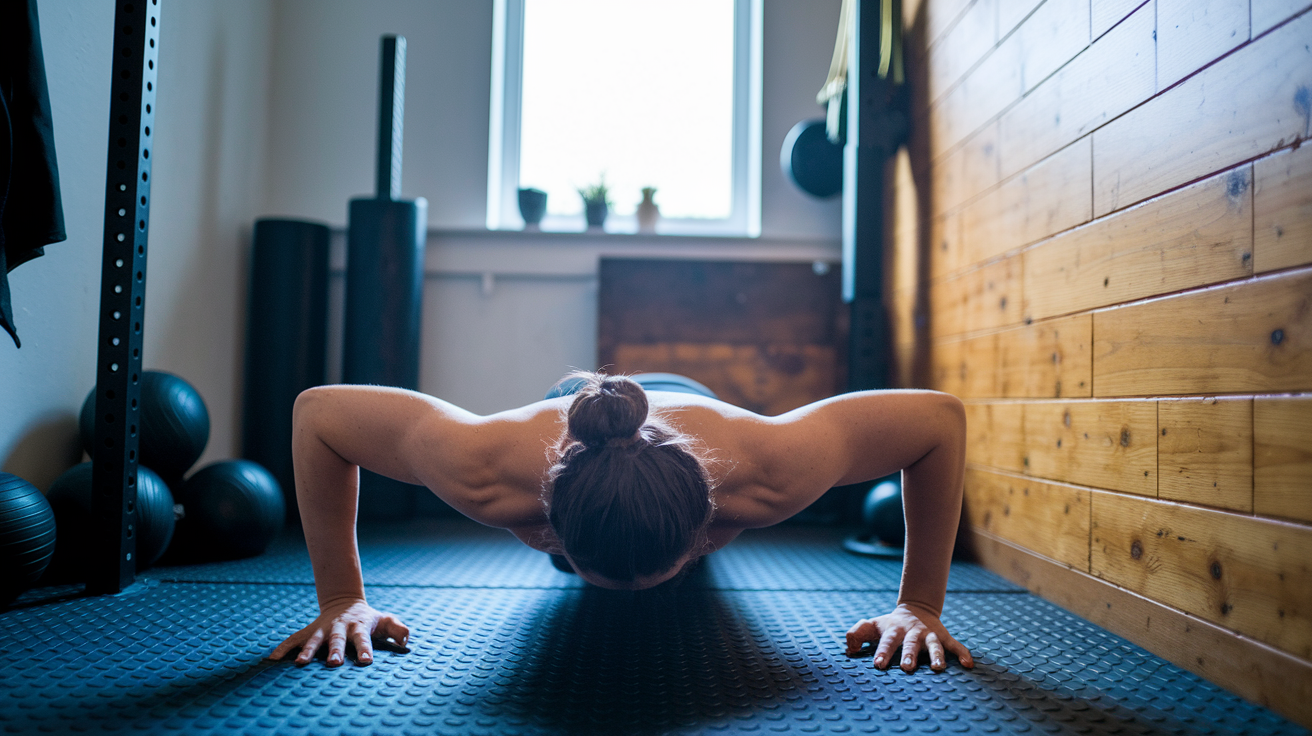

Think you need heavy dumbbells to build muscle? Think again.
You can make real, lasting muscle with only your body if you use the right moves and keep increasing the challenge.
Bodyweight exercises create tension and damage, and with progressive overload (gradually increasing the difficulty) they trigger the same growth as weights.
We’ll show how that works, which exercises to start with, and simple ways to keep getting stronger at home or on the road.
No gym required. Just planning and consistency.
How Muscle Growth Works Without Weights

Your muscles grow when you give them a reason to adapt. That reason doesn’t need to come from dumbbells or barbell plates. Bodyweight exercises create mechanical tension and muscle damage, the two main signals that trigger hypertrophy. When you lower into a deep push-up or hold the bottom of a split squat, you’re putting stress on muscle fibers. If that stress is challenging enough and repeated consistently, your body rebuilds those fibers slightly thicker and stronger.
Progressive overload is the key requirement. It just means gradually making the work harder over time. You can do that by adding more reps, slowing down each rep, pausing at the hardest point, or shifting to a tougher variation. External weight is one way to add overload. But it’s not the only way.
Research confirms that muscle activation in many bodyweight movements can match or exceed what happens with moderate external loads. A study comparing push-ups to bench presses found that push-ups performed to near failure produced similar strength gains to bench pressing at 40% of one-rep max. The difference isn’t whether you can activate muscle. It’s how easily you can keep increasing the challenge. Weights let you add five pounds whenever you’re ready. Bodyweight training requires more creativity, but the muscle itself doesn’t care where the tension comes from, as long as the tension keeps growing over weeks and months.
Four core drivers stimulate growth:
- Mechanical tension – The force your muscles produce to move or hold your body against gravity or leverage.
- Muscle damage – Microscopic tears created during challenging reps, especially when lowering slowly.
- Progressive overload – Gradually increasing the difficulty of the exercise so your muscles continue to adapt.
- Consistent stimulus – Training regularly, since even two weeks of no activity produces measurable muscle loss.
Foundational Bodyweight Exercises for Full-Body Muscle Development
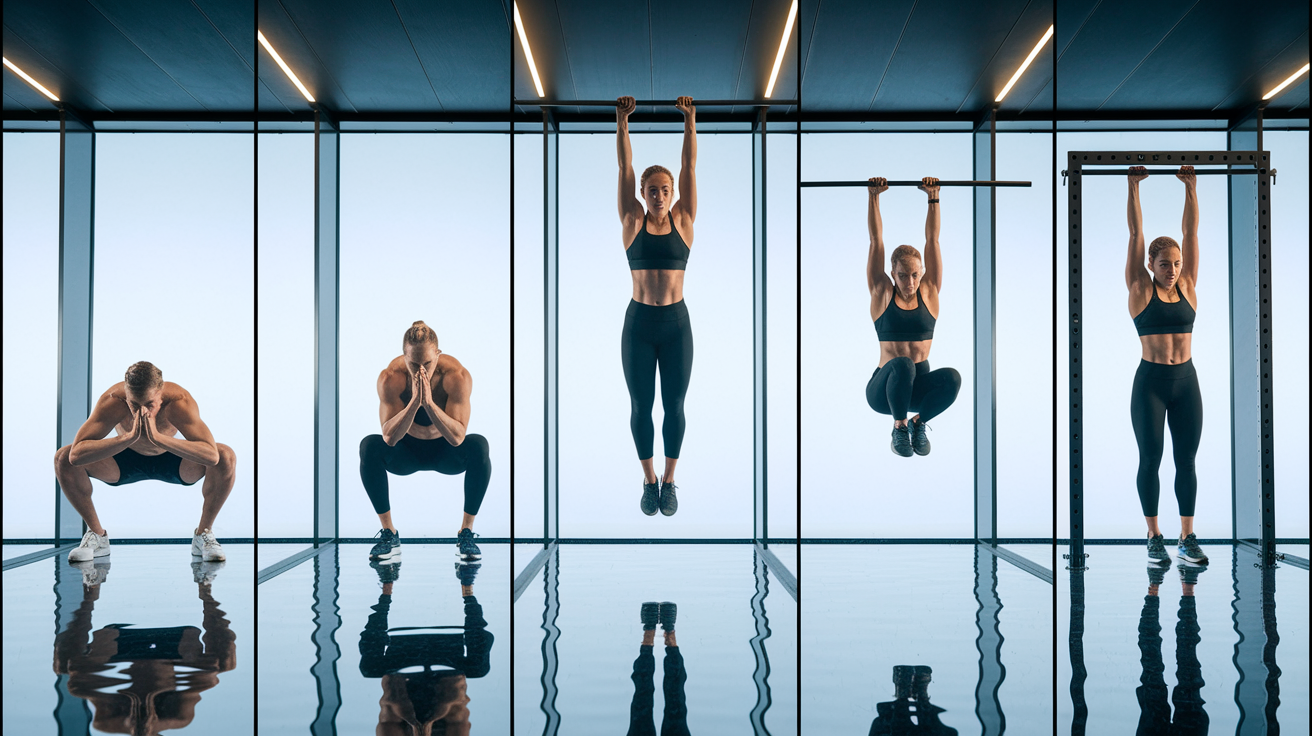
The foundation of bodyweight muscle building is compound movements that recruit multiple muscle groups at once. These exercises mimic the big lifts you’d do in a gym, but they use your body mass and leverage as the resistance.
Push-ups train your chest, shoulders, and triceps in one coordinated movement. Squats and lunges load your quads, glutes, and hamstrings while challenging balance and core stability. Pull-ups and rows (using a sturdy table edge or door frame) work your back, biceps, and grip. Planks and side planks stabilize your entire core, including the deep muscles that support your spine. These movements are efficient because they build real-world strength and let you progress without needing a rack full of equipment.
Each exercise can scale up or down to match your current strength. New to training? Start with wall push-ups, assisted squats holding a counter, and knee planks. Once you can perform 15 to 20 clean reps of a basic variation, it’s time to make the movement harder instead of just piling on more reps. Advancing to a single-leg squat or a decline push-up keeps the rep range moderate and the tension high, which is what drives continued growth.
Compound bodyweight moves also improve coordination and joint stability in ways that isolated machine exercises can’t match.
Six core exercises cover every major muscle group:
- Push-ups (chest, shoulders, triceps) – Progress from wall to knee to full to decline or single-arm variations.
- Squats (quads, glutes, hamstrings) – Progress from bodyweight to paused squats to pistol squats.
- Lunges (quads, glutes, balance) – Progress to reverse lunges, Bulgarian split squats, or jumping lunges.
- Planks (core, shoulders) – Progress by increasing hold time or shifting to side planks and single-arm planks.
- Glute bridges (glutes, hamstrings) – Progress to single-leg bridges or elevated bridges.
- Rows or door-frame pulls (back, biceps) – Use a sturdy table edge or door frame, pivot your feet to increase difficulty.
Applying Progressive Overload Without Equipment

Progressive overload is the non-negotiable principle for muscle growth, and you can apply it without touching a single weight plate. The goal is to increase the total demand on your muscles from week to week. That demand can come from more reps, more sets, slower reps, shorter rest periods, or harder exercise variations.
Once an exercise becomes easy for 15 to 20 reps, continuing to add reps turns the session into endurance work instead of muscle-building work. Instead, change one variable to make each rep harder. A pistol squat is significantly more challenging than a standard squat because you’re supporting your full body weight on one leg. A decline push-up with your feet elevated shifts more load onto your upper chest and shoulders.
Slowing down the lowering phase of any movement, called the eccentric, increases time under tension and creates more muscle damage. Both of which stimulate growth. For example, take three full seconds to lower into a squat, pause for two seconds at the bottom, then stand. That single rep will feel harder than a quick bounce squat.
Adding isometric holds at the hardest point of a movement, like holding the bottom of a lunge or the top of a glute bridge, forces your muscles to work without movement. It’s a different and effective stimulus. Manipulating these variables keeps bodyweight training progressive for months or even years before you hit a true ceiling.
Seven specific progression techniques to increase difficulty:
- Add reps or sets – Increase total volume by moving from 3 sets of 10 to 3 sets of 15, or add a fourth set.
- Slow down the tempo – Use a 3-second descent and 2-second pause to increase time under tension and metabolic stress.
- Shift to unilateral work – Single-leg squats and single-arm push-ups double the relative load on each limb.
- Reduce rest intervals – Drop from 90-second rests to 60 seconds to increase session density and metabolic demand.
- Change leverage or range of motion – Elevate your feet for decline push-ups. Deepen squats to full depth. Widen or narrow hand placement.
- Add isometric holds – Pause at the hardest position for 2 to 5 seconds to increase muscle activation.
- Incorporate plyometrics – Add jump squats or clapping push-ups to recruit fast-twitch muscle fibers and add a power stimulus.
Using Resistance Bands as an Optional Alternative
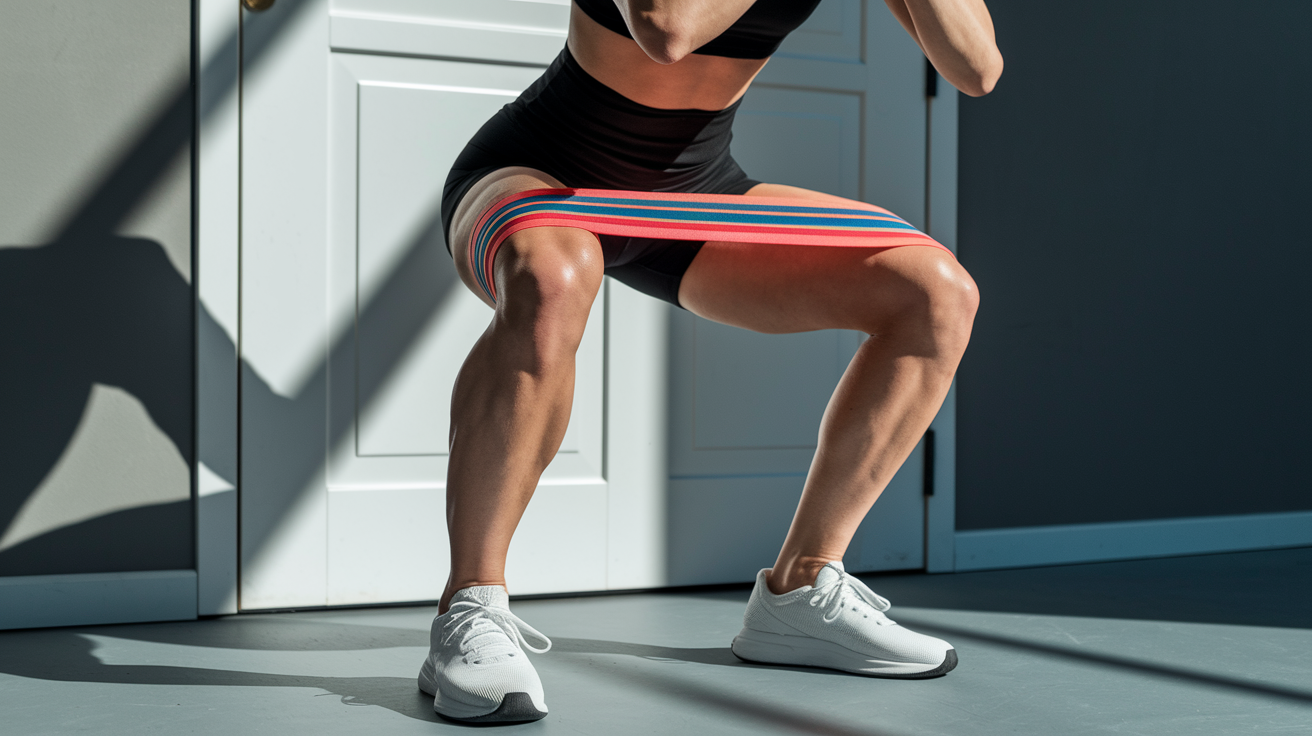
Resistance bands aren’t required to build muscle at home. But they’re a simple tool that can extend your progression for years. Bands provide variable resistance, meaning the tension increases as you stretch them, which loads your muscles differently than gravity alone. You can wrap a band around your back for banded push-ups, loop one around your thighs for banded squats, or anchor a band to a door to mimic cable rows and chest presses.
They’re lightweight, inexpensive, and pack into a drawer, which makes them practical for travel or small spaces. Bands also let you add resistance to movements that are hard to overload with bodyweight alone, like shoulder raises or bicep curls.
The main advantage is control. When a bodyweight squat becomes too easy but a pistol squat is still too hard, a medium-resistance band can bridge that gap. Loop it under your feet and hold the handles at shoulder height to add 20 or 30 pounds of tension to your squat without needing a barbell. Bands work well in combination with bodyweight exercises rather than replacing them. You’re still using your body as the foundation, and the band is just another way to increase the challenge when other progression methods start to plateau.
Sample At‑Home Muscle‑Building Workouts

A simple weekly structure for bodyweight muscle building is three full-body sessions spaced across the week, or a push-pull-legs split if you prefer to train four or five days. Full-body routines are efficient for beginners and intermediate trainees because they let you hit every major muscle group multiple times per week. That’s ideal for hypertrophy.
Each session should include a push movement, a pull movement, a lower-body movement, and a core movement. Aim for 2 to 4 sets per exercise, with rep ranges between 8 and 20 depending on the difficulty of the variation. Rest 60 to 90 seconds between sets if your goal is muscle growth, and push each set to within 1 to 3 reps of failure.
Beginners should start with basic variations and focus on learning clean technique before adding intensity. An example beginner session might include incline push-ups, bodyweight squats, glute bridges, and planks for 3 rounds. As you adapt, swap incline push-ups for standard push-ups, then decline push-ups. Replace bodyweight squats with Bulgarian split squats. Add tempo work and isometric holds.
Track your reps and progressions in a simple notebook or phone app so you know when it’s time to increase difficulty.
The table below shows three sample routines at different training levels:
| Workout Type | Exercises | Sets/Reps |
|---|---|---|
| Beginner Full-Body | Incline push-ups, bodyweight squats, glute bridges, plank holds | 3 sets of 8–12 reps; 30–45s planks |
| Intermediate Full-Body | Decline push-ups (3s tempo), Bulgarian split squats, single-leg glute bridges, side planks | 4 sets of 10–15 reps; 45–60s planks per side |
| Advanced Push-Pull-Legs | Single-arm push-ups, pistol squats, door-frame rows, jump lunges, L-sit holds | 4–5 sets of 6–12 reps; 20–30s L-sits |
How Long It Takes to Build Muscle Without Equipment

Beginners can expect to gain 1 to 2 pounds of muscle per month during the first few months of consistent training, assuming nutrition and recovery are in place. Those early gains, often called newbie gains, happen quickly because your nervous system is learning to recruit muscle fibers more efficiently and your muscles are responding to a completely new stimulus.
If you’re returning to training after a break, you’ll experience similar rapid progress as your body rebuilds lost muscle. A 12-week bodyweight program in untrained adults produced significant increases in both muscle strength and size, so measurable results show up within two to three months if you’re progressive and consistent.
For intermediate and advanced trainees, the rate of growth slows because your body has already adapted to basic training stress. You’ll still gain muscle, but it might be closer to half a pound per month, and progress requires more strategic manipulation of volume, intensity, and exercise variation. Bodyweight-only training can continue to produce results for years if you keep advancing to harder movements. But eventually the ceiling is lower than what you could achieve with heavy external loads.
Most people can build and maintain a solid, functional physique with bodyweight work indefinitely, especially if the goal is health, athleticism, and moderate muscle size rather than maximal strength or competitive bodybuilding size.
The timeline also depends on how close you push each set to failure. Training to true failure every set isn’t necessary and can increase injury risk, but stopping 1 to 3 reps short of failure consistently drives growth. If your sets feel easy and you’re not progressing the difficulty every few weeks, muscle growth will stall regardless of how long you train.
Track your workouts, increase the challenge when you hit the top of your rep range, eat enough protein and total calories to support recovery, and sleep at least seven hours per night. Those factors together determine whether you see steady progress or a frustrating plateau.
Bodyweight Training vs Traditional Weight Training

Weight training is more efficient for building maximal muscle size and absolute strength because you can add precise amounts of load whenever you’re ready. Adding 5 pounds to a barbell squat is simple. Adding the equivalent difficulty to a bodyweight squat requires changing the exercise entirely, which takes more planning and sometimes trial and error.
For someone chasing the fastest possible muscle growth or training for a strength sport, free weights and machines are the better long-term tool. But for general fitness, functional strength, and moderate hypertrophy, bodyweight training can match muscle activation and produce similar results, especially in the first one to three years of training.
Research comparing push-ups to bench presses found that push-ups to near failure produced strength gains comparable to bench pressing at 40% of one-rep max. The key phrase is near failure. If you stop your bodyweight sets when they’re still comfortable, you won’t stimulate much growth.
The trade-off is convenience and accessibility. Bodyweight training requires no membership, no commute, and no equipment budget. You can train anywhere, anytime, which makes consistency easier for people with unpredictable schedules, limited budgets, or no access to a gym. Weights are better for efficiency. Bodyweight is better for flexibility and sustainability.
Five practical differences between the two methods:
- Load precision – Weights allow exact, incremental increases. Bodyweight requires variation and leverage changes.
- Exercise selection – Weights offer more direct isolation. Bodyweight emphasizes compound, functional movements.
- Space and cost – Bodyweight training is free and requires minimal space. Weights need a gym or home setup and ongoing costs.
- Learning curve – Basic bodyweight moves are intuitive. Advanced variations like pistol squats and one-arm push-ups require significant skill and balance.
- Ceiling for growth – Weights can be loaded indefinitely. Bodyweight progression eventually requires creativity or added tools like bands or a weighted vest.
Practical Tips to Maximize Muscle Growth at Home

Push your sets close to failure, ideally leaving only 1 to 3 reps in reserve. That intensity is what drives hypertrophy when external load is limited. If you can easily complete 20 reps of an exercise, it’s time to change the variation rather than continuing to add reps.
Track every workout in a simple log so you know when you’ve hit your rep target and it’s time to progress. Consistency over weeks and months matters more than any single perfect session. Aim for at least two full-body sessions per week, and three or four if your recovery allows.
Eat enough protein to support muscle repair and growth. A common target is around 0.7 to 1 gram of protein per pound of body weight per day, spread across meals. Increase your total calorie intake slightly above maintenance if you want to maximize muscle gain, especially if you’re training hard and not seeing progress.
Sleep is non-negotiable. Seven to nine hours per night gives your body time to complete the repair process that builds new muscle tissue. If you’re chronically under-slept or under-fed, even the best training program will produce minimal results.
Use tempo work, isometric holds, and unilateral exercises to keep sessions challenging without needing more equipment. Pre-exhaust easier muscle groups by placing an isolation-style movement before a compound move. For example, do glute bridges to fatigue your glutes before moving into split squats, so your glutes become the limiting factor. That strategy increases the training stimulus on a specific muscle group even when the exercise itself is relatively simple.
Small adjustments like these extend the effectiveness of bodyweight training for years before you need to consider adding weights or bands.
Final Words
You can build muscle without weights. Bodyweight moves create mechanical tension and metabolic stress, and progressive overload (more reps, harder variations, slower tempo) is what makes muscles grow.
Pick core compound moves—push-ups, pull-ups, squats, lunges—and progress them over weeks. Track simple nutrition and prioritize sleep and recovery.
So, can you build muscle without weights? Yes. With steady progress, smart habits, and patience, you’ll get stronger and see real results.
FAQ
Q: Can you build muscle with high cortisol?
A: You can build muscle with high cortisol, but high cortisol makes it harder. Prioritize regular resistance work, enough protein, good sleep, and stress tools like walks or breathing to protect gains.
Q: Can you keep muscle while on tirzepatide?
A: You can keep muscle while on tirzepatide by lifting regularly, eating enough protein, and avoiding big calorie cuts. Aim for consistent resistance sessions and roughly 0.7–1.0 grams protein per pound of bodyweight.
Q: Can you gain muscle with Marfan syndrome?
A: You can gain muscle with Marfan syndrome, but progress should be conservative and doctor-cleared. Use controlled resistance, avoid maximal lifts, and work with a clinician to tailor safe loads and joint care.
Q: Can you get ripped without weights?
A: You can get ripped without weights by using progressive bodyweight variations, training near failure, managing calories, and keeping protein high. Use harder variations, slower tempo, and short rest to raise intensity.