


What if a single timer could make your workouts shorter, smarter, and actually more effective?
EMOM (Every Minute on the Minute) does exactly that.
You do a set at the start of each minute, then use the leftover seconds to rest before the next minute begins.
That simple clock rhythm forces pacing, protects your form, and packs measurable volume into 10 to 20 minutes.
In this post I’ll show how EMOMs work, why they fast-track strength and conditioning, and how to pick the right reps and timing for your goals.
Core Explanation of EMOM Workouts

EMOM stands for Every Minute on the Minute. It’s a time-based training format where you knock out a set number of reps at the start of each minute, then rest for whatever’s left. So if 10 push-ups take you 18 seconds, you get 42 seconds to breathe before the next minute hits and you go again.
The format locks you into a fixed work and rest schedule, minute after minute, until your session ends. You’ll see EMOMs in strength programs, conditioning sessions, and CrossFit boxes because they keep intensity high while guaranteeing built-in recovery every round.
Here’s what makes up an EMOM:
Work – A prescribed number of reps or a timed effort (like 40 seconds of rowing) completed at the start of each minute.
Rest – Whatever seconds remain in that minute, based on how fast you finish.
Minute-based cadence – Every new set starts exactly when the clock rolls to the next minute, creating a strict rhythm that runs for however long you’ve planned.
How EMOM Workouts Function in Practice

An EMOM runs on 60-second intervals. You watch a timer, do your assigned reps as soon as the minute starts, then use the leftover time to recover before the next minute arrives. Finish fast and you rest longer. Take most of the minute and your rest shrinks.
EMOMs can follow several formats. A single-movement EMOM repeats the same exercise every minute (one heavy back squat or 10 kettlebell swings) for the entire session. An alternating EMOM cycles between two or more movements, usually targeting different muscle groups to manage fatigue (minute 1 = squats, minute 2 = push-ups, repeat). Progressive EMOMs increase reps as you go, building cumulative volume. Time-based EMOMs prescribe a duration of work instead of counting reps (40 seconds of rowing followed by 20 seconds of rest inside each minute).
Rest duration is self-regulating. Faster work buys more recovery. Slower work leaves you gasping into the next round. This teaches pacing and discourages rushing through sloppy reps just to finish early, because poor form eventually catches up and eats your rest.
Common EMOM formats:
Single-movement fixed reps – Same exercise and rep count every minute (5 burpees every minute for 12 minutes).
Alternating movements – Rotate exercises by minute (minute 1 = power cleans, minute 2 = double-unders).
Ascending or progressive reps – Start low and add reps each minute or each round (1 burpee in minute 1, 2 in minute 2, up to 15 in minute 15).
Time-based work blocks – Set a work duration inside each minute rather than counting reps (40 seconds of bike calories, 20 seconds rest).
Benefits of EMOM Training
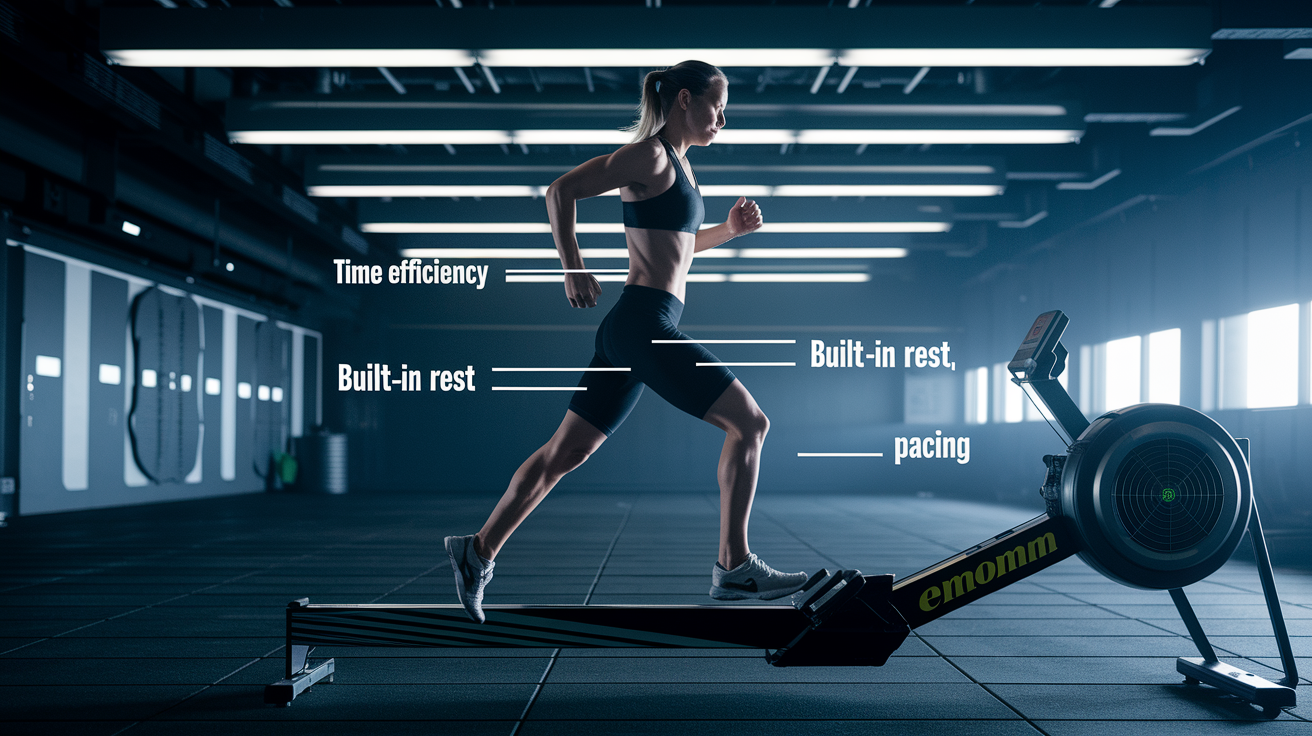
EMOMs pack high-volume work into short sessions without letting you coast. The minute-by-minute structure keeps you accountable to consistent output, and the predictable start of each round removes guesswork about when to go again.
Because rest is built in and self-regulating, you can push hard during work intervals without completely burning out. The format also rewards efficiency and good technique. Cleaner reps mean more recovery time, which reinforces doing the movement right instead of rushing sloppily.
Key benefits:
Time efficiency – Most EMOMs run 10 to 20 minutes, delivering measurable volume and intensity in less time than traditional programs.
Built-in rest – Unlike continuous work, the EMOM guarantees recovery between efforts, protecting movement quality and reducing injury risk.
Scalability – Adjust reps, load, or total minutes to match your ability. Beginners can start with 6-minute EMOMs and low rep counts.
Progressive overload control – Add one rep per minute or increase weight slightly session to session, tracking progress in small, repeatable steps.
Pacing and mental focus – The clock enforces discipline. You learn to regulate effort, manage fatigue, and stay consistent across all rounds.
EMOM vs AMRAP vs Interval Training

EMOM, AMRAP, and traditional interval training all structure work and rest differently. Each serves a distinct training goal.
| Format | How It Works | Primary Goal |
|---|---|---|
| EMOM | Fixed reps or timed work at the start of each minute; rest the remainder of that minute; repeat for programmed duration. | Pacing consistency, technique quality, controlled intensity with predictable rest. |
| AMRAP | As Many Rounds (or Reps) As Possible within a set time; work is continuous with minimal or self-chosen rest. | Max volume, mental toughness, pushing through fatigue without enforced recovery. |
| Traditional Intervals | Work and rest ratios vary (e.g., 30s work / 30s rest, or 3 min work / 1 min rest); timing is flexible and often longer. | Cardiovascular conditioning, endurance, flexible intensity manipulation. |
EMOM suits athletes who want repeatable, measurable efforts with built-in recovery. Strength athletes practicing heavy singles, CrossFitters refining skills under time pressure, or beginners learning to pace work. AMRAP favors those chasing volume and mental grit, willing to tolerate continuous fatigue. Traditional intervals work well for endurance-focused training where work and rest blocks can stretch beyond one minute and vary widely to target specific energy systems.
Common EMOM Exercises

EMOMs work best with movements you can perform safely and efficiently under time pressure. Compound lifts, bodyweight staples, and conditioning tools all fit well because they produce measurable output in short bursts.
Widely used EMOM exercises:
Back squats – Heavy singles or moderate sets to build strength and work capacity.
Snatches and power cleans – Low-rep Olympic lifts that demand speed, technique, and focus.
Burpees – Full-body conditioning movement that scales easily by adding or removing the push-up or jump.
Kettlebell swings – Hip-hinge power and cardiovascular demand in a simple, repeatable pattern.
Push-ups – Upper-body pressing with minimal setup. Regressions like knee push-ups make it beginner-friendly.
Air squats – Bodyweight staple for leg endurance and pacing practice.
Double-unders or jump rope – Skill-based cardio that fits neatly into short work windows.
Rowing or bike calories – Measured output on cardio machines, easy to track and scale by distance or time.
Sample EMOM Workouts for Different Goals

A strength-focused EMOM keeps reps low and loads high to practice heavy lifts with controlled fatigue. Try a 10-minute EMOM performing one back squat at 80 to 85 percent of your estimated max every minute. The single rep takes around 5 to 10 seconds, leaving 50-plus seconds to recover, reset your brace, and prepare for the next lift. Over 10 minutes you complete 10 quality singles, accumulating meaningful volume without the grind of a traditional 5×5 scheme. Adjust load down if rest time shrinks below 40 seconds or form starts to break.
A conditioning-focused EMOM pushes cardiovascular output and muscular endurance across moderate rep ranges. Set a timer for 15 minutes and perform 12 burpees every minute. If burpees take roughly 30 seconds, you get 30 seconds rest before the next round starts. The challenge is maintaining speed and technique as fatigue builds. By minute 10, those 12 reps will feel significantly harder than they did in minute 2. Scale by dropping to 8 or 10 burpees per minute, or remove the push-up and jump to make the movement easier.
A beginner-friendly EMOM introduces the format with simple exercises and conservative rep counts. Run a 12-minute EMOM alternating two movements: minute 1 = 8 bodyweight squats, minute 2 = 6 push-ups (knees allowed), repeat for six total rounds. Reps are low enough to finish in 15 to 20 seconds, guaranteeing 40-plus seconds of rest every minute. This teaches pacing, builds confidence with the clock, and lets you practice form without rushing. Progress by adding one rep per movement or extending the session to 15 or 18 minutes.
Mistakes to Avoid in EMOM Training

Choosing too many reps per minute is the most common error. If your work takes 50 seconds or more, rest disappears and the EMOM turns into continuous, grinding effort that degrades form and strips away the format’s main benefit (structured recovery). Aim to finish each minute’s work in 20 to 40 seconds, leaving enough rest to reset and breathe.
Common mistakes to watch for:
Skipping the warm-up – Jumping straight into timed work without preparing joints and movement patterns increases injury risk and reduces performance.
Selecting overly complex movements – Technical lifts like snatches or muscle-ups demand focus. Fatigue under the clock can reinforce poor mechanics if you’re not ready.
Ignoring rest time – Treating EMOM like AMRAP and starting the next set early defeats the purpose. Wait for the minute to roll over.
Progressing too fast – Adding reps, weight, and minutes all at once overloads recovery. Change one variable at a time and track how your body responds.
Tools and Timers for EMOM Workouts

Most gyms display a running clock on the wall, making it easy to track minutes without extra equipment. If you train at home or outdoors, a stopwatch app on your phone works perfectly. Set it to count up from zero and watch for each new minute to begin.
Dedicated interval timer apps add helpful features like audible beeps at the start of each minute, visual countdowns, and preset EMOM modes that automate the structure. Some timers let you program work duration (like 40 seconds) and rest duration (20 seconds) inside each minute, which is useful for time-based EMOMs. Whether you use a wall clock, phone timer, or interval app, the key is clear visibility and reliable sound cues so you never miss a start.
Final Words
You start each minute, do the work, then rest for whatever time is left. That simple pattern is the through-line: we defined EMOM, explained timing and formats, and showed common exercises and benefits.
We compared EMOMs to AMRAP and intervals, shared sample workouts, flagged common mistakes, and suggested timers so you can keep pace without guessing.
If you still wonder what is emom workout, it’s Every Minute on the Minute, a simple, repeatable way to build strength and conditioning. Try one this week and watch steady progress.
FAQ
Q: What is the 3-3-3 rule at the gym?
A: The 3-3-3 rule at the gym is usually performing three sets of three reps on a main lift to build strength, using heavy weight with full recovery between sets.
Q: Do EMOM workouts burn fat?
A: EMOM workouts burn fat by boosting calorie burn and conditioning, but they reduce body fat only if combined with a calorie deficit and consistent training; they also help preserve muscle during weight loss.
Q: What is the difference between EMOM and HIIT?
A: The difference between EMOM and HIIT is EMOM starts work at the top of every minute with built-in rest, while HIIT uses variable high-intensity intervals and rest, often aiming for all-out effort.
Q: Can you build muscle with EMOM?
A: You can build muscle with EMOM by using strength-focused reps, heavy enough load, and progressive overload; prioritize compound lifts, full range of motion, and recovery to support hypertrophy.