


Over 60 strength training builds muscle and cuts fall risk — and you can do it safely.
Muscle slips away every decade, so legs get weaker and balance gets shakier.
That’s why simple resistance work twice a week matters more than long cardio.
This post lays out a 30–40 minute, twice-weekly plan, clear safety rules, and easy progressions you can do at home.
No fancy gear. No risky moves.
Just steady, technique-first training that strengthens muscles, steadies balance, and helps you stay independent.
Best Strength Training Routine for Adults Over 60 (Start Here)

Strength training after 60 fights the muscle loss that’s been creeping up since your 30s. It accelerates every decade. This loss, sarcopenia, weakens your legs, messes with your balance, and turns simple stuff like getting out of a chair or taking the stairs into real work. A basic strength routine twice a week slows that slide, keeps you moving on your own terms, and cuts down your fall risk.
You don’t need a gym or fancy gear. Start with two sessions each week, with at least one full day off between so your muscles can rebuild. Each session takes 30 to 40 minutes, including five minutes of walking or marching in place to warm up. Learn the movements first. Weight and reps come after.
Your starting routine hits all the major muscle groups with movements you can control from beginning to end. Pick a weight or resistance that feels tough by your eighth or tenth rep but doesn’t wreck your form.
Starting Routine (2x per week):
- Sit-to-stand – 2 sets of 8–12 reps (sturdy chair, stand all the way up, sit back down with control)
- Wall pushups – 2 sets of 8–12 reps (hands at chest height, lower until your elbows hit 90 degrees)
- Resistance-band rows – 2 sets of 8–12 reps (pull band to your ribcage, squeeze your shoulder blades)
- Step-ups – 2 sets of 8–10 reps per leg (6-inch step or sturdy platform)
- Standing calf raises – 2 sets of 10–15 reps (hold a counter if you need balance help)
- Hip bridges – 2 sets of 10–12 reps (lie on your back, push hips up, squeeze your glutes)
Rest one to two minutes between sets. If an exercise feels too easy after your second week, toss in one or two more reps per set. After four weeks of showing up consistently, you can bump up resistance a bit. Hold light dumbbells, grab a thicker resistance band, or add a third set. Go slow. Your strength will build without beating up your joints.
Key Benefits of Strength Training After Age 60

Adults lose three to five percent of their muscle every decade after 30. By 60, that’s added up. Your strength drops, movements slow down, balance gets shakier. Resistance training flips this. It triggers muscle growth at any age and rebuilds what you’ve lost.
Stronger muscles stabilize your joints and take strain off cartilage, tendons, ligaments. That matters most for knees, hips, shoulders, where wear and age cause stiffness and aches. Regular strength work also increases bone density by putting controlled stress on your skeleton. Your body responds by reinforcing bone structure, which lowers fracture risk.
Muscle tissue burns more calories at rest than fat does. Keeping or building muscle helps regulate your metabolism and makes weight management easier. That supports heart health and cuts your risk of type 2 diabetes.
Strength training makes daily life easier. Carrying groceries, getting out of a car, reaching overhead, walking stairs. All of it gets simpler and safer when your legs, core, and upper body are strong. That independence stretches out your active years and keeps you doing what matters.
Safety Guidelines for Adults Over 60

Warming up gets your muscles, tendons, and heart ready for what’s coming. It cuts injury risk. Spend five minutes walking, marching in place, or doing easy arm circles and leg swings before you touch a weight or band. Light movement increases blood flow and loosens your joints.
Start with the lightest resistance you can find. Learn the movement patterns before you add load. Your body adapts slowly to new stress. Going too heavy too fast increases your risk of strains, joint pain, and giving up. Add weight only when you can finish your target reps with solid form and no discomfort.
Core Safety Principles:
- Breathe steady through every exercise (exhale when you lift or push, inhale when you lower)
- Move slowly, don’t jerk or use momentum to finish a rep
- Keep your spine neutral (don’t arch or round your lower back too much)
- Stop right away if you feel sharp pain, dizziness, or weird shortness of breath
- Use a sturdy chair, wall, or counter for balance during standing exercises
If you’ve got a history of heart disease, uncontrolled high blood pressure, joint replacement in the past six months, or bad arthritis, check with your doctor before starting. Some conditions need modified exercises or supervised training at first. Listen to your body. Don’t push through pain that gets worse during or after a workout. Soreness that shows up a day later and fades in 48 hours? Normal. Sharp or lasting pain? Not normal.
Beginner-Friendly Strength Exercises Demonstrated
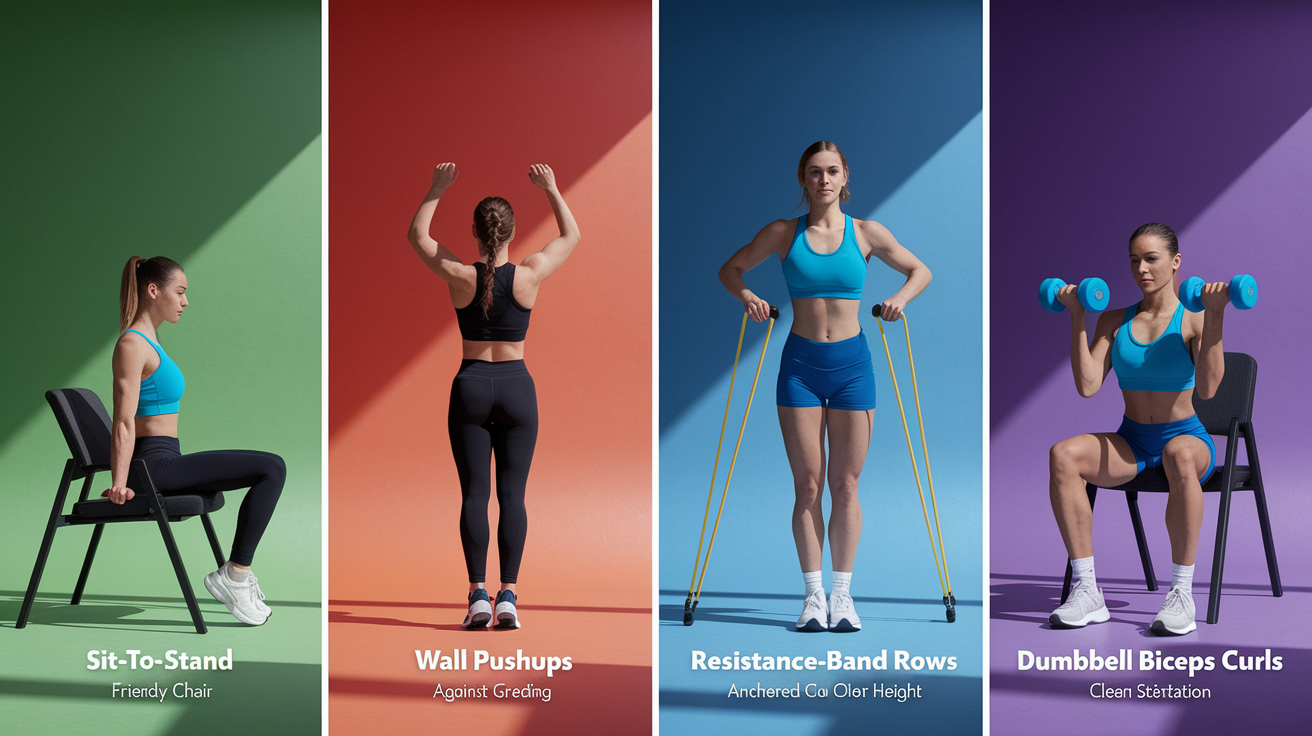
Sit-to-Stand
Stand in front of a sturdy chair, feet hip-width apart. Lower yourself slowly until your butt lightly touches the seat, then push through your heels to stand fully. Don’t lock your knees. Keep your chest up and your weight centered over your midfoot. This strengthens your quads, glutes, and core, which are critical for getting up from low surfaces.
Wall Pushups
Stand an arm’s length from a wall, feet together. Put your palms flat against the wall at chest height, a bit wider than shoulder-width. Lower your chest toward the wall by bending your elbows. Keep your body in a straight line from head to heels. Push back to the start. This cuts joint stress compared to floor pushups and builds your chest, shoulders, triceps.
Resistance-Band Rows
Wrap a resistance band around a sturdy post or close it in a door at chest height. Hold one end in each hand, step back until the band has light tension. Pull both handles toward your ribcage, squeeze your shoulder blades together at the end. Return slowly to the start. Band rows strengthen your upper back and fix posture, which eases shoulder and neck discomfort.
Dumbbell Biceps Curls
Stand with feet shoulder-width apart, holding a light dumbbell in each hand. Arms hang at your sides, palms forward. Curl the weights toward your shoulders by bending your elbows. Keep your upper arms still. Lower the weights slowly back to the start. Biceps curls improve your ability to lift and carry stuff in daily life.
Exercise Modifications for Joint Stiffness and Limited Mobility

Joint discomfort, arthritis, or old injuries don’t mean you can’t train. They just mean you need adjustments to cut strain and keep moving without pain. Chair-supported exercises improve stability and let you focus on form without worrying about balance. Resistance bands instead of free weights reduce compression on joints and allow smoother motion through a comfortable range.
Shortening your range of motion helps you work around stiffness or pain without stopping completely. If a full squat or step-up bothers your knees, use a higher seat or lower step so the movement stays controlled and pain-free. As your strength and mobility improve, you can gradually go deeper or higher.
Practical Modifications:
- Use a chair with armrests for sit-to-stand if you need hand support to stand safely
- Do pushups against a countertop or sturdy table instead of a wall to ease shoulder strain
- Replace step-ups with marching in place or slow alternating knee lifts if balance is shaky
- Sit during overhead presses or biceps curls to eliminate lower back stress and improve stability
Start with these tweaks and check back every two to four weeks. Many people find that consistent training reduces joint stiffness over time. Movements that felt uncomfortable at first get easier. Go at your own pace. Don’t compare your modifications to anyone else’s routine. Your goal is training you can sustain without pain or setbacks.
Recommended Equipment for Effective Strength Training Over 60

You can start with nothing but a sturdy chair and a wall, but a few cheap tools expand your options and help you progress safely. Resistance bands are the most versatile and joint-friendly choice for beginners. A set with three to five resistance levels costs $10 to $30 and lasts for years. Bands create smooth, adjustable tension and work well for rows, chest presses, shoulder exercises, leg work.
Light dumbbells from two to ten pounds give you more control over load than bands alone. Fixed-weight dumbbells are cheap and durable, with pairs running $10 to $60 depending on weight. Adjustable dumbbells save space and let you increase resistance in small jumps, though they cost more upfront (around $50 to $150 for a set).
A sturdy, stable chair without wheels is essential for sit-to-stand exercises, balance support, seated movements. You probably already have one. A low step platform or sturdy aerobic step (6 to 8 inches high) works for step-ups and runs $15 to $40.
Recommended Starting Equipment:
- Resistance band set with light, medium, heavy bands
- Two pairs of light dumbbells (3 lb and 5 lb, or 5 lb and 8 lb)
- Sturdy chair with a flat seat, no wheels
- Optional: low step platform, yoga mat for floor exercises, balance pad for advanced stability work
Skip heavy weights or complex machines until you’ve trained consistently for at least eight weeks. Most beginners do fine with bands and light dumbbells for the first three months. Once you’ve built a foundation of strength and confidence, you can add equipment based on your goals.
Frequency, Sets, and Progression Guidelines for Seniors

Training two to three days per week on nonconsecutive days gives your muscles time to recover and adapt. Recovery is when strength actually builds, not during the workout. Schedule sessions on Monday and Thursday, or Tuesday, Thursday, and Saturday, so you’ve got at least 48 hours between workouts. Each session takes 30 to 45 minutes, including warm-up and cooldown.
Start with one to two sets per exercise and eight to twelve reps per set. This builds strength without overwhelming your body early on. If you can finish twelve reps with good form and moderate effort, the weight or resistance level is right. If you struggle to hit eight reps, drop the load.
Progression Steps:
- Train consistently at your starting weight for two full weeks before changing anything
- Add one to three reps to each set once your target reps feel easy (move from 10 reps to 12, for example)
- Add a third set to each exercise after four to six weeks of consistent training
- Bump up weight or resistance by five to ten percent once you can finish all sets and reps with controlled form
Expect to see real strength improvements within six to eight weeks if you train consistently and progress gradually. You’ll notice daily tasks like standing from a chair, climbing stairs, carrying groceries become noticeably easier. Balance and confidence improve as your legs and core get stronger. Long-term progress comes from showing up twice a week, month after month. Not from pushing too hard in a single session.
Final Words
Start with 2–3 sessions a week and use the simple routine we showed: sit-to-stand, wall pushups, band rows, step-ups, dumbbell curls. Aim for 8–12 reps and 1–2 sets to begin.
Warm up, pick light resistance, and use chair or band modifications if joints feel stiff. Keep equipment basic—bands, light dumbbells, a stable chair.
Progress slowly by adding reps, then weight. Small, steady steps add up. Over 60 strength training builds strength, balance, and confidence—keep going.
FAQ
Q: How often should a 60 year old man strength train?
A: A 60-year-old man should strength train 2–3 times per week, focusing on full-body sessions with 8–12 reps and 1–2 sets to start, allowing rest days between workouts.
Q: Can you lift weights with osteoporosis?
A: You can lift weights with osteoporosis by using low to moderate loads, prioritizing good form, avoiding high-impact or deep spinal flexion, and getting medical clearance before starting.
Q: Can I lift weights while taking Zepbound?
A: You can usually lift weights while taking Zepbound, but check with your prescriber first; start lighter, monitor energy and dizziness, stay hydrated, and reduce intensity if you feel unwell.
Q: What is a good weight lifting routine for over 60?
A: A good routine for over 60 is full-body, done 2–3 times weekly, with six moves (sit-to-stand, wall pushup, band row, hinge, biceps curl, carry), 8–12 reps and 1–2 sets to start.