


You don’t need an hour to get stronger.
In 20 minutes you can hit every major muscle, raise your heart rate, and actually build strength.
This 20-minute full-body strength workout uses five exercises in a 40-second work, 20-second rest circuit, repeated four times.
You’ll need dumbbells if you have them, a bench or chair helps, and a mat is nice.
Do the routine as written and you’ll leave with more strength, better endurance, and a plan you can repeat every few days to see real progress.
Complete 20-Minute Strength Workout Breakdown (Full Routine, Timing, and Steps)

This workout gives you exactly 20 minutes of training using a straightforward 40 second work, 20 second rest setup. You’ll run through five exercises in order for one full round (that’s five minutes), then repeat the circuit three more times. You’ll need dumbbells if you have them, a bench or chair if available, and a mat helps.
The format switches between muscle groups so you can keep pushing without completely gassing any one area. Upper body, lower body, and core all get direct work in every round. The short rest keeps your heart rate up while the rep or time targets create enough tension to actually build strength. No weird transitions or confusing combos, just a straight circuit you can follow with a stopwatch or any interval timer app.
Pick a weight based on where you’re at right now. If you’ve got dumbbells, grab a load you can handle for the full 40 seconds without your form falling apart. You picked right if you feel a slight muscle shake, your heart rate climbs, and each rep takes real effort. One woman’s 10 pounds is another woman’s unloaded movement, and both are building strength at their edge.
The Full Circuit (Repeat 4 Rounds for 20 Minutes Total):
- Bicycle Crunch – 40 seconds work / 20 seconds rest (core)
- Bulgarian Split Squat – 40 seconds work / 20 seconds rest (stick with the same leg for the full 40 seconds, switch legs next round)
- Superman with Arm Extension – 40 seconds work / 20 seconds rest (upper back and glutes)
- Feet Elevated Glute Bridge – 40 seconds work / 20 seconds rest (glutes and hamstrings)
- Elevated Push Up – 40 seconds work / 20 seconds rest (chest, shoulders, triceps)
Printable Timing Block:
Round 1: 5 minutes
Round 2: 5 minutes
Round 3: 5 minutes
Round 4: 5 minutes
Total: 20 minutes
Beginner tweak: cut work intervals to 30 seconds or drop reps by half if you’re counting them. Advanced tweak: go heavier with the dumbbells or slow the lowering phase to 3 or 4 seconds.
Essential Warm Up Movements for a 20 Minute Full Body Session

Three to five minutes of warm up gets your hips, shoulders, and spine ready for the loading patterns you’re about to hit. Dynamic drills raise tissue temperature and open up joint range without wearing you out before the real work starts. You want better movement and less early fatigue, not a pre exhaustion beatdown.
Use big, controlled ranges that look like the workout ahead. Downward dog with hand release push ups opens your shoulders and wakes up your chest. Hip switches in a 90-90 position prep the internal and external hip rotation you’ll need for split squats and bridges. Deep bodyweight squats and side leg swings loosen hips and fire up single leg stability.
Quick Warm Up Sequence (3 to 5 Minutes):
- Downward dog plus multiplanar lunge (1 minute)
- Deep lunge with rotation (1 minute)
- Side leg swings (1 minute)
- Light arm circles and torso twists (1 to 2 minutes)
Keep it simple and keep moving. If you only have three minutes, hit the first three drills and go.
Exercise Technique Guide for Full Body Strength Movements

Clean form turns a 20 minute session into actual strength work instead of rushed chaos. Key cues: chest up, core braced, controlled tempo, glute squeeze, stable shoulder position. Every exercise below hits multiple muscle groups, so small form errors pile up fast under fatigue. Nail the basics first, then push harder.
Bulgarian Split Squat Technique
Stand two to three feet in front of a bench or chair with your rear foot resting on the elevated surface, shoelaces down. Hands can stay behind your head, at your sides, or holding dumbbells. Lower your body until your front thigh gets roughly parallel to the floor and your front knee tracks over your toes without caving in. Drive through the front heel to stand, keeping your torso upright and core tight the whole time. You should feel this in your front quad and glute, not your low back. Easier version: do a standard split squat with both feet on the floor.
Elevated Push Up Technique
Put your hands on a bench, box, or sturdy chair in a high plank with your body in a straight line from head to heels. Lower your chest toward the bench with elbows tracking back at roughly 45 degrees, not flaring straight out. Press back up until your arms fully extend, squeezing your chest and triceps at the top. Brace your core like you’re about to take a light punch to the stomach. Firm, not stiff. This keeps your hips from sagging or piking. Raising your hands is better than dropping to your knees because it keeps full body tension and core engagement. Easier version: wall push ups or a higher surface like a countertop.
Feet Elevated Glute Bridge Technique
Lie on your back with your heels on a bench or chair, knees bent, and arms resting at your sides. Squeeze your glutes and drive your hips up until your body forms a straight line from knees to shoulders. Hold the top spot for a quick count, then lower with control and repeat. Keep your ribs down and abs engaged so you don’t overarch your low back at the top. You should feel this in your glutes and hamstrings, not your low back. Easier version: standard glute bridge with feet flat on the floor.
Equipment Options and Weight Selection for a 20 Minute Strength Routine
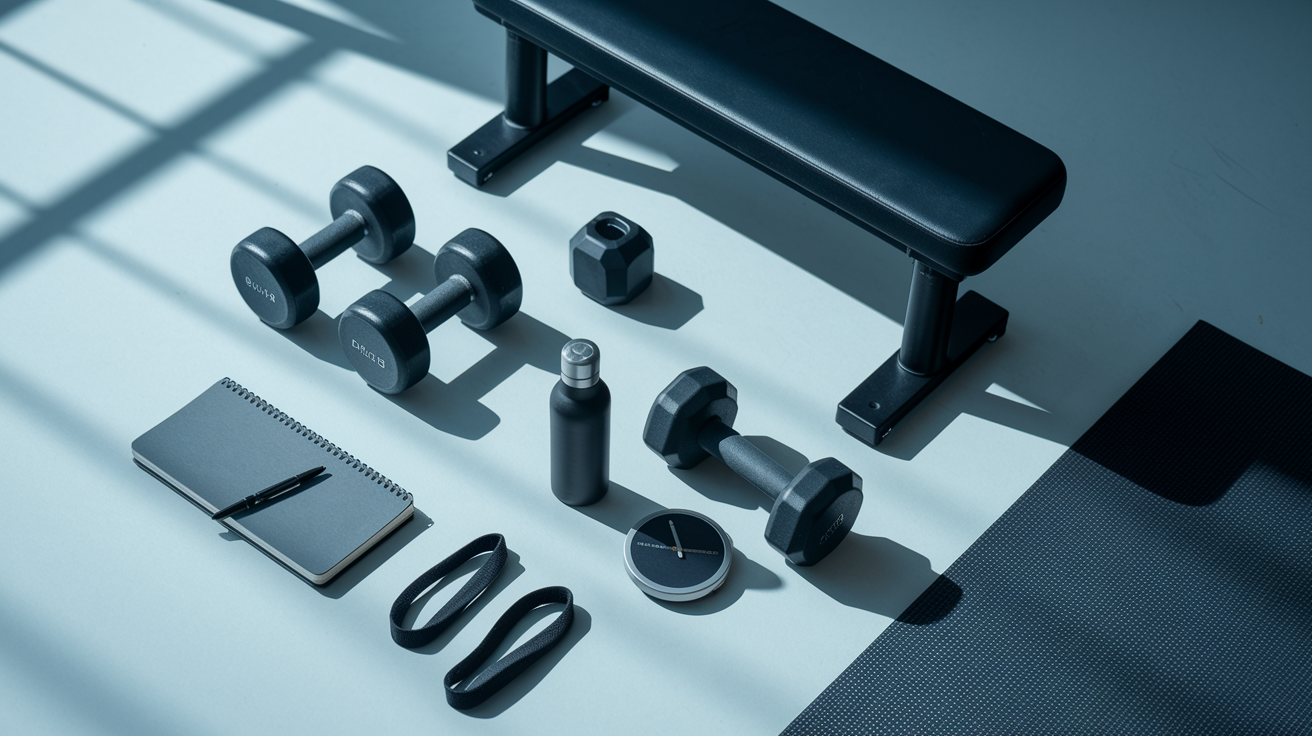
Most 20 minute full body routines work well with a pair of medium dumbbells, a bench or chair, and an exercise mat. If you’re training at home, a set of adjustable dumbbells or two fixed pairs gives you enough range to match exercises to your strength levels. You might use 15 pounds for thrusters and 20 pounds for rows, or 10 pounds across the board if you’re newer to loaded training.
Signs you picked the right weight: slight muscle tremble during the final few reps, elevated heart rate, and deliberate effort to finish each rep with good form. If you breeze through 40 seconds without feeling challenged, go heavier next round. If form breaks down halfway through, drop the load or switch to bodyweight. Progress happens when you can add a rep, hold tension longer, or bump the weight while keeping technique clean.
Minimal Equipment Alternatives:
- No dumbbells: use water jugs, a loaded backpack, or pure bodyweight with tempo variations
- No bench: use a sturdy chair, couch, or elevated surface like stairs
- No mat: towel or carpet works fine for cushioning
- Bodyweight only option: remove all external load and increase rep speed or hold times to keep intensity up
How to Scale the 20 Minute Full Body Strength Workout (Beginner to Advanced)

Scaling lets you meet the workout where your body is today without skipping the session or hurting yourself. Beginners cut volume and complexity. Advanced lifters add load, slow tempo, or stretch hold duration. Joint friendly tweaks include step backs instead of jumps and elevated push ups instead of kneeling variations that can bug your knees.
Beginner tweaks: cut work intervals to 30 seconds, drop reps by roughly 30 to 50 percent, use lighter weights or bodyweight only, swap complex holds for forearm planks, and remove rear foot elevation from split squats. These changes lower intensity while keeping movement patterns intact so you still learn proper form and build a base.
Advanced tweaks: bump dumbbell load by five to ten pounds, slow the lowering phase to three or four seconds, stretch hold durations from 45 seconds to 60 seconds, and add explosive elements like a clean and press at the end of thrusters. You can also tack on a fifth round if you have extra time, but that pushes total duration past 20 minutes.
| Level | How to Modify | Impact on Intensity |
|---|---|---|
| Beginner | 30 second work intervals, bodyweight or light dumbbells, standard split squat, forearm plank instead of complex holds | Cuts load and volume by around 40%, keeps form safe under lower fatigue |
| Intermediate | Full 40 second intervals, moderate dumbbells, rear foot elevation, 45 second holds | Balances intensity and recovery, builds strength and conditioning together |
| Advanced | Heavier dumbbells, 3 to 4 second eccentric tempo, 60 second holds, explosive variations, optional fifth round | Maxes out mechanical tension and metabolic demand, ramps up time under load significantly |
Proven Workout Structure Principles Behind 20 Minute Strength Gains

Short full body sessions rely on switching movement patterns and minimal rest to pack maximum work into limited time. When you finish a lower body exercise and jump straight to upper body or core, the muscles you just loaded get active recovery while you challenge a different area. This sequencing lets you keep going without complete fatigue in any single muscle group, driving both strength and conditioning gains in one block.
The 40 second work, 20 second rest interval keeps tension high enough to trigger strength while the short breaks hold an elevated heart rate. Rep schemes like 10 to 16 reps or timed AMRAP intervals make sure you hit meaningful load density (total reps times weight, divided by time), which drives hypertrophy and metabolic response. Circuits repeated two to four times give you enough volume to see progress without turning a 20 minute plan into an hour long slog.
Minimal rest also forces your body to clear lactate and manage fatigue under continued demand, which improves work capacity over time. You’re not just getting stronger in each movement. You’re training your system to recover faster between efforts and keep output high across multiple rounds. That combo of strength, conditioning, and efficiency is why 20 minute full body sessions punch above their weight.
Cooling Down After a 20 Minute Full Body Session

A five minute cool down helps bring your heart rate down gradually and cuts next day soreness by encouraging blood flow through the muscles you just worked. Static stretching after training, when tissues are warm, also supports long term mobility and joint health. You don’t need some elaborate routine, just three to four stretches held long enough to feel a gentle pull and let your nervous system downshift.
Hit the areas you loaded hardest: hips, hamstrings, glutes, chest, and shoulders. Piriformis stretches and straight leg hamstring stretches cover the lower body. Child’s pose opens the hips and lower back while giving your shoulders a gentle stretch. Hold each spot for roughly 60 to 90 seconds, breathing slowly and letting tension release with each exhale.
Simple Cool Down Sequence (5 Minutes Total):
- Piriformis stretch (90 seconds per side)
- Straight leg hamstring stretch (90 seconds per side)
- Child’s pose (90 seconds)
Tracking Progress and Staying Consistent With 20 Minute Workouts

Progress with short strength sessions shows up in three main spots: finishing rounds within the target time, bumping weight or reps while keeping form clean, and holding good technique under fatigue. If you finished two rounds last week and hit all four this week, that’s measurable progress. If your 15 pound dumbbells felt easy this month and you moved to 20 pounds, you advanced. Small, repeatable wins stack into real strength over weeks and months.
Frequency matters more than any single heroic session. Shoot for three to four 20 minute workouts per week, spaced with at least one rest or active recovery day between sessions. Consistency builds the habit, and the habit builds the result. Track your sessions in a simple notebook, app, or printed log sheet. Date, exercises, weight used, rounds completed, and one note about how it felt. Did you add a rep this week? Did your form look cleaner? That counts.
Simple Tracking Methods:
- Write down the weight and reps for each exercise after every session
- Note which tweaks you used and when you progressed past them
- Record total rounds completed and any time adjustments
- Check in monthly: compare your first week log to your current week log and celebrate the gap
Final Words
Start the clock: 40 seconds on, 20 off—five moves, four rounds. You learned a quick warm-up, the ready-to-use circuit, technique cues, equipment notes, scaling options, and a short cool-down.
This plan gives full-body coverage in a short block. It’s easy to tweak for beginners or to push as you get stronger. Track rounds, weight, or reps to measure progress.
Use the 20-minute full-body strength workout three times a week and watch strength and confidence grow. Small, consistent steps win.
FAQ
Q: How is the 20-minute full-body strength workout structured and timed?
A: The 20-minute full-body strength workout is structured as 40 seconds work / 20 seconds rest, with 5 moves per circuit repeated for 4 rounds, totaling 20 minutes of focused effort.
Q: Which exercises should I use for a ready-to-go 20-minute routine?
A: The 20-minute routine should use five full-body moves like thrusters, reverse lunges, chest presses, rows, and core holds, each done for 40 seconds with 20 seconds rest, four times through.
Q: What equipment do I need for this 20-minute workout?
A: The equipment needed: dumbbells optional; bench or chair optional; mat recommended for comfort and core work.
Q: How should I warm up in 3–5 minutes before the session?
A: A 3–5 minute warm-up should include mobility drills like downward dog, world’s greatest stretch, hip switches, deep squats, and leg swings to prime hips, shoulders, and spine.
Q: How can I scale this workout for beginners or advanced trainees?
A: To scale: beginners reduce reps/effort by about 30–50% and use lighter loads; advanced increase load, slow eccentric tempo, add holds or clean-and-press variations to raise intensity.
Q: How do I pick the right dumbbell weight for each exercise?
A: Pick a weight that causes a slight muscle tremble and makes the last few reps challenging but clean, with controlled tempo and an elevated heart rate by the final round.
Q: How often should I do this 20-minute workout to build strength?
A: Do the 20-minute workout 3–4 times per week for consistent strength and body-composition improvements, allowing rest days or lighter sessions in between.
Q: What simple tracking methods show progress with this routine?
A: Track progress by counting completed rounds, raising weight, adding reps or cleaner form under fatigue, and noting lower perceived effort for the same work over weeks.
Q: What basic technique cues and regressions should I use?
A: Use cues like chest up, core braced, controlled tempo, and glute squeeze. Regressions include wall push-ups, standard glute bridges, and non-elevated split squats when needed.
Q: How should I cool down after the 20-minute session?
A: Cool down with about 5 minutes of static stretches such as piriformis stretch, hamstring stretch, and child’s pose to lower heart rate and reduce post-workout tightness.