


Think you need hours in the gym to get stronger?
This 30-day workout plan for beginners is a simple home routine you can do in 20 to 30 minutes most days, with built-in rest, short warm-ups, and easy progressions.
Use one pair of dumbbells or bodyweight only, follow the daily calendar, and you’ll build strength, mobility, and real consistency without overwhelm.
It’s a step-by-step plan that meets you where you are and helps you improve in measurable ways over 30 days.
Complete 30-Day Beginner-Friendly Workout Calendar (Daily Plan Included)

This 30-day workout plan runs four full weeks with a 5-day training split that you can easily dial back to 3 or 4 days when life gets messy. Most sessions clock in between 20 and 30 minutes, with a few hitting 35 and some quick 10 to 15 minute options when you’re short on time. Weekly time commitment lands around 100 to 150 minutes if you stick to all 5 sessions. Each workout already has warm-up and cool-down baked into the time. Days 7, 14, 21, and 28 are rest days, but grab more whenever your body asks for it.
The plan mixes standing dumbbell strength, bodyweight workouts, HIIT, low-impact cardio, Pilates, kettlebell sessions, mobility, and stretching. You’ll see squats, lunges, Romanian deadlifts, shoulder presses, rows, push-ups, bicep curls, tricep work, calf raises, dead bugs, and plank circuits. Week 1 starts with a 20-minute full-body session using dumbbells, a 25-minute arm workout, and a 20-minute leg day. Week 2 adds a 25-minute full-body, a 20-minute quick arm session, and a 20-minute glute workout with an optional resistance band. Week 3 brings in a 25-minute full-body with abs, a 20-minute all-standing arm workout, and a 25-minute dumbbell leg day. Week 4 wraps with a 30-minute strength and steps session, a 20-minute arms and abs combo, and a 30-minute knee-friendly leg day using dumbbells and a band.
Rest days include optional 15-minute standing cardio, 5-minute ab sessions, or 10-minute stretching and mobility work. These short sessions keep you moving without messing with recovery. Day 10 shows up again on Day 24 so you can track your progress in core strength and endurance using the exact same workout. The plan also lists alternatives for nearly every workout, so swapping in a no-equipment option or shorter session is simple.
Key features:
- 30 consecutive days split across 4 weeks with built-in rest days
- Most workouts are 20 to 30 minutes, a few reach 35 minutes, several short 10 to 15 minute options available
- Primary equipment is a set of dumbbells (typical range 8 to 20 pounds per workout)
- Optional gear includes a kettlebell, resistance band, plyo box or bench, and a Pilates ball for one day
- Modifications included for every exercise with intensity options for different fitness levels
- Free downloadable PDF calendar and full-length video playlist, no sign-up required
- Mix of strength, HIIT, low-impact cardio, Pilates, kettlebell, and mobility sessions
- Suggested weekly frequency: 3 to 5 workouts per week depending on recovery needs
- Typical beginner starting point: 2 to 3 sets of 8 to 12 reps for strength exercises
- Intentional workout repetition (Day 10 on Day 24) to track measurable improvement
To follow the plan daily, check your calendar each morning or the night before. Pull up the video for that day’s workout, set out your dumbbells and any optional gear, and hit play. If it’s a rest day, you can take it completely off or choose one of the short optional sessions. If a workout feels too hard, dial back the weight or use one of the modifications shown in the video. If it feels easy, grab heavier dumbbells or add an extra round. The plan is designed to meet you where you are and help you build strength, mobility, and consistency over the next 30 days.
Beginner-Friendly Workout Structure and How the 30-Day Plan Progresses

The plan builds in a predictable pattern that helps your body adapt without overwhelming it. Each week introduces a small change in intensity, volume, or exercise variation. You’re not jumping from zero to hero overnight. You’re layering on challenge in a way that feels doable and gives your nervous system time to learn the movements before you push harder.
Week 1 focuses on foundational movement patterns using 2 rounds of each circuit with 30 seconds of work and 15 seconds of rest. You’ll learn the form on bodyweight squats, wall push-ups, reverse lunges, plank holds from your knees, glute bridges, and marching in place. Week 2 keeps the same movements but increases work time to 35 seconds and upgrades a few exercises, moving from wall push-ups to incline push-ups and adding single-leg glute bridges. Week 3 bumps you to 3 rounds, shortens rest to 10 seconds, and introduces variations like squat pauses, plank shoulder taps, and slow mountain climbers. Week 4 keeps 3 rounds and extends work intervals to 40 seconds, adding jump squats (or fast bodyweight squats), full push-ups, reverse lunges with a knee drive, and moderate-pace mountain climbers.
Weekly training themes:
- Week 1, Foundation: Learn form, build confidence, complete 2 rounds at 30 seconds per exercise.
- Week 2, Endurance: Same movements with slightly longer work intervals (35 seconds) and harder variations.
- Week 3, Challenge: Increase to 3 rounds, reduce rest to 10 seconds, add pauses and tempo changes.
- Week 4, Advanced Beginner: 3 rounds at 40 seconds per exercise with plyometric options and full-range variations.
If an exercise feels too easy, you can progress to a harder variation, increase your work time, add a third round early, or shorten your rest. If it’s too hard, drop back to a regression like wall push-ups or plank holds from your knees, reduce the work time, or pause and resume as needed. The structure is forgiving. You’re allowed to adjust on the fly. The goal is to finish each session feeling like you worked hard but not wrecked.
Equipment Guide for a Beginner 30-Day Workout Plan

You need one piece of equipment to complete the majority of this plan: a set of dumbbells. Recommended weight range is 8 to 20 pounds depending on the exercise and your current fitness level. Choose a weight where the final reps of each set are a struggle but your form stays clean. If you’re brand new, start with 8 to 10 pounds for upper-body movements and 12 to 15 pounds for lower-body exercises. You can always grab heavier dumbbells as you progress. If you don’t own dumbbells yet, you can substitute household items like water bottles or canned goods for the first week, but investing in a basic set will make the plan more effective.
Beyond dumbbells, most of the optional equipment is truly optional. A resistance band (mini loop style) shows up on a few leg days and can add extra glute activation, but you can skip it and still get a solid workout. A kettlebell or single heavy dumbbell appears in one or two sessions, but you can use your regular dumbbell instead. A chair, bench, or plyo box is helpful for step-ups, incline push-ups, or box squats, but a sturdy couch or coffee table works fine. One workout mentions a Pilates ball, but it’s completely optional. The plan includes several no-equipment bodyweight options on rest days and a handful of workouts that can be done entirely without gear if you’re traveling or want a break from the weights.
Recommended optional gear:
- Mini loop resistance band for added glute and leg activation
- Kettlebell or single heavy dumbbell for specific AMRAP or core sessions
- Chair, bench, or plyo box for step-ups, incline push-ups, and elevated exercises
- Pilates ball for one optional inner-thigh workout
- Yoga mat for floor exercises and stretching (makes planks and cool-downs more comfortable)
Daily Warm-Up and Cool-Down Protocols for Your 30-Day Beginner Plan

Every workout includes a 3-minute dynamic warm-up at the start. Dynamic means you’re moving through ranges of motion that prepare your joints and muscles for the work ahead, not holding static stretches. Think leg swings, arm circles, walking lunges, inchworms, and bodyweight squats. The goal is to raise your heart rate slightly, get blood flowing, and rehearse the movement patterns you’re about to load with weight or intensity. A proper warm-up reduces injury risk and helps you perform better during the main circuit.
The cool-down is also 3 minutes and focuses on static stretching. After you finish the last exercise, you’ll move through holds for your hamstrings, hip flexors, quads, chest, shoulders, and lower back. This is where you breathe deeply and let your heart rate come down gradually. Static stretches at the end help reduce soreness and start the recovery process. If you skip the cool-down, you’re more likely to feel stiff the next day.
On rest days, the plan includes optional 10 to 15 minute mobility or stretching sessions. These are longer, slower routines that target common tight spots like hip flexors, thoracic spine, and shoulders. Examples include dead bugs for core stability, hip-flexor stretches to counter sitting all day, and thoracic mobility exercises to improve posture and shoulder range. If you have time, adding one of these sessions to your rest day speeds up recovery and sets you up for a better workout the next time you train.
Sample warm-up and cool-down moves:
- Warm-up: leg swings (forward and side), arm circles, walking lunges, inchworms, bodyweight squats, hip openers
- Cool-down: standing hamstring stretch, quad stretch, hip-flexor lunge, chest opener, seated forward fold, child’s pose
Beginner Safety, Exercise Modifications, and Low-Impact Options
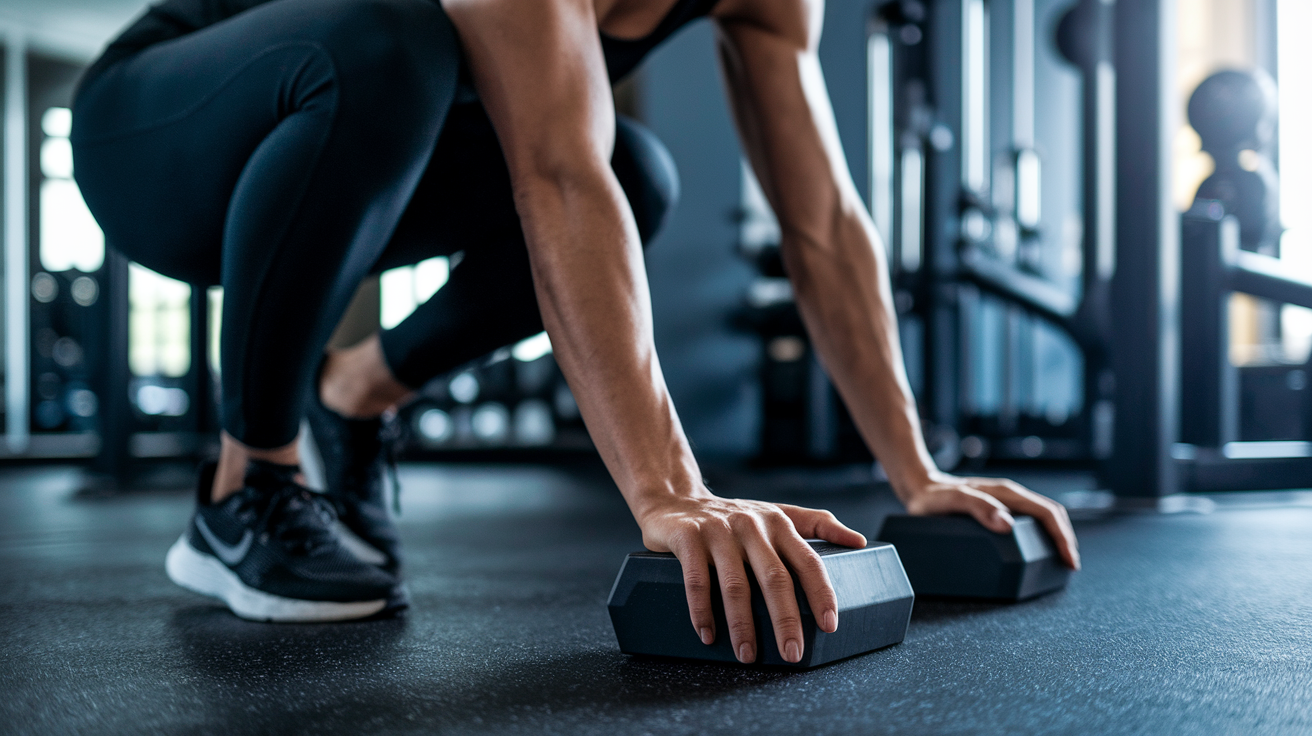
Form comes first, every single time. If you’re new to strength training, the first two weeks are about learning how each movement should feel, not how much weight you can lift. Watch the cues in the video carefully. You should feel squats in your glutes and legs, not your low back. You should feel rows in your mid-back and lats, not your neck. If something feels off, stop, reset, and try again with less weight or a simpler variation. It’s better to do 8 reps with perfect form than 12 reps with sloppy technique.
Every workout includes modifications for common limitations. Push-ups can be done against a wall, on an incline surface like a counter or bench, from your knees, or as full push-ups depending on your strength. Planks can be held from your knees or toes. Jump squats can be swapped for fast bodyweight squats if you’re avoiding impact. Lunges can be done as reverse lunges (easier on the knees) or skipped entirely if you have joint pain. Pregnancy-specific notes are included in many workouts, with guidance to avoid exercises that cause coning or doming in your abdomen and to use incline variations for push-ups and planks. Before starting this or any exercise program, consult your physician or midwife, especially if you’re pregnant, postpartum, managing an injury, or new to exercise.
Common modifications:
- Push-ups: wall, then incline (counter/bench), then knee, then full
- Planks: knees or toes, reduce hold time if needed
- Jump squats: replace with fast bodyweight squats or pause squats
- Lunges: reverse lunges (less knee stress), walking lunges, lunge with knee drive
- Pregnancy: avoid exercises that cause abdominal coning, use incline for all planks and push-ups, choose low-impact cardio options
Stop the workout immediately if you feel sharp pain, dizziness, shortness of breath beyond normal exertion, or any sensation that doesn’t match typical muscle fatigue. Soreness in the muscle belly is normal, especially in the first week. Pain in a joint or a pulling sensation in a tendon is not. When in doubt, scale back the intensity, choose the easier modification, or take an extra rest day. Consistency over 30 days beats one heroic workout that leaves you injured for two weeks.
Nutrition Basics to Support a 30-Day Beginner Workout Plan

You can’t out-train a poor diet, but you also don’t need to overhaul your entire life to see results from this plan. The two simplest nutrition priorities for beginners are adequate protein and consistent hydration. Protein supports muscle repair and growth, especially when you’re doing resistance training multiple times per week. Aim for a palm-sized portion of protein at each meal: chicken, fish, eggs, Greek yogurt, cottage cheese, beans, lentils, tofu, or a protein shake. If you’re eating three meals a day, that’s three opportunities to hit your protein target without obsessing over grams or macros.
Hydration matters more than most beginners realize. You should be drinking water consistently throughout the day, not just during your workout. A good rule: drink a glass of water when you wake up, one with each meal, and one or two between meals. If your urine is dark yellow, you’re behind. If it’s pale yellow, you’re in the right range. Dehydration makes every workout feel harder, slows recovery, and increases soreness. On workout days, drink an extra glass before and after your session to replace what you lose through sweat.
Sample grocery staples for active beginners:
- Protein: eggs, Greek yogurt, chicken breast, canned tuna, protein powder
- Carbs: oats, rice, sweet potatoes, whole-grain bread, bananas
- Fats: avocado, nuts, seeds, olive oil, nut butter
- Vegetables: spinach, broccoli, bell peppers, carrots, frozen mixed veggies
- Hydration: water, sparkling water, herbal tea (skip sugary sports drinks unless you’re training over an hour)
Tracking Progress Through Your 30-Day Beginner Workout Plan

Progress in the first 30 days shows up in ways that have nothing to do with the scale. You’ll notice endurance improvements by Week 2. Workouts that felt impossible on Day 1 will feel manageable by Day 10. By Week 3, you’ll see visible strength gains. Maybe you’re using heavier dumbbells, completing more reps, or holding a plank longer. By Week 4, you’ll feel more toned, your energy will be higher, and your sleep and mood will likely improve. Body-composition changes (fat loss, visible muscle definition) usually begin around Week 3 or 4, but dramatic visible change often takes 6 to 8 weeks plus consistent nutrition.
The plan intentionally repeats certain workouts so you can measure progress objectively. Day 10 is repeated on Day 24. When you do that workout the second time, compare how it felt. Did you add a rep? Did you use heavier dumbbells? Did your form look cleaner? That’s measurable progress. Another simple tracking method: write down your dumbbell weights and reps for each workout in a notebook or notes app. At the end of the week, glance back and see if anything improved. Small wins stack up fast.
| Metric | How to Measure | When to Check |
|---|---|---|
| Endurance | How long you can hold a plank or how many reps you complete in one set | End of Week 1, end of Week 3 |
| Strength | Dumbbell weight used for key exercises (squats, rows, presses) | Day 1, Day 15, Day 30 |
| Recovery Speed | How sore you are 24 to 48 hours after a workout | After first workout, after Week 2, after Week 4 |
| Consistency | Number of planned workouts completed each week | End of each week |
Don’t obsess over daily weight fluctuations. Your weight can swing 2 to 5 pounds in a single day based on water retention, digestion, and stress. If you want to track weight, weigh yourself once per week at the same time of day (first thing in the morning, after using the bathroom, before eating) and watch the trend over four weeks. Better yet, take progress photos in the same lighting and outfit on Day 1, Day 15, and Day 30. Visual changes often show up before the scale moves.
Motivation and Habit-Building Strategies for Completing a 30-Day Beginner Plan

Research shows it takes an average of 66 days to form a new habit, but the first 30 days are the most critical. That’s when your brain is deciding whether this new behavior is worth the effort or just another thing you tried and quit. The key to making it through is lowering the friction and stacking small wins. Don’t rely on motivation. Motivation is unreliable and disappears the moment you’re tired or stressed. Instead, build a system that makes it easier to show up than to skip.
Start by anchoring your workout to an existing habit. If you always drink coffee in the morning, do your workout right after. If you always walk the dog at 6 p.m., do your workout before the walk. This is called habit stacking, and it removes the need to decide when to work out. The decision is already made. Another strategy: lay out your workout clothes the night before. When you wake up and see them, you’ve already reduced one small barrier. Put your dumbbells somewhere you’ll trip over them. Make the default action the right action.
Practical motivation tactics:
- Schedule workouts in your calendar like any other appointment and set a reminder 15 minutes before
- Track your streak: mark each completed workout with an X on a paper calendar and don’t break the chain
- Find an accountability partner (friend, family member, online group) and check in weekly
- Celebrate non-scale wins: more energy, better sleep, lifting heavier, holding a plank longer
- Keep the bar low on hard days: a 10-minute workout counts, showing up beats skipping entirely
Post-Plan Options: What to Do After Completing a 30-Day Beginner Workout Program

After 30 days, you’ve built a foundation. Your body is stronger, your endurance is better, and you’ve proven to yourself that you can stick with a plan. Now you have options. The simplest path is to repeat the 30-day plan starting at Week 3 intensity. Skip the foundational Week 1 and Week 2 workouts and jump straight into the higher-volume, higher-intensity sessions. This gives you another month of progressive overload without needing a new program.
Another option is to increase session length. If you’ve been doing 20-minute workouts, try 25 to 30 minutes. Add an extra round to each circuit, increase your work intervals by 5 seconds, or tack on a 5-minute finisher at the end. You can also layer in new equipment. Add resistance bands to your leg days, try kettlebell swings, or follow a HIIT-forward program that includes more compound movements and conditioning work. Some people choose to shift into a structured strength split (upper/lower or push/pull/legs) and repeat that split 2 to 3 times before moving to a more advanced plan.
Recommended next-phase paths:
- Repeat the plan starting at Week 3 intensity for another 30 days, focusing on heavier weights and cleaner form.
- Extend session length to 25 to 30 minutes by adding rounds, increasing work intervals, or including finishers.
- Add resistance bands or kettlebells to introduce new stimulus and challenge different movement patterns.
- Follow a longer structured program (12-week strength plan, HIIT program, or sport-specific training) that builds on the base you’ve created.
Final Words
In the action: you now have a full 30-day calendar with daily sessions, progressions, warm-ups, safety tips, and simple equipment choices.
The plan builds week-to-week — foundations, endurance, a challenge week, then advanced-beginner moves. You also got quick nutrition, mobility, and tracking cues so progress isn’t guesswork.
Follow the daily sessions, keep notes, and use the modifications when needed. This 30 day workout plan for beginners gives a clear next step: repeat or add load after 30 days. Small, steady wins add up.
FAQ
Q: What are some beginner 30 day workout plans?
A: Beginner 30-day workout plans typically mix 3–4 strength sessions, 1–2 cardio or HIIT sessions, and weekly rest days. Sessions run 20–35 minutes, use bodyweight or light dumbbells, and progress each week.
Q: How much exercise should a diabetic get a day?
A: A person with diabetes should aim for at least 30 minutes of moderate activity most days, plus two weekly strength sessions. Check with your doctor and monitor blood sugar before and after exercise.
Q: What is the 3 3 3 rule at the gym?
A: The 3 3 3 rule at the gym means doing 3 sets of 3 reps for low-volume, heavy strength work, focusing on power and form. Use heavier load and 2–3 minutes rest between sets.
Q: Can I get into shape in 30 days?
A: You can make noticeable fitness improvements in 30 days with consistent 20–35 minute workouts, smart nutrition, and progressive overload. Expect better endurance, strength, and habits, not dramatic body changes.