


Think you need a gym membership to get stronger?
You don’t.
This 4-week progressive overload dumbbell plan runs four short sessions a week, 30 to 45 minutes each, and uses only dumbbells, simple trisets, circuits, and a unilateral complex to build strength and work capacity.
Week 1 teaches the moves, Week 2 adds weight, Week 3 cuts rest, and Week 4 pushes reps so you safely do more over time.
Follow the schedule and you’ll finish the month noticeably stronger and ready to keep progressing.
4-week dumbbell-only training plan for beginners
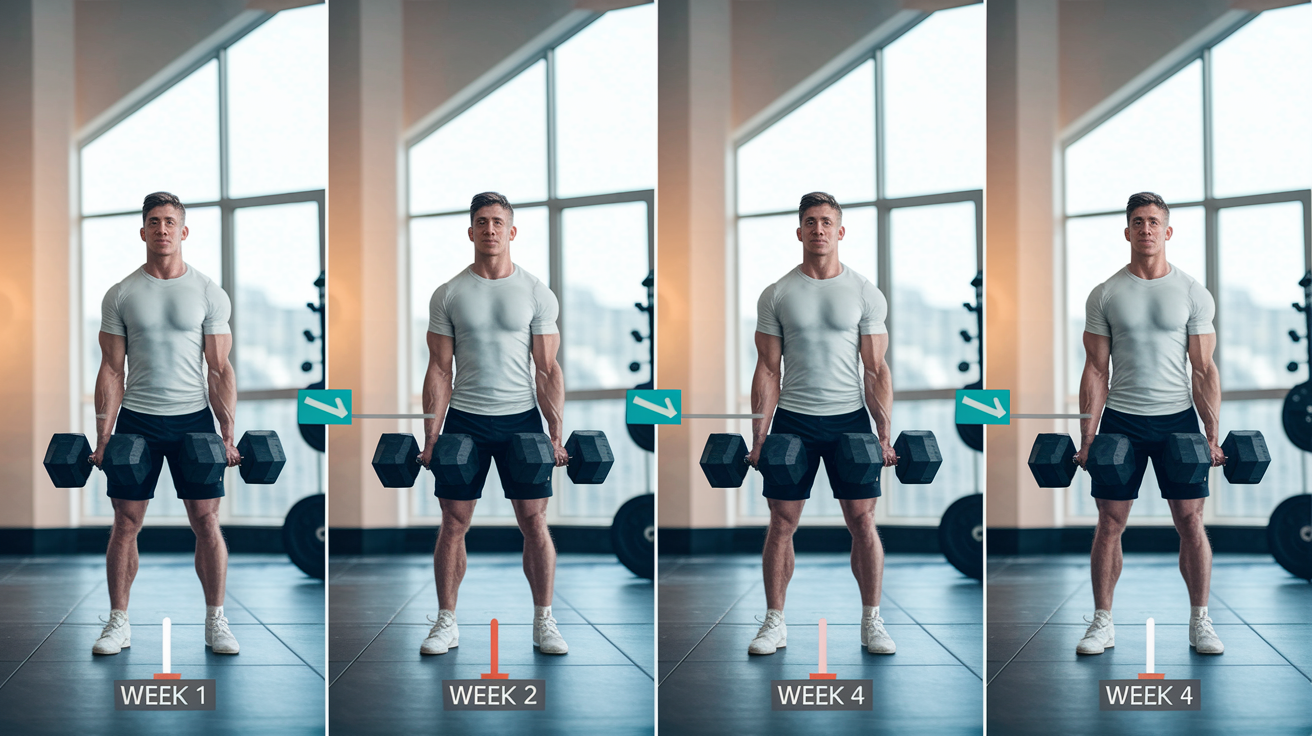
This runs four workouts per week over four weeks. You train on Days 1, 2, 4, and 6 each week. Rest on Days 3, 5, and 7. Each session takes 30 to 45 minutes. Just dumbbells.
The program uses progressive overload, so you’ll gradually do a little more over time. Week 1 is about learning the movements. Week 2 adds 5 to 10 pounds to your dumbbells. Week 3 cuts rest periods by 10 seconds. Week 4 pushes reps to the upper end of each range while keeping the weight and rest from Weeks 2 and 3.
Week 1
| Day | Exercise | Sets | Reps | Rest |
|---|---|---|---|---|
| 1 | Triset 1 (10-min AMRAP): Romanian Deadlift, Dumbbell Squat to Press, Bent-Over Dumbbell Row | AMRAP | 8 each | As needed within 10 min |
| 1 | Triset 2 (10-min AMRAP): Goblet Alternating Cossack Squat, Unilateral Floor Press, Tall-Kneeling Halo | AMRAP | 8/side each | 3 min between trisets |
| 2 | Circuit (3 rounds): Seated Arnold Press, Single-Arm Row, Pause Push-Up, Half-Kneeling Woodchopper | 3 | 12, 12–15/side, 10–15, 12/side | 90–120 sec between rounds |
| 3 | Rest or 20–30 min low-intensity cardio | — | — | — |
| 4 | Triset 1 (3 rounds): Jump Squat, Alternating Goblet Reverse Lunge, Step-Up | 3 | 6–12, 12/leg, 8–12/leg | 120 sec between trisets |
| 4 | Triset 2 (3 rounds): One-In-A-Half Goblet Squat, Contralateral Kickstand RDL, Farmers Carry | 3 | 8–15, 8–12/leg, 40–100 steps | 120 sec between trisets |
| 5 | Rest or 20–30 min cardio | — | — | — |
| 6 | Unilateral Complex (3 rounds per side): Snatch, Overhead Carry, Front Squat, Push Press, Cross-Body Row | 3/side | 6–8 each | 120 sec between rounds and sides |
| 7 | Rest | — | — | — |
Week 2
| Day | Exercise | Sets | Reps | Rest |
|---|---|---|---|---|
| 1 | Triset 1 (10-min AMRAP): Romanian Deadlift, Dumbbell Squat to Press, Bent-Over Dumbbell Row | AMRAP | 8 each | As needed within 10 min |
| 1 | Triset 2 (10-min AMRAP): Goblet Alternating Cossack Squat, Unilateral Floor Press, Tall-Kneeling Halo | AMRAP | 8/side each | 3 min between trisets |
| 2 | Circuit (3 rounds): Seated Arnold Press, Single-Arm Row, Pause Push-Up, Half-Kneeling Woodchopper | 3 | 12, 12–15/side, 10–15, 12/side | 90–120 sec between rounds |
| 3 | Rest or 20–30 min low-intensity cardio | — | — | — |
| 4 | Triset 1 (3 rounds): Jump Squat, Alternating Goblet Reverse Lunge, Step-Up | 3 | 6–12, 12/leg, 8–12/leg | 120 sec between trisets |
| 4 | Triset 2 (3 rounds): One-In-A-Half Goblet Squat, Contralateral Kickstand RDL, Farmers Carry | 3 | 8–15, 8–12/leg, 40–100 steps | 120 sec between trisets |
| 5 | Rest or 20–30 min cardio | — | — | — |
| 6 | Unilateral Complex (3 rounds per side): Snatch, Overhead Carry, Front Squat, Push Press, Cross-Body Row | 3/side | 6–8 each | 120 sec between rounds and sides |
| 7 | Rest | — | — | — |
Add 5 to 10 pounds to your dumbbells. Pick a weight that lets you finish the target reps with good form but feels harder than Week 1.
Week 3
| Day | Exercise | Sets | Reps | Rest |
|---|---|---|---|---|
| 1 | Triset 1 (10-min AMRAP): Romanian Deadlift, Dumbbell Squat to Press, Bent-Over Dumbbell Row | AMRAP | 8 each | As needed within 10 min |
| 1 | Triset 2 (10-min AMRAP): Goblet Alternating Cossack Squat, Unilateral Floor Press, Tall-Kneeling Halo | AMRAP | 8/side each | 2 min 50 sec between trisets |
| 2 | Circuit (3 rounds): Seated Arnold Press, Single-Arm Row, Pause Push-Up, Half-Kneeling Woodchopper | 3 | 12, 12–15/side, 10–15, 12/side | 80–110 sec between rounds |
| 3 | Rest or 20–30 min low-intensity cardio | — | — | — |
| 4 | Triset 1 (3 rounds): Jump Squat, Alternating Goblet Reverse Lunge, Step-Up | 3 | 6–12, 12/leg, 8–12/leg | 110 sec between trisets |
| 4 | Triset 2 (3 rounds): One-In-A-Half Goblet Squat, Contralateral Kickstand RDL, Farmers Carry | 3 | 8–15, 8–12/leg, 40–100 steps | 110 sec between trisets |
| 5 | Rest or 20–30 min cardio | — | — | — |
| 6 | Unilateral Complex (3 rounds per side): Snatch, Overhead Carry, Front Squat, Push Press, Cross-Body Row | 3/side | 6–8 each | 110 sec between rounds and sides |
| 7 | Rest | — | — | — |
Keep the same weight you used in Week 2. Cut rest periods by 10 seconds on every circuit and triset. Your heart rate stays higher and you’re pushing metabolic conditioning.
Week 4
| Day | Exercise | Sets | Reps | Rest |
|---|---|---|---|---|
| 1 | Triset 1 (10-min AMRAP): Romanian Deadlift, Dumbbell Squat to Press, Bent-Over Dumbbell Row | AMRAP | 10 each | As needed within 10 min |
| 1 | Triset 2 (10-min AMRAP): Goblet Alternating Cossack Squat, Unilateral Floor Press, Tall-Kneeling Halo | AMRAP | 10/side each | 2 min 50 sec between trisets |
| 2 | Circuit (3 rounds): Seated Arnold Press, Single-Arm Row, Pause Push-Up, Half-Kneeling Woodchopper | 3 | 14, 15/side, 15, 14/side | 80–110 sec between rounds |
| 3 | Rest or 20–30 min low-intensity cardio | — | — | — |
| 4 | Triset 1 (3 rounds): Jump Squat, Alternating Goblet Reverse Lunge, Step-Up | 3 | 12, 14/leg, 12/leg | 110 sec between trisets |
| 4 | Triset 2 (3 rounds): One-In-A-Half Goblet Squat, Contralateral Kickstand RDL, Farmers Carry | 3 | 15, 12/leg, 100 steps | 110 sec between trisets |
| 5 | Rest or 20–30 min cardio | — | — | — |
| 6 | Unilateral Complex (3 rounds per side): Snatch, Overhead Carry, Front Squat, Push Press, Cross-Body Row | 3/side | 8 each | 110 sec between rounds and sides |
| 7 | Rest | — | — | — |
Same weight and rest times from Week 3. Push reps to the top of each range. On Day 1, shoot for 10 reps per exercise in the AMRAP windows instead of 8. On Day 2, hit 14 to 15 reps. On Day 4, go for 12 to 15 reps and 100 steps on the farmers carry. On Day 6, aim for 8 reps per movement in the complex.
If you want to tack on a finisher, try light goblet squats for 20 seconds on and 40 seconds off, three to five rounds, after Day 1. After Day 2, try a dumbbell hollow hold for 30 seconds on and 30 seconds off, two to three rounds.
Warm-up and cooldown essentials

Spend five to seven minutes warming up before each session. You’re waking up your shoulders, hips, and core, plus getting your heart rate up just enough to feel ready.
Simple warm-up sequence:
Arm circles forward and backward, 10 each direction. Scapular push-ups (push-up position, protract and retract shoulder blades), 8 reps. Glute bridges, 10 reps. Bodyweight squats, 10 reps. Thoracic rotations (half-kneeling or quadruped), 6 per side. Light jog in place or jumping jacks, 30 seconds.
After your workout, take three to five minutes to cool down. Your heart rate drops and your body gets the signal that training is done.
Simple cooldown sequence:
Walk slowly in place or around the room, 60 seconds. Standing quad stretch, 20 seconds per leg. Standing hamstring stretch (foot on a low step or bench), 20 seconds per leg. Child’s pose (kneeling stretch), 30 seconds. Chest stretch in doorway or against a wall, 20 seconds per side. Shoulder rolls forward and backward, 10 each direction. Deep breathing (inhale for four counts, exhale for six counts), five breaths.
You don’t need every move every time, but hit the major areas you worked that day.
Key technique cues for beginners
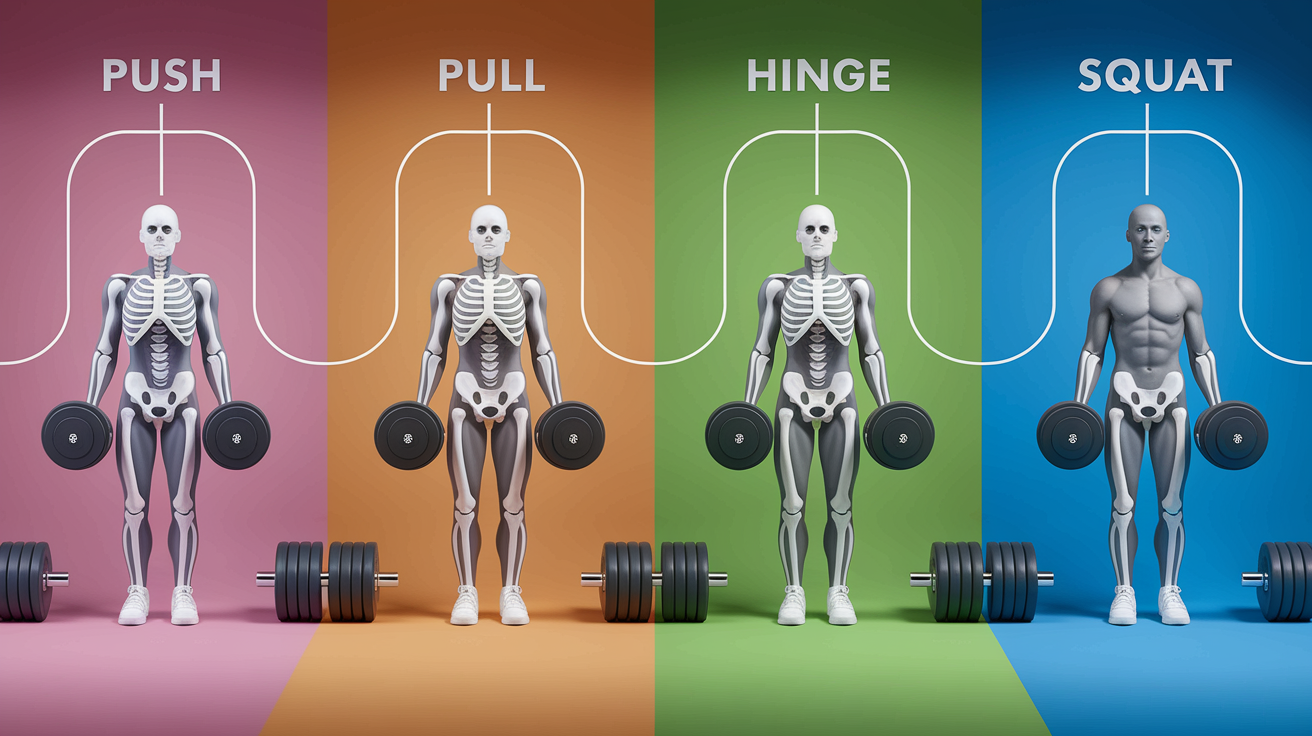
Push
When you push a dumbbell overhead or away from your chest, keep your core tight and your ribs down. Don’t let your lower back arch hard. Before you press, take a breath and brace like you’re about to take a light punch to the stomach. Firm, not stiff.
Keep your wrists stacked over your elbows. If your wrists bend back too far, the weight’s probably too heavy or your grip is off.
Common mistakes: flaring elbows out too wide on bench presses (keep them around 45 degrees from your body), shrugging shoulders up toward your ears during overhead presses (keep shoulders down and back), speeding through reps without control.
Pull
When you row or pull a dumbbell toward your body, start by squeezing your shoulder blade back and down. Your arm follows your shoulder blade. Don’t yank with your bicep first.
Keep your spine neutral. If you’re bent over, your back should stay flat, not rounded. You should feel this in the muscles between your shoulder blades and along your upper back, not in your lower back or neck.
Common mistakes: using momentum or a jerking motion to start the pull, letting your shoulder roll forward at the bottom of the row, twisting your torso to lift a weight that’s too heavy.
Hinge
A hinge happens at your hips, not your lower back. Push your hips back like you’re trying to close a car door with your butt. Your knees bend slightly, but your shins stay mostly vertical.
Keep the dumbbells close to your legs. You should feel tension in your hamstrings and glutes, not your lower back. Your chest stays proud and your shoulders stay over or slightly in front of the weights.
Common mistakes: rounding the lower back, squatting instead of hinging (knees come too far forward), lifting your chest too early on the way up so your hips shoot up first.
Squat
Start every squat by bracing your core and taking a controlled breath. As you descend, push your knees out slightly and keep your chest up. Your weight should stay in the middle of your foot, not on your toes.
Go as low as you can while keeping your heels down and your lower back neutral. For most people, that’s thighs parallel to the floor or slightly below.
Common mistakes: knees caving inward, heels lifting off the ground, leaning too far forward so your chest drops, not going deep enough because the weight is too heavy.
How to track your progression

Write down what you did after every session. Notebook, notes app, simple spreadsheet. Tracking turns guesswork into proof.
Five things to track:
Weight used for each exercise (write it next to the exercise name). Reps completed per set (if a range is given, note the actual number you hit). Number of rounds or total reps in AMRAP windows (especially on Day 1). Rest periods between sets or circuits (use a timer on your phone). How hard it felt on a scale of 1 to 10 (called RPE, or rate of perceived exertion; 7 is hard but doable, 9 means one rep left in the tank, 10 means you couldn’t do another rep).
At the end of each week, compare your numbers. Did you add weight in Week 2? Did you complete more rounds in Week 3 even though rest was shorter? Did your reps go up in Week 4? Those are wins.
Recovery, rest, and beginner-friendly tips

Rest days are part of the program, not a break from it. Your muscles adapt and grow stronger when you’re recovering, not when you’re lifting.
Practical recovery tips:
Drink water throughout the day, not just during workouts (half your body weight in ounces is a starting point). Eat enough protein to support muscle repair (a palm-sized portion at most meals is a simple guideline). Sleep seven to nine hours per night when possible (this is when most recovery happens). Do light movement on rest days like walking, stretching, or easy bike rides (20 to 30 minutes keeps blood flowing without adding fatigue). If a muscle group is still sore on a training day, you can train it lightly, but don’t push for new PRs (personal records) until soreness fades. Pay attention to joint pain versus muscle soreness. Muscle soreness is normal; sharp or pinching joint pain means stop and reassess. If you miss a workout, just pick up where you left off the next training day. Don’t try to cram two sessions into one day. Keep a water bottle and a small towel nearby during sessions so you stay hydrated and can wipe down dumbbells between rounds.
You don’t need to be perfect. Consistency over four weeks builds more strength than one perfect week followed by three weeks off.
Final Words
Grab your dumbbells and start week 1—this post laid out the full 4-week program with daily tables so you can jump right in.
Use the warm-up and cooldown sequences, practice the technique cues for push, pull, hinge, and squat, and pick a simple tracking method to record progress.
Follow the recovery tips and increase reps, sets, or weight each week. This 4-week progressive overload dumbbell plan for beginners is built to be doable and steady.
You’ve got this. Small, consistent steps add up.
FAQ
What exercises should be included in a 4-week beginner dumbbell program?
A 4-week beginner dumbbell program should include foundational movements covering push, pull, hinge, and squat patterns. Common exercises are goblet squats, dumbbell rows, chest presses, Romanian deadlifts, shoulder presses, and bicep curls. Balance upper and lower body work across 3 to 4 sessions per week with progressive increases in reps or weight.
How often should beginners train with dumbbells each week?
Beginners should train with dumbbells 3 to 4 times per week. This frequency allows adequate recovery between sessions while building consistency and foundational strength. Rest at least one day between sessions to support muscle adaptation and reduce injury risk.
What is progressive overload in a dumbbell workout plan?
Progressive overload in a dumbbell workout plan means gradually increasing the challenge each week by adding reps, sets, or weight. This steady progression forces your muscles to adapt and grow stronger. Beginners typically add one or two reps per exercise weekly before increasing weight.
How long should rest periods be for beginner dumbbell exercises?
Rest periods for beginner dumbbell exercises should be 60 to 90 seconds between sets. This rest window allows partial recovery without letting heart rate drop completely. Compound movements like squats may need slightly longer rest than isolation exercises like curls.
What warm-up should beginners do before a dumbbell workout?
Beginners should do a 5 to 10 minute warm-up before a dumbbell workout including arm circles, bodyweight squats, lunges, hip circles, and light cardio. This prepares joints, raises body temperature, and reduces injury risk. Dynamic movement is more effective than static stretching before lifting.
Why is a cooldown important after dumbbell training?
A cooldown after dumbbell training helps lower heart rate gradually, reduce muscle soreness, and support recovery. Spend 5 to 10 minutes doing light stretching or slow movement. This transition helps your body shift from work mode back to rest mode safely.
What are common form mistakes beginners make with dumbbells?
Common form mistakes beginners make with dumbbells include arching the lower back, using momentum instead of control, incomplete range of motion, and holding their breath. Focus on neutral spine, slow tempo, full movement, and steady breathing to build safe habits early.
How should beginners track progress in a dumbbell program?
Beginners should track progress by recording reps completed, sets performed, weight used, how hard each set felt, and any performance notes. Write this down after every workout. Consistent tracking shows measurable improvement and helps you know when to add weight or reps.
How many rest days do beginners need between dumbbell workouts?
Beginners need at least one full rest day between dumbbell workouts. Training 3 to 4 days per week with rest days in between supports muscle repair and strength gains. Rest is when adaptation happens, not during the workout itself.
What recovery habits help beginners progress with dumbbell training?
Recovery habits that help beginners progress include sleeping 7 to 9 hours nightly, drinking enough water daily, eating adequate protein, taking full rest days, doing light activity on off days, and listening to soreness signals. Recovery supports the adaptations you’re working for in the gym.