


Want to lose fat and keep muscle while only lifting three times a week?
For recomposition, aim for about 0.8–1.0 grams of protein per pound of bodyweight (1.8–2.2 g/kg) daily, low end if you’re new or at maintenance, higher if you’re cutting hard or well trained.
This post gives clear targets by experience and calorie status, simple timing rules, and easy meal plans so you can hit your number without overthinking it.
Simple, practical steps.
Optimal Daily Protein Targets for Recomposition on a 3‑Day Training Schedule

For someone lifting three times a week and chasing recomposition, you’re looking at 0.8–1.0 grams of protein per pound of bodyweight. That’s about 1.8–2.2 grams per kilogram. Multiple controlled studies back this range when you’re trying to hold onto muscle while dropping fat. Where you land depends on your calorie situation, how hard you’re training, and how lean you already are.
If you’re new to lifting or carrying extra fat, the lower end works. Think 0.8 g/lb or 1.8 g/kg. If you’re eating in a moderate deficit or you’ve been training for a while, push toward 0.9–1.0 g/lb (2.0–2.2 g/kg) to protect muscle while losing fat. Here’s how to pick:
- Beginner in a small deficit: 0.8 g/lb (1.8 g/kg). So a 165 lb person hits 132 g protein daily.
- Intermediate lifter, moderate deficit (15–20% below maintenance): 0.9 g/lb (2.0 g/kg). That’s 148 g for 165 lb.
- Advanced lifter or deeper cut (more than 20% below maintenance): 1.0 g/lb (2.2 g/kg). Same person, now 165 g daily.
- Small surplus or eating at maintenance: 0.8–0.9 g/lb (1.8–2.0 g/kg) does the job.
- Higher body fat (over 25%): lean toward the upper range even as a beginner, because muscle loss risk climbs during fat loss.
Stick with your number every single day. Total daily protein beats timing or how many meals you eat. Studies on overfeeding show that going above 2.2 g/kg doesn’t build more muscle. It just adds calories, which can stall fat loss or even add unwanted fat.
How Protein Needs Change With Training Frequency and Workout Structure

When you’re lifting three days a week instead of five or six, the actual protein requirement per kilogram doesn’t change. But your margin for error gets smaller. Each training session kicks up muscle protein synthesis for 24 to 48 hours, so Monday, Wednesday, Friday keeps you in an elevated synthesis window most of the week. What matters is keeping daily protein high on both training and rest days to support synthesis and limit breakdown. The 1.8–2.2 g/kg range holds whether you lift three times or six.
Session intensity and volume do matter. If your three weekly sessions are full-body workouts with compound lifts and progressive overload, muscle damage and recovery demands are real. You’ll want the higher end of that range, especially if you’re in a deficit. If your sessions are shorter or easier, the lower end works fine as long as you’re consistent.
Total daily protein drives recomposition more than workout frequency. Someone training three days a week who hits 2.0 g/kg daily will outpace someone training six days who only manages 1.2 g/kg. Frequency determines how often you stimulate synthesis. Daily protein determines how much tissue you can actually build or preserve during that window.
Protein Timing for Maximizing Recomposition Efficiency
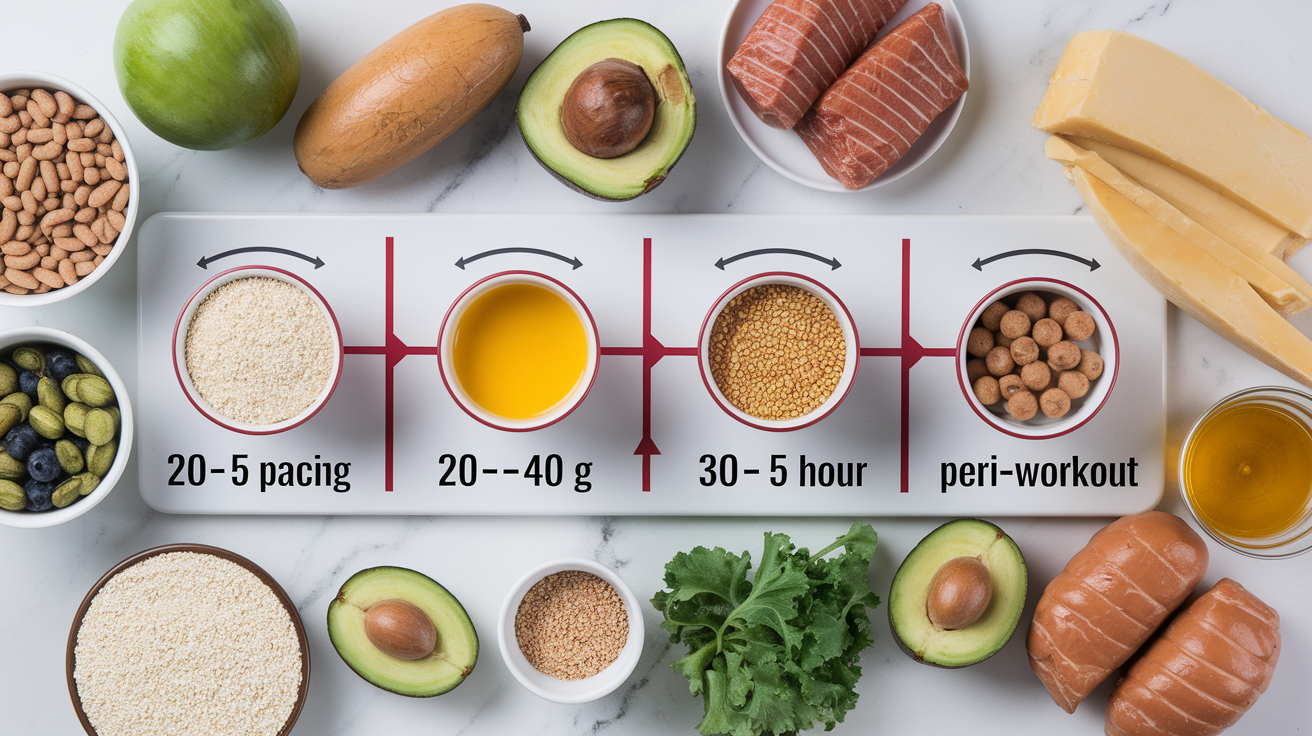
Spreading your daily protein across three to five meals keeps muscle protein synthesis elevated all day and night. Each meal that delivers 20–40 grams of quality protein triggers the anabolic response. Spacing those meals every three to five hours maximizes cumulative synthesis over 24 hours. This matters more during recomposition because you’re asking your body to simultaneously support recovery and manage a calorie deficit.
Post-workout protein does support recovery, but the old 30-minute anabolic window thing is overblown. As long as you eat a protein meal within two hours before or after training, you’ll capture most of the benefit. If you train fasted, get protein in soon afterward. On days you don’t lift, the same meal-spacing principle applies. Your body is still repairing and adapting even without acute training stimulus.
Here are the core timing principles for a three-day lifting schedule:
- Aim for 3–5 protein meals or snacks per day, spaced 3–5 hours apart.
- Include 20–40 g of protein per meal to reliably trigger synthesis.
- Eat one of those meals within about 2 hours before or after each training session.
- If your last meal is more than 8 hours before breakfast, consider a pre-bed protein serving (around 30–40 g) to support overnight synthesis.
Practical Meal Examples to Hit Daily Protein Targets

Real meals that deliver 30–45 grams of protein are easier to build than most people think. Pick protein-dense whole foods or convenient supplements and pair them with carbs and fats that fit your calorie target. Below are six straightforward meal templates that work across different schedules and preferences.
| Meal Type | Protein Source | Approx. Protein (g) |
|---|---|---|
| Breakfast | 3 whole eggs + 1 cup plain Greek yogurt | ~36 g |
| Lunch | 6 oz grilled chicken breast + 1 cup cooked rice | ~42 g |
| Post-workout | 1 scoop whey isolate + 1 medium banana | ~25 g |
| Dinner | 5 oz lean ground turkey + ½ cup black beans + vegetables | ~38 g |
| Snack | ½ cup cottage cheese + handful almonds | ~18 g |
| Pre-bed (optional) | 1 scoop casein protein or 1 cup cottage cheese | ~30 g |
Hitting your daily target becomes a repeatable habit when you use the same core proteins across multiple meals and adjust portion sizes to fit your calorie budget. A 165 lb person targeting 148 g protein per day can meet that with breakfast (36 g), lunch (42 g), post-workout shake (25 g), dinner (38 g), and one small snack (18 g). No single meal has to be enormous. Nothing needs to be complicated. Focus on whole foods first, and use shakes or bars to fill gaps when schedule or appetite makes whole-food meals impractical.
Adjusting Protein Intake for Calorie Deficits, Surpluses, and Training Experience

When you’re in a calorie deficit, muscle breakdown increases and the body’s ability to build new tissue decreases. Protein becomes more protective. Aim toward the higher end of the range, 0.9 to 1.0 g/lb (2.0–2.2 g/kg), especially if your deficit is moderate to aggressive (more than 15–20% below maintenance). This higher intake acts as insurance against lean-mass loss and supports recovery even when energy availability is limited.
In a small calorie surplus or at maintenance, the lower to middle range (0.8–0.9 g/lb or 1.8–2.0 g/kg) is usually enough. Energy availability supports anabolism and the risk of muscle loss is minimal. A controlled overfeeding study showed that groups consuming 1.8 g/kg and 3.0 g/kg gained the same amount of lean mass in a surplus. Adding more protein beyond the moderate range just adds calories without additional muscle benefit.
Training experience also shifts the recommendation. Beginners respond strongly to training stimulus and can build muscle even at the lower end of the range. Advanced lifters have slower adaptation rates and benefit from maximizing recovery signals, especially in a deficit. Here’s how to adjust:
- Beginner or detrained, small deficit or maintenance: start at 0.8 g/lb (1.8 g/kg).
- Intermediate lifter, moderate deficit (15–20% below maintenance): use 0.9 g/lb (2.0 g/kg).
- Advanced lifter or aggressive deficit (more than 20%): aim for 1.0 g/lb (2.2 g/kg) and monitor recovery closely.
Supplement Options to Support Protein Intake

Protein powders are useful tools when whole-food meals don’t fit your schedule or appetite. But they’re not mandatory if you can hit your daily target with chicken, eggs, dairy, beans, and other whole sources. Whey protein isolate absorbs quickly and delivers roughly 25 grams of protein per scoop with minimal fat and carbs. Practical immediately after training. Casein protein digests slowly over several hours, so a scoop before bed (around 30–40 grams) supports overnight muscle protein synthesis without spiking blood sugar or disrupting sleep.
Plant-based protein powders (pea, brown rice, or blended formulas) work for recomposition as long as the blend provides a complete amino acid profile, including at least 3 grams of leucine per serving. Most quality vegan isolates hit that target in a 25–30 gram scoop and work identically to animal proteins when total daily intake is adequate. If you’re vegan or lactose-intolerant, choose a pea and rice blend or a soy isolate to match the leucine and essential amino acid content of whey.
Here’s a quick comparison of the three main types:
- Whey isolate: fast absorption, around 25 g protein per scoop, best post-workout or any time you need quick protein.
- Casein: slow digestion, around 25–30 g protein per scoop, ideal before an 8+ hour overnight fast.
- Plant blends (pea + rice or soy): moderate absorption, around 25 g protein per scoop, complete amino profile when blended, suitable any time of day.
Final Words
In the action, this post gave exact daily targets (0.7–1.0 g per pound or 1.6–2.2 g per kg), explained when to aim higher, and showed how a 3-day lifting split changes distribution and timing.
You also got meal examples, supplement options, and simple rules for adjusting intake in a deficit or surplus.
Use the protein targets for recomposition while lifting 3 times per week as your baseline, pick the higher end when cutting or pushing intensity, and spread protein across meals. Track strength and intake. Small, steady progress wins.
FAQ
Q: Is working out 3 times a week enough for body recomp?
A: Working out three times a week can be enough for body recomposition when you follow a focused strength plan, progressive overload, consistent protein, and modest calorie control.
Q: What is the 3-3-3 rule in gym?
A: The 3-3-3 rule in the gym typically means three sets of three reps, a low-rep, heavy approach used to build maximal strength and nervous system efficiency.
Q: How much protein should I eat if I lift weights three times a week?
A: If you lift weights three times a week, aim for about 0.7–1.0 g per pound (1.6–2.2 g/kg) daily; choose the higher end during calorie deficit or heavier training.
Q: What should my protein goal be for body recomp?
A: Your protein goal for body recomposition should be 0.7–1.0 g per pound (1.6–2.2 g/kg) daily, with higher targets when dieting or during higher-intensity training to protect muscle.