


What if your hard work in the gym isn’t paying off because you’re guessing your weekly volume?
Weekly training volume — the number of hard sets per muscle each week — is the single simplest thing to fix that.
Learn to count only hard sets (finished within 0 to 2 reps from failure), add them across seven days, and compare your total to the 10 to 20 set guideline.
Then we show how to adjust for experience, exercise type, and recovery so you can progress without burning out.
Simple math. Real results.
Core Method for Determining Weekly Training Volume

Weekly training volume is just the total number of hard sets you do for each muscle group over seven days. You can calculate it by counting work sets, multiplying by reps, then multiplying by the load. Or if you’re focused purely on strength, just count hard sets per muscle and move on. Most research points to 10 to 20 hard sets per muscle per week for steady gains. That range shows up across dozens of studies and thousands of lifters.
A hard set is any set where you finish within about 0 to 2 reps of failure. Warm-up sets don’t count. If you knock out 3 sets of 5 reps on bench press with a weight you could maybe squeeze out 6 or 7 reps with, those 3 sets count. If you do 2 light sets to grease the groove, those don’t. This keeps your volume calculation honest and tied to what actually drives adaptation.
How to calculate your weekly volume for any muscle group:
- List every exercise that trains the target muscle (for chest: bench press, incline dumbbell press, chest fly).
- Count only the sets where you finished close to failure (0 to 2 reps left in the tank).
- Add up those sets across the entire week.
- Compare your total to the 10 to 20 set guideline and adjust up or down depending on your recovery and progress.
If your weekly volume sits below 10 sets for a muscle group and your strength isn’t moving, you probably need more stimulus. If you’re pushing 20 or more sets and your lifts still stall or your joints hurt, you might be overshooting your recovery capacity. The formula is simple. The art is in tweaking the number based on what your training log shows over the next few weeks.
How Training Experience and Recovery Change Volume Needs

A lifter who’s been training consistently for six months will usually make steady progress with 6 to 10 hard sets per muscle per week. An advanced lifter with three or more years under the bar often needs 15 to 20 sets. Some respond best to 20 or more. Training age is the single biggest modifier of your ideal weekly volume because your nervous system and muscle tissue adapt to the same stimulus over time. What used to cause growth now just maintains it.
Recovery capacity is the second big lever. Two people with identical training ages can have wildly different abilities to handle volume because one sleeps eight hours a night and the other sleeps five. One manages stress at work. The other is juggling two jobs and three kids. Recovery isn’t just about muscle repair. It’s about your entire system’s ability to adapt to a training load and come back ready for the next session. If your life is chaotic or your nutrition is shaky, your effective weekly volume ceiling drops even if your training age suggests you should handle more.
Start with the research-backed range for your experience level, then adjust based on how you feel and perform week to week. If you’re new and 8 sets per muscle is moving your lifts, don’t jump to 15 just because the internet says advanced lifters do it. If you’re experienced and 12 sets stopped working six months ago, don’t stay stuck there because someone told you more volume is always junk volume. Recovery and training age set the boundaries. Your training log tells you where you land inside them.
Exercise Selection and Its Effect on Weekly Volume

Not every set contributes the same amount of stimulus to strength or size. A heavy set of 5 reps on the squat creates more systemic fatigue and recruits more muscle fibers than a set of 12 leg extensions, even if both are taken close to failure. Compound lifts like squats, deadlifts, bench presses, and rows demand coordination across multiple joints and muscle groups, so they cost more recovery per set but also deliver a bigger strength return. Isolation exercises like curls, lateral raises, or leg curls let you add volume to a specific muscle without the full-body fatigue tax.
Effective reps are the reps in a set that actually challenge high-threshold motor units and drive adaptation. If you do a set of 10 reps and only the last 3 or 4 feel genuinely hard, those last few reps are the effective ones. Compound lifts done with moderate to heavy loads produce more effective reps earlier in the set because the weight is significant from rep one. Isolation lifts often require you to push closer to failure before the set becomes hard enough to count. This difference means a set of 5 squats at RPE 8 can produce as much stimulus as a set of 15 leg extensions at RPE 9, even though the rep count and tonnage look completely different.
How different exercise types affect your weekly volume calculation:
- Compound lifts contribute the most to weekly volume for multiple muscle groups at once but also accumulate the most fatigue per set.
- Isolation lifts let you safely add 2 to 5 extra sets per week to a lagging muscle without blowing up your recovery budget.
- Accessory lifts (variations like paused squats, tempo bench, or RDLs) bridge the gap, offering moderate systemic cost with specific carryover to your main movements.
When you plan your weekly volume, count all hard sets but remember that 15 sets of only compounds will feel heavier and require more recovery than 10 compound sets plus 5 isolation sets, even though the total set count is the same.
Progressing Weekly Volume Over Time

Steady strength gains require a slow, deliberate increase in training stress over weeks and months. The simplest progression strategy is adding 5 to 10 percent more weekly volume every two to four weeks. That might mean one extra set per exercise, or adding a fourth training session when you’ve been doing three, or swapping one exercise for a variation that lets you push a bit harder. The key is that the change is small enough that your body adapts instead of breaking down.
Progressive overload works because your nervous system and muscle tissue respond to new demands by getting stronger and more efficient. But if you jump your weekly volume by 30 percent in one shot, fatigue outpaces adaptation and your performance drops. That’s why experienced lifters use planned deload weeks every four to six weeks. A deload cuts your weekly volume by 30 to 50 percent for one week, giving your joints, connective tissue, and central nervous system a chance to catch up. You come back the next week ready to push harder than you could have without the break.
Simple five-step model for progressing weekly volume:
- Start at the low end of the research range (10 sets per muscle per week if you’re newer, 12 to 15 if you’re intermediate).
- Track your performance on key lifts every week and watch for consistent progress.
- After three to four weeks of progress, add one set per exercise or one extra exercise for that muscle group (roughly 2 to 3 more weekly sets).
- If strength stalls or soreness lingers for more than 48 hours after a session, hold your current volume for another two weeks before adding more.
- Every fourth or sixth week, cut volume in half for a deload, then resume the progression the following week.
This model keeps you moving forward without guessing. If your squat goes from 225 for 5 reps to 235 for 5 over four weeks, the volume was right. If it stays stuck at 225 for three weeks in a row, either add a bit more volume or check your recovery and nutrition before assuming more sets are the answer.
Example Calculations for Different Muscle Groups
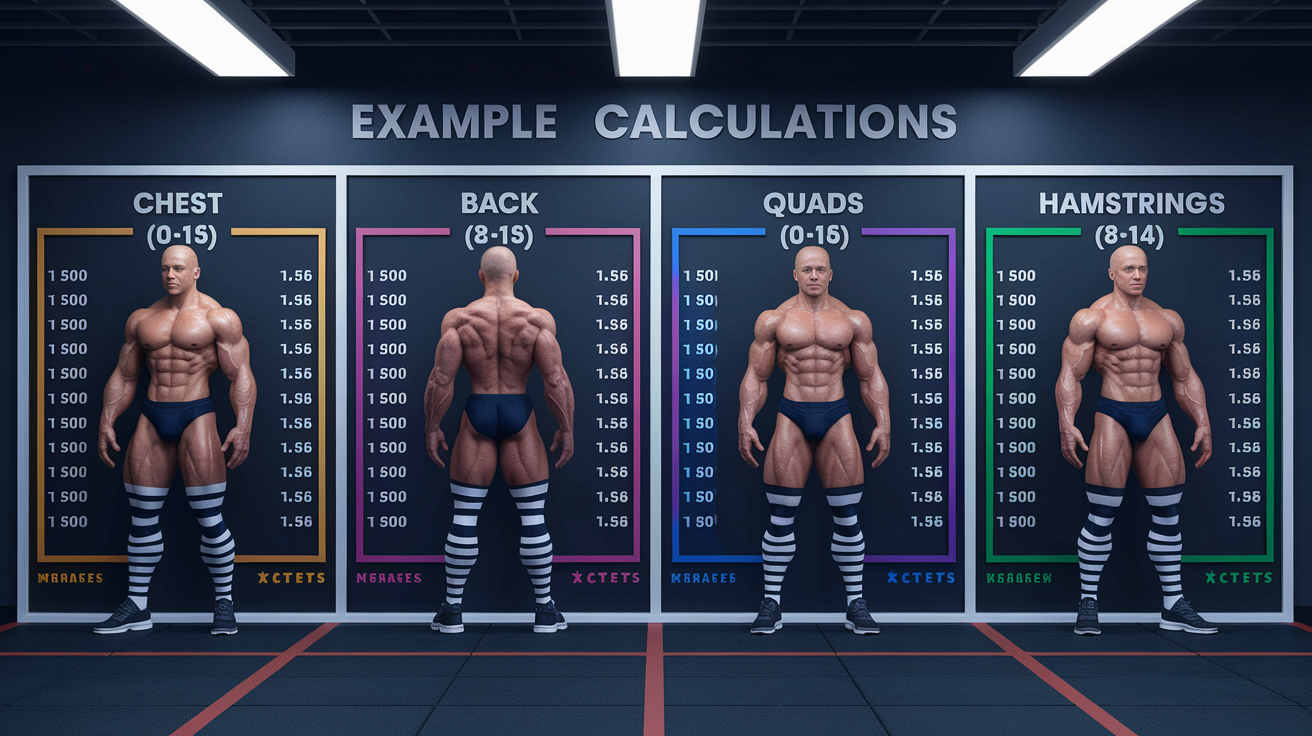
Here’s how the weekly set guidelines translate into real training weeks for four major muscle groups. These examples assume an intermediate lifter training each muscle two or three times per week.
| Muscle Group | Weekly Set Target | Example Breakdown |
|---|---|---|
| Chest | 10–15 sets | Monday: 4 sets bench press, 3 sets incline dumbbell press. Thursday: 4 sets close-grip bench, 2 sets cable fly. Total = 13 sets. |
| Back | 12–18 sets | Monday: 4 sets barbell row, 3 sets lat pulldown. Wednesday: 4 sets deadlift (counted for back and hamstrings). Friday: 3 sets chest-supported row, 2 sets face pull. Total = 16 sets. |
| Quads | 10–18 sets | Tuesday: 5 sets back squat, 3 sets leg press. Friday: 4 sets front squat, 3 sets leg extension. Total = 15 sets. |
| Hamstrings | 8–14 sets | Wednesday: 4 sets deadlift (shared with back). Saturday: 3 sets Romanian deadlift, 3 sets lying leg curl. Total = 10 sets. |
These examples show how weekly volume accumulates across multiple sessions and exercises. Notice the back example includes deadlifts, which contribute to both back and hamstring totals. Overlap like that is normal and doesn’t mean you’re doing too much. It just means you’re using efficient compound movements that hit multiple muscle groups at once. If you’re newer, aim for the lower end of each range. If you’ve been training consistently for a year or more and your strength has plateaued, try nudging toward the higher end and watch how your body responds over the next month.
Tracking Weekly Volume for Steady Long-Term Progress

Tracking your weekly volume keeps you honest and helps you spot patterns before they become problems. The simplest method is a training log where you write down every exercise, the number of hard sets, the reps, and the load you used. At the end of the week, add up your sets per muscle group and compare them to the previous week. If your volume is climbing and your lifts are moving, keep going. If your volume is climbing but your lifts are stuck or dropping, you’ve likely overshot your recovery capacity.
Performance indicators matter more than the raw set count. You want to see your working weights go up over time, your rep counts increase at the same weight, or your RPE drop for the same load and reps. Those changes tell you the volume you’re doing is driving adaptation. If none of those markers improve after four to six weeks, either your volume is too low to create a stimulus or it’s too high and you’re buried in fatigue. The log tells you which direction to adjust.
Three simple tracking methods that work:
- Notebook or app: write every set, rep, and load immediately after each exercise so you don’t forget details by the end of the session.
- Weekly summary sheet: at the end of the week, tally your total sets per muscle group and compare it to your plan and your previous week.
- Monthly performance check: every four weeks, test a key lift (like your top set of 5 on squat or bench) and compare the result to four weeks earlier. If the weight went up or the reps increased, your volume strategy is working.
Tracking doesn’t need to be complicated. You’re not writing a research paper. You’re collecting enough data to know whether more volume helps or hurts your progress. Most lifters who track consistently discover they were either doing more volume than they thought (and needing to dial it back) or less volume than they assumed (and needing to add a bit more). Either way, the log gives you the truth instead of a guess.
Final Words
Start with the simple math: count hard sets or use Sets × Reps × Load. Aim for roughly 10–20 quality sets per muscle per week, with beginners nearer 6–10 and advanced trainees toward the high end.
Pick exercises that match your recovery—compounds demand more rest, isolation adds volume with less fatigue. Progress volume slowly (about 5–10% increases) and schedule deloads when needed.
Track your weeks, adjust based on performance, and practice how to calculate weekly volume for steady strength gains. Small, steady steps build real strength.
FAQ
Q: How much volume per week for strength?
A: The weekly volume for strength is generally 10–20 hard sets per muscle per week for steady gains; beginners can progress with 6–10 sets, while advanced trainees often need 15–20+ sets, adjusted by recovery.
Q: What is the 3-3-3 rule at the gym?
A: The 3-3-3 rule is performing three sets of three reps for a lift, focusing on heavy low‑rep strength work, using long rests and steady form; it’s a simple template to build raw strength without chasing volume.
Q: What is the 2 2 2 rule in the gym?
A: The 2 2 2 rule is doing two working sets of two reps for key lifts, emphasizing very heavy loads, full recovery between sets, and minimal volume—useful briefly for peaking or pure strength focus.
Q: What is the 5 3 1 rule?
A: The 5 3 1 rule is a monthly strength cycle (Wendler’s 5/3/1) using three key weeks of 5, 3, and 1 rep sets at percentages of your training max, promoting slow, sustainable progress.