


Stuck on a strength plateau?
That’s not a failure. It’s a signal. Your body learned the routine and needs a smarter nudge.
This post shows clear, practical fixes, including how to find the real cause (mechanical limits, poor recovery, or programming), smart ways to reintroduce progressive overload, simple volume and intensity changes, and short periodization plans that move the needle.
Use these methods to restart steady, trackable progress without burning out or overcomplicating your week.
Identifying What’s Causing Your Strength Plateau

Mechanical adaptation is usually the first thing that stops you cold. You’ve been running the same exercises, reps, sets, and weights for weeks. Your nervous system gets really good at that exact pattern, so it quits recruiting fresh motor units or sharpening coordination. Your muscles adapted to the demand you gave them. Think of it like walking the same path every morning. You get efficient at that one route, but you’re not ready for a steep hill or rocky trail. This adaptation typically kicks in around four to six weeks of identical programming. You’re not weaker. You’re just not being challenged anymore.
Recovery deficits stack up fast when you don’t adjust. Hard training tears muscle fibers, drains glycogen, and hammers your central nervous system. Push week after week without tweaking volume or taking planned rest, and those stresses pile up faster than your body can fix them. You might actually be strong enough to lift more, but chronic soreness, sluggish bar speed, and lousy session quality hide your real capacity. A plateau that comes with constant muscle aches and dragging workouts? That’s usually a recovery problem, not a strength ceiling.
Programming imbalance is the third issue. Lots of lifters either run too much volume for what they can recover from, or too little stimulus to force any real change. Maybe you’re doing five heavy sets every session when three would let you perform better. Or you’re coasting through light weights that feel comfortable but don’t push your muscles. Mismatched intensity and volume leave you spinning your wheels. You’re working hard, just in the wrong direction. Balancing these variables gets progress moving again.
Clear signs you’re stuck in a true plateau:
- Your main lifts (squat, deadlift, bench, row, overhead press) haven’t moved for three or more weeks straight, even with consistent effort.
- Bar speed on your working sets has slowed noticeably compared to a month ago, even at the same weight.
- You feel chronically sore or tight, and warm-ups feel harder than they used to.
- Your training readiness or motivation has dropped. Sessions that used to feel doable now feel draining.
- You’re losing reps on exercises you used to complete easily, or you’re missing lifts you hit last month.
- Grip strength fades early, coordination feels off, or technique breaks down on weights that were previously clean.
Methods to Reintroduce Progressive Overload

Progressive overload stops working when the jumps you’ve been using become too big for your nervous system to absorb. Or when you’ve maxed out what “add weight every week” can give you. If you’ve been trying to jump five or ten pounds every session on an upper body lift, your body may reject that leap even though you’re capable of slightly more load. The answer isn’t grinding harder at the same weight. It’s finding smaller, smarter ways to impose new stress. Micro progressions and alternative overload tactics let you nudge adaptation forward when the obvious path is blocked.
Changing the type of overload you apply often works better than forcing the same strategy that already stalled. Your muscles respond to many forms of increased demand, not just heavier barbells. Tempo changes, adding a rep or two, tightening rest periods, or increasing range of motion all create fresh stimulus without requiring you to load another plate. These methods let you progress within the same exercise and keep your technique sharp while your strength catches up.
Five overload techniques to restart progress:
- Micro load increases Add 1.25 to 2.5 pounds on upper body lifts or 2.5 to 5 pounds on lower body movements instead of the usual five or ten pound jumps. Use fractional plates or small chain links if your gym allows it.
- Rep range laddering If you hit three sets of eight reps at a given weight, add one rep per set each week until you reach three sets of ten or twelve, then increase the load and drop back to sets of six to eight.
- Tempo manipulation Slow your eccentric (lowering) phase to three or four seconds on one or two sets per exercise. This increases time under tension and exposes weak points in your range of motion without adding external load.
- Partial reps and overload zones Use pin squats, board presses, or rack pulls to handle supramaximal loads in a shortened range. This teaches your nervous system to recruit against heavier weight and can improve lockout strength.
- Accommodating resistance Add light bands or chains to barbells so the resistance increases as you move through the concentric phase. This keeps tension high at the top of the lift where most people are strongest, forcing continued effort past the sticking point.
Adjusting Training Volume and Intensity for New Adaptation

Volume and intensity work like a seesaw. If your weekly volume (sets times reps times load) climbs too high, your recovery systems can’t keep up. Performance degrades even though you’re working harder. If volume’s too low, you don’t give your muscles and nervous system enough reasons to adapt. Intensity, how close you work to your one rep max or failure, adds another layer. High intensity work with insufficient volume won’t build the muscle you need to support heavier lifts. High volume at low intensity turns into cardio with weights, building endurance but not maximal strength. Most plateaus live in this imbalance. You’re either grinding too many hard sets and burying yourself, or you’re doing a lot of easy work that doesn’t push your ceiling.
Common mistakes include assuming more is always better and confusing effort with effective stimulus. Lifters often add sets because a workout “didn’t feel hard enough,” even though their weekly totals already exceed what their joints and CNS can recover from. Others mistake working to near failure on every set for smart training, when strategic submax work would let them accumulate more quality volume. If your weights haven’t moved in a month, the fix is rarely “do even more of the same.”
Practical volume and intensity adjustments to break a plateau:
- Reduce total weekly working sets by 20 to 30 percent for one week to clear accumulated fatigue, then return to your previous plan with fresher performance and possibly better bar speed.
- Add one high intensity top set at 85 to 90 percent of your estimated max after your normal working sets, using a single or double to expose your nervous system to heavier loads without wrecking recovery.
- Shift one session per week to higher reps (eight to twelve) at 65 to 75 percent intensity while keeping your other sessions in the three to six rep strength range, spreading the training stimulus across different adaptation pathways.
- Cut rest periods by 15 to 30 seconds on accessory lifts to increase training density and metabolic stress without changing load or total reps, forcing your work capacity to improve.
- Increase frequency and drop per session volume by splitting your weekly squat volume across two lighter sessions instead of one heavy day, which improves skill practice and manages fatigue better for the same total load.
Periodization Approaches for Breaking Plateaus

Periodization resolves adaptation stalls by organizing your training into phases that target different qualities in sequence. Instead of pushing the same intensity and volume week after week until you hit a wall, you cycle through blocks that build work capacity, refine strength, and then test your peak performance. This prevents your body from fully adapting to one stimulus and keeps progress moving across multiple timescales.
Linear Periodization
Linear periodization gradually increases intensity while decreasing volume over a training cycle, typically eight to twelve weeks. You start with higher rep sets at moderate loads to build muscle and work capacity, then shift to heavier weights and fewer reps as the cycle progresses. For example, weeks one through four might use three to five sets of eight to twelve reps at 65 to 75 percent of your max, weeks five through eight drop to four to six reps at 75 to 85 percent, and weeks nine through eleven push singles to triples at 85 to 95 percent. This approach is predictable and works well for lifters who respond to steady, progressive loading and have a clear performance deadline like a test week or competition.
Undulating Periodization
Undulating periodization varies intensity and volume on a workout to workout or week to week basis instead of following a single rising trend. A common three session per week setup rotates a heavy day (three to five reps at 85 to 90 percent), a light or speed day (two to four reps at 60 to 70 percent with explosive intent), and a volume day (eight to twelve reps at 65 to 75 percent). This frequent variation prevents adaptation to any single load range and manages fatigue better because no single quality is hammered continuously. It’s especially useful for intermediate lifters who train the same movements multiple times per week and need built in recovery fluctuation.
Block Periodization
Block periodization sequences distinct training phases (accumulation, transmutation, and realization) to build qualities in order and peak them when needed. The accumulation block uses moderate intensity and higher volume to add muscle and general strength, typically three to five sets of eight to twelve reps for four weeks. The transmutation or intensification block raises intensity to 75 to 85 percent for four to six reps over three to four weeks, converting that added muscle into force production. The realization block peaks strength with low volume, high intensity work at 85 to 95 percent for one to three weeks, preparing you to test maximal lifts. Block periodization is powerful for advanced lifters because it isolates training goals and prevents interference between conflicting adaptations.
| Model | Best For |
|---|---|
| Linear Periodization | Beginners and lifters with a single test date who respond well to gradual intensity increases |
| Undulating Periodization | Intermediate lifters training the same lifts 3+ times per week who need built in fatigue management |
| Block Periodization | Advanced lifters seeking maximum strength peaks and willing to dedicate 8 to 12 weeks to structured phases |
Strategic Exercise Variation Without Losing Specificity
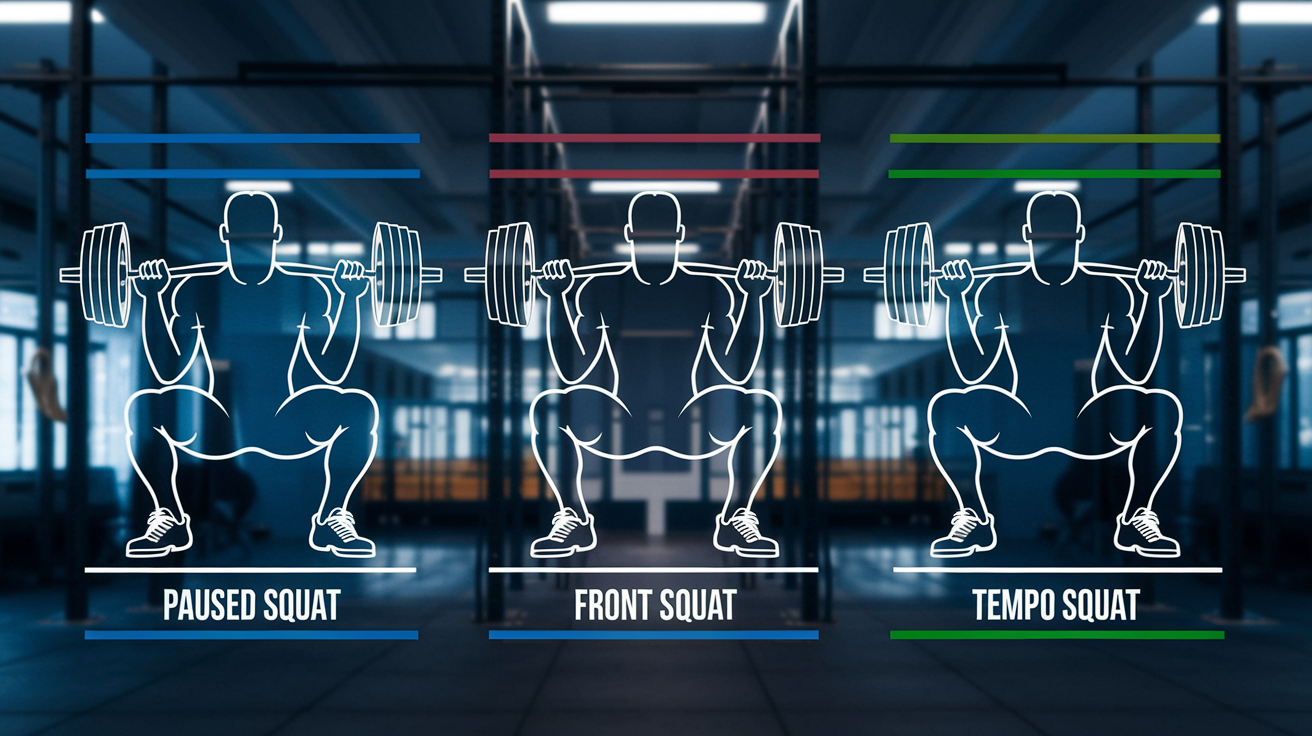
Introducing the right amount of exercise variation prevents your nervous system from fully adapting to one movement pattern while keeping you close enough to your main lifts that strength transfers directly. The key is changing angles, loading tools, or ranges of motion without abandoning the core movement you want to improve. A plateau often signals that your brain has squeezed all the efficiency it can from the exact bar path, grip width, and stance you’ve been using. Swapping to a close grip bench press or a front squat for four to eight weeks gives your body a novel challenge that still trains the same muscle groups and joint actions. When you return to your primary lift, you often find you’re stronger because you’ve eliminated weak points and added coordinative capacity your old pattern couldn’t access.
You don’t want to change exercises so often that you never practice the skills required for heavy lifts. Specificity still matters. If your goal is a bigger back squat, doing only Bulgarian split squats and leg presses won’t get you there, even though they build leg strength. The variation should look and feel similar enough that the carryover is immediate. Think of it as training the same language with a different dialect. Paused squats, tempo deadlifts, and deficit pulls all reinforce the mechanics you need while exposing and fixing the spots where your technique or strength breaks down.
Effective variations for major full body lifts:
- Squat variations Pause squats (two second hold at the bottom to eliminate bounce and build starting strength), box squats (consistency in depth and posterior chain emphasis), front squats (quad and upper back demand with less spinal load), and tempo squats (three to four second eccentrics to improve control and time under tension).
- Hinge variations Romanian deadlifts (hamstring and glute focus with less low back fatigue), deficit deadlifts (increased range of motion to strengthen the pull off the floor), block or rack pulls (partial ROM to overload lockout and upper back strength), and single leg RDLs (unilateral balance and stability work that exposes asymmetries).
- Horizontal push variations Pause bench press (eliminate momentum at the chest and build strength out of the bottom), close grip bench (tricep emphasis and carryover to lockout), incline press (upper chest and front delt development), and floor press (partial range focusing on mid and top portions of the press).
- Vertical push variations Seated overhead press (removes leg drive to isolate shoulders), push press (teaches explosiveness and lets you handle slightly heavier loads), and single arm dumbbell press (unilateral stability and identifies left right imbalances).
- Pull variations Pendlay rows (dead stop each rep for consistent position and explosiveness), chest supported rows (removes lower back fatigue and isolates upper back contraction), weighted pull ups or chin ups (vertical pulling strength and lat development), and single arm dumbbell rows (unilateral work and anti rotation core demand).
- Accessory lifts for weak points Hamstring curls (knee flexion strength for lockout), leg press (quad volume without spinal load), dips (tricep and chest strength for pressing lockout), and face pulls (rear delt and upper back health to support pressing and pulling posture).
Optimizing Recovery, Sleep, and Nutrition for Continued Strength Gains

Sleep affects your bar speed, coordination, and your nervous system’s ability to send strong signals to your muscles. If you’re averaging less than seven hours per night, your reaction time slows, your perceived exertion rises, and your body prioritizes survival over building strength. Even one or two nights of poor sleep can drop your performance measurably. Aim for seven to nine hours consistently, and protect that time by keeping your bedroom cool, dark, and quiet. Turn off screens one to two hours before bed, and try to go to sleep and wake up at the same times every day, even on weekends. Your CNS recovers during deep sleep, and strength adaptations happen when your brain consolidates the motor patterns you practiced in the gym.
Nutrition fundamentals for strength are simpler than most people think. Protein intake around 1.6 to 2.2 grams per kilogram of bodyweight per day (roughly 0.73 to 1.0 grams per pound) gives your muscles the amino acids they need to repair and grow. If you’re significantly below that range, adding one extra high protein meal or snack each day can restart progress within a couple of weeks. Total calorie intake matters just as much. Strength and muscle gains require energy. If you’ve been in a calorie deficit for weeks trying to lose fat, your body won’t prioritize building new tissue or improving force output. Shift to maintenance calories or a slight surplus (250 to 500 calories above your daily burn) until your lifts start moving again. Carbohydrates fuel your training sessions, so eating 20 to 30 grams of carbs one to two hours before lifting and including carbs in your post workout meal keeps performance high and aids recovery.
Chronic fatigue often masquerades as a strength plateau. If you feel run down, your joints ache more than usual, your resting heart rate is elevated, or your motivation to train has tanked, you’re likely overreached. This isn’t a sign to push harder. It’s a signal to back off for one week, let your body catch up, and then resume training with fresh energy. Ignoring fatigue turns a temporary dip into a long term stall or injury.
Immediate recovery upgrades to implement this week:
- Shift your bedtime 30 minutes earlier and track whether your energy and bar speed improve over the next seven to ten days.
- Add one recovery day per week where you do light movement, stretching, or mobility work instead of another hard training session, especially if you’re currently training five or more days.
- Drink at least 30 to 35 milliliters of water per kilogram of bodyweight daily (roughly half your bodyweight in ounces if you’re in the U.S.), and add electrolytes if you sweat heavily during sessions.
- Plan a deload week every four to eight weeks by reducing your total volume by 40 to 60 percent or dropping intensity by 10 to 20 percent while maintaining your usual training frequency and exercise selection.
- Increase your daily protein by 20 to 40 grams if you’re currently below 1.6 grams per kilogram, using an extra serving of meat, fish, eggs, Greek yogurt, or a protein shake to hit your target consistently.
Troubleshooting Stubborn Plateaus and Long-Term Maintenance

Some plateaus persist even after you’ve adjusted volume, intensity, periodization, and recovery. When standard fixes don’t work, the problem often hides in technique drift or neurological fatigue that a simple deload won’t clear. Technique drift happens when small compensations creep into your lifts over weeks or months. Your squat depth shortens by an inch, your bench bar path drifts forward, or your deadlift setup becomes inconsistent. These changes feel normal because they happen gradually, but they cost you leverage and force production. Record your working sets on video from multiple angles and compare them to footage from two or three months ago. Look for shifts in joint angles, bar paths, and timing. If you spot differences, spend two to four weeks drilling corrective cues at 60 to 75 percent of your max before pushing heavy again. Bar speed tracking with a device or app can also reveal whether your velocity at a given percentage has dropped, signaling that your nervous system is fatigued even if the weight feels manageable. If your speed at 80 percent one rep max has slowed by 10 percent or more compared to a month ago, take an extended deload of seven to ten days with very light loads and prioritize sleep and nutrition.
Some lifters need longer recovery blocks between intense phases than others. If you’ve followed a structured program for twelve weeks, hit a new peak, and then immediately jumped into another high intensity cycle, your CNS may not have recharged. Consider taking a full week of active recovery (movement, stretching, and light conditioning) before starting your next training block. You can also rotate between strength focused and hypertrophy focused mesocycles every eight to twelve weeks to give your joints and nervous system a break from max effort loading while still building muscle that will support future strength gains.
Long term progression depends on tracking more than just the weight on the bar. Log your sets, reps, load, and RPE (rate of perceived exertion) for every working set. Add notes about sleep quality, stress levels, and how the session felt overall. Over months, patterns emerge. You’ll see which volume ranges work best for you, how often you need deloads, and which exercises or rep schemes produce the most consistent gains. That data turns training from guesswork into a repeatable process. When you hit your next plateau (and you will, because progress isn’t linear forever), you’ll have a clear record of what worked before and a system for diagnosing what needs to change now.
Final Words
Start by diagnosing the stall: is it mechanical adaptation, poor recovery, or a programming mismatch? That tells you what to change first.
Then reintroduce progressive overload with micro‑increases, tweak volume and intensity, or pick a periodization model. Add targeted exercise variations, lock down sleep and protein, and schedule planned deloads. If it still sticks, track technique and bar speed and consider a longer break.
Follow these steps and keep testing what works. With steady changes like this you’ll know how to break through a plateau in full body strength training and keep getting stronger.
FAQ
Q: How to get out of a plateau in weight lifting? / How to trick your body out of a plateau?
A: Getting out of a weight-lifting plateau or tricking your body means adding a new stimulus: try micro-load increases, change reps/tempo, swap accessory lifts, cycle volume, take a planned deload, and improve sleep and protein.
Q: What is the 3-3-3 rule at the gym?
A: The 3-3-3 rule at the gym is a simple strength template: three sets of three reps, used to lift heavier with focused form and bar speed while keeping volume low for strength gains.
Q: What is the 5-3-1 rule in gym?
A: The 5-3-1 rule in the gym is a four-week strength cycle: build to heavy top sets of 5 reps, then 3 reps, then 1 rep across weeks, using percentage-based loads and targeted accessory work.