


Think you can’t build muscle after 40?
You can if you train smart.
Muscle loss isn’t inevitable. Progressive resistance, good technique, and proper recovery flip the script.
Training after 40 boosts bone density, improves blood sugar control, and helps you move with less pain.
This post gives a clear, practical plan you can actually follow: safe beginner, intermediate, and advanced programs, warm-ups and mobility, recovery rules, and simple equipment options.
Read on for a step-by-step way to get stronger without overdoing it.
Can You Build Strength After 40? (Short Answer: Yes)

You can absolutely get stronger after 40. Muscle loss usually starts around your mid-30s and picks up speed if you don’t do anything about it, but resistance training flips that around. Studies from 2010 through 2018 back this up: older adults who train consistently with progressive resistance get stronger, build muscle, and improve how their bodies function. The question isn’t whether you can do it. It’s how you do it.
Strength training after 40 does more than make you look better. It increases bone density, which matters when you’re trying to avoid osteoporosis and fractures down the road. It helps your body manage blood sugar better, cuts body fat more effectively than cardio by itself, and restores joint stability that might’ve worn down from years of sitting or not moving much. People in their 40s, 50s, 60s, and older who train regularly say they move better, have more energy, and feel more confident.
Safety becomes more important as your body’s recovery changes. Start with lighter loads, nail down proper movement, and give yourself enough rest between sessions. That reduces injury risk and sets you up for long-term progress. If you’ve got joint issues, heart concerns, or a history of injuries, ease into things and check with your doctor if you need to. Pain during training isn’t something to push through.
Five Core Principles of Training Over 40:
- Progressive overload: gradually add weight, reps, or difficulty over time
- Technique focus: prioritize movement quality and control over heavy weight
- Balanced programming: train all major movement patterns with appropriate volume
- Recovery prioritization: schedule rest days, sleep 7 to 9 hours, and manage stress
- Consistency: train 2 to 4 times per week on a sustainable schedule
Practical Strength Training Framework for Ages 40+
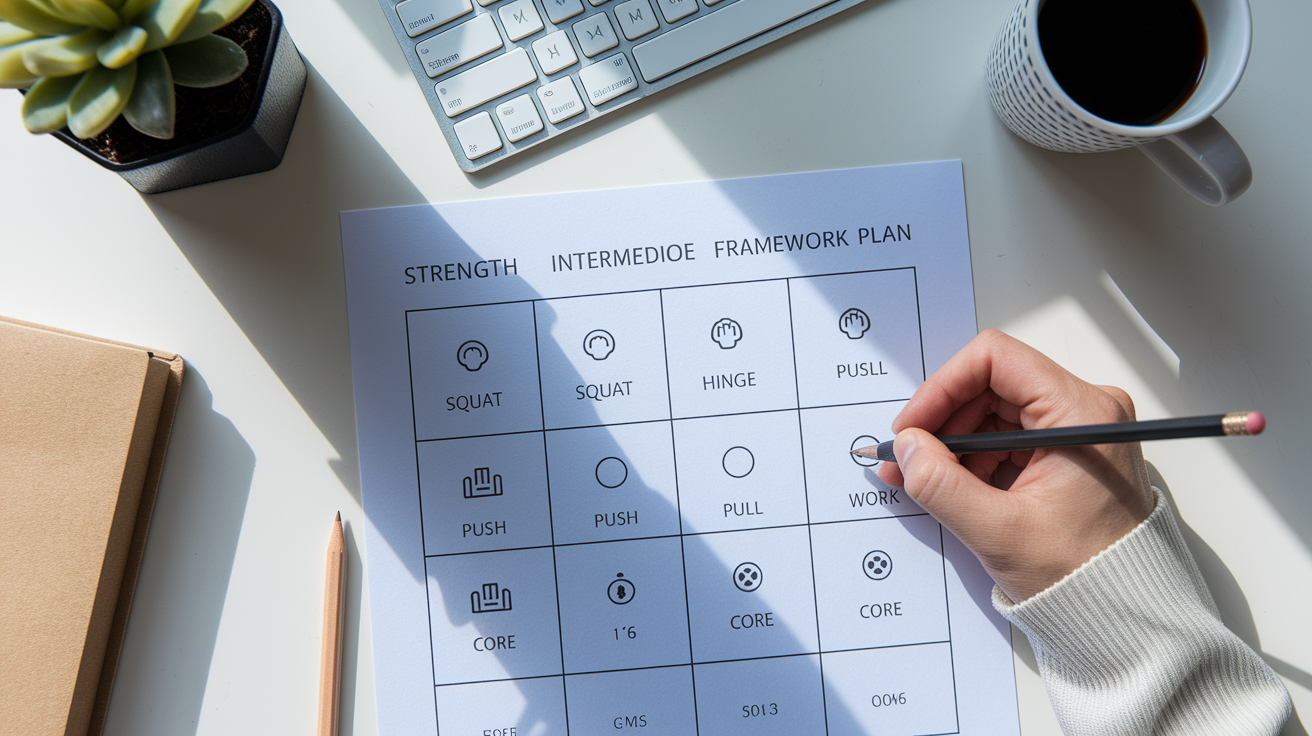
You need structure. A clear plan keeps you from bouncing around between random workouts that lead to burnout or injury. Adults over 40 do well with simple weekly schedules that balance effort with recovery and let you track progress. Whether you’re just starting or returning after time off, the framework below will walk you through beginner, intermediate, and advanced phases.
Beginner Program
If you’re new to lifting or haven’t trained consistently in years, start with two to three full-body sessions each week. Each session should hit four to five compound movements: a squat or leg press, a hinge like a Romanian deadlift, a horizontal push like a dumbbell chest press, a horizontal pull like a cable row, and a core stability exercise. Use two sets of 8 to 12 reps per exercise. Rest 90 seconds between sets.
Learn the form before you pile on weight. Weeks 1 through 4 should feel manageable. Easy, even. In weeks 5 through 8, bump up to three sets per exercise and add 2.5 to 5 pounds on upper-body lifts or 5 to 10 pounds on lower-body lifts when you can complete all reps with control. Track every session in a notebook or app so you know when to move forward.
Intermediate Program
Once you’ve trained consistently for eight to twelve weeks and feel solid with basic movements, switch to an upper/lower split three times per week. On upper days, include a horizontal push, a vertical push like a dumbbell shoulder press, a horizontal pull, a vertical pull like a lat pulldown, and an accessory like bicep curls. On lower days, include a squat variation, a hinge variation, a unilateral movement like split squats, and a loaded carry or core exercise.
Use three sets of 6 to 12 reps for most exercises, working at about a 7 or 8 out of 10 effort. Add one heavier, lower-rep set (3 to 6 reps) to one or two compound lifts every 7 to 10 days to build pure strength. Increase weight in small increments and rotate exercise variations every 4 to 6 weeks to reduce joint stress and prevent overuse.
Advanced Program
Advanced trainees over 40 often train four times per week using a push/pull/legs split or an upper/lower split with higher volume. Sessions may include four to six exercises with three to four sets each. You’ll use periodization, which means cycling through phases that emphasize volume, intensity, or recovery. Accumulation phases (higher reps, moderate weight) should outnumber intensification phases (lower reps, heavier weight) by a ratio of 2:1 or 3:1 to protect your joints and keep recovery manageable.
Advanced programming also includes tempo work (slow eccentrics, pauses), time under tension strategies, and deliberate exercise variation to manage spinal loading. If you squat or deadlift twice in a training week, load the barbell heavy only once. Use machines, unilateral movements, or lighter implements on the second day. Schedule a deload week every 4 to 8 weeks by cutting volume by 40 to 60 percent or intensity by 10 to 20 percent.
| Program Level | Weekly Frequency | Focus |
|---|---|---|
| Beginner | 2 to 3 sessions | Full-body, learning movement patterns, building work capacity |
| Intermediate | 3 sessions | Upper/lower split, progressive overload, exercise variation |
| Advanced | 4 sessions | Push/pull/legs or upper/lower, periodization, tempo and TUT |
| Active Recovery | 1 to 2 sessions | Light mobility, walking, swimming, low-impact movement |
| Deload Week | 2 to 3 sessions | Reduced volume or intensity, recovery emphasis |
| Hybrid Athlete | 4 to 5 sessions | Strength plus conditioning blend, cardiovascular capacity |
Mobility, Warm-Ups, and Joint Preparation for Adults Over 40

Joint stiffness, reduced range of motion, and minor aches show up more often after 40. That means warm-ups go from optional to essential. A proper warm-up lubricates your joints, activates stabilizer muscles, and primes your nervous system for the work ahead. Skip it and you’re asking for injury and limiting how much quality work you can do.
Dynamic mobility work beats static stretching before lifting. Spend 5 to 10 minutes on light cardio (walking, cycling, or rowing) to raise your heart rate and body temperature. Then move through dynamic stretches and joint rotations that mirror the movements you’re about to load. If you’re squatting, include bodyweight squats, hip circles, and leg swings. If you’re pressing, include arm circles, band pull-aparts, and light push-ups.
Essential Components of an Over-40 Warm-Up:
- Light cardio for 5 to 10 minutes to increase blood flow and body temperature
- Joint rotations (hips, shoulders, ankles, thoracic spine) to improve movement range
- Dynamic stretches like leg swings, walking lunges, and arm circles
- Activation drills (glute bridges, band walks, scapular slides) to wake up stabilizers
- Movement-specific priming with 1 to 2 light sets at 30 to 50 percent of your working weight
- Controlled breathing to reduce tension and improve focus before heavier sets
Pair your warm-up with short daily mobility sessions on non-training days to maintain hip, shoulder, and thoracic spine health over the long term. Five to ten minutes of targeted stretching, foam rolling, or joint-focused movement keeps you moving better and cuts down on the nagging stiffness that can wreck consistency. Think of mobility work as insurance.
Recovery, Hormonal Factors, and Injury Prevention Over 40

Recovery gets harder as you age because hormonal shifts affect how quickly your body repairs muscle and manages stress. Testosterone and growth hormone levels gradually drop starting in your late 30s. That affects muscle protein synthesis, fat distribution, and energy availability. Women face more dramatic hormonal changes during menopause, which can mess with sleep quality, recovery capacity, and stress tolerance. Both sexes benefit from training that respects these realities.
Sleep is the most powerful recovery tool you’ve got. Aim for 7 to 9 hours per night, and protect that time like you protect your training sessions. Poor sleep throws off cortisol patterns, reduces muscle repair, and increases injury risk. Schedule deload weeks every 4 to 8 weeks to give your joints and nervous system a break. Active recovery days with light walking, swimming, or mobility work keep you moving without piling on training stress. Nutrition also matters. Aim for 1.6 to 2.2 grams of protein per kilogram of bodyweight per day, spread across three to four meals.
Injury prevention starts with load management and exercise selection. Limit how often you load your spine heavily with barbell squats or deadlifts. If you train legs twice per week, use the barbell on one day and swap in leg presses, step-ups, or sled pushes on the other. Use tempo control, isometric holds, and unilateral exercises to build joint stability and address weak stabilizers before increasing weight. Stop immediately if you feel sharp joint pain, prolonged swelling, dizziness, or palpitations during training. Seek professional evaluation.
Weekly Recovery Checklist for Adults Over 40:
- Log sleep hours and aim for 7 to 9 hours per night
- Schedule at least one full rest day with no structured training
- Include light movement (walking, stretching) on non-training days
- Hit protein targets across three to four meals daily
- Plan a deload week every 4 to 8 weeks to reduce cumulative fatigue
Essential Strength Training Equipment and Safe Progressions for Ages 40+

You don’t need a full commercial gym to train effectively after 40. Adjustable dumbbells, resistance bands, and a single kettlebell can cover most movement patterns and let you add load gradually without requiring big jumps in weight. Dumbbells are joint-friendly because they let you move naturally and train each arm or leg independently, which helps address strength imbalances. Resistance bands add variable tension and work well for warm-ups, accessory exercises, and travel. A simple flat bench opens up a lot more exercise options.
If you’ve got access to a gym, machines can help manage joint stress while still giving you progressive overload. Leg presses, chest-supported rows, and cable stations let you train hard without the balance and stabilization demands of free weights. That’s especially useful if you’re dealing with arthritis, past injuries, or fatigue that makes barbell work riskier on a given day. Machines also let you isolate muscle groups safely during accessory work.
Six Safe Progression Methods for Trainees Over 40:
- Incremental weight increases: add 2.5 to 5 pounds (upper body) or 5 to 10 pounds (lower body) when you hit target reps
- Range-of-motion expansions: progress from box squats to full squats as mobility improves
- Tempo changes: slow down the eccentric (lowering) phase or add pauses to increase difficulty
- Rep additions: add one rep per set each week until you reach the top of your target range
- Set additions: increase from two sets to three, or three to four, before adding weight
- Exercise variations: rotate grip, stance, or equipment every 4 to 6 weeks to reduce overuse
Equipment selection and progression strategy should support long-term consistency, not short-term ego. Start with tools that match your current mobility and strength level. Upgrade only when your training demands it. A home setup with adjustable dumbbells (typically $40 to $300 depending on range), a bench ($70 to $250), and bands ($10 to $40) is enough for years of progress if you apply the progression principles above. Track your lifts, add load or reps gradually, and trust that small, steady changes compound into real strength over months and years.
Final Words
Start with a simple plan: full‑body sessions, solid warm‑ups, and slow, steady loading. Do the basics well and track small wins.
This article showed that strength gains after 40 are real, why mobility and recovery matter, and how to pick equipment and progress safely. Use progressive overload, prioritize technique, balance your program, rest, and stay consistent.
Over 40 strength training works when you pair sensible programming with recovery. Keep going — small steps add up, and you’ll keep getting stronger.
FAQ
Q: How often should a 40 year old lift weights?
A: A 40-year-old should lift weights 2–4 times per week, using full-body or split sessions, prioritizing progressive overload, good form, and extra recovery between harder workouts.
Q: What is the 3-3-3 rule at the gym?
A: The 3-3-3 rule at the gym is a simple beginner strength template: three sets of three reps on core lifts, repeated across sessions to build strength and technique before adding load.
Q: Can you lift weights with osteoporosis?
A: You can lift weights with osteoporosis, but get medical clearance, use controlled resistance, avoid high-impact moves, and focus on balance and bone-building loads with a coach or therapist.
Q: Can I lift weights while taking Zepbound?
A: You can lift weights while taking Zepbound, but check with your prescriber, expect appetite or energy shifts, start gradually, and monitor hydration, protein intake, and recovery.