


What if slowing down your lifts builds more muscle and keeps your joints safer than blasting through fast reps?
Slow strength training stretches each rep to about 3–5 seconds or longer, forcing the muscle to handle the full load and increasing time under tension.
Think of it like driving in low gear: more control, less momentum, and workouts that are short but actually hard.
This post shows why controlled tempos grow size and strength with less injury risk, and gives simple tempos and short routines you can use right away.
Core Principles Behind Slow Strength Training Techniques
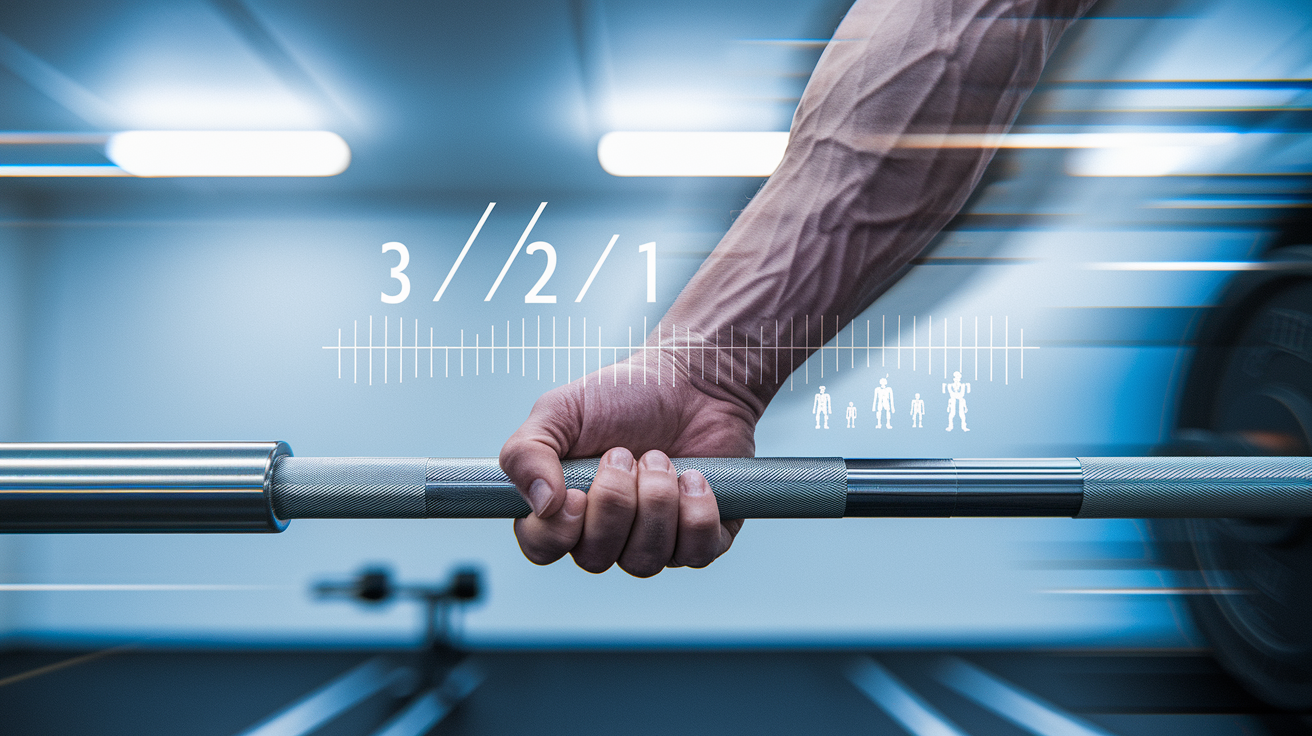
Slow strength training slows down both phases of each rep, usually to 3–5 seconds or longer. That controlled pace keeps your muscles tensed longer. We call this time under tension (TUT). The more time your muscle spends under load, the more fibers you recruit across the full range. Think of it this way: rushing through a rep lets momentum help you out. Slowing down makes the muscle handle everything from start to finish.
The technique isn’t about moving slowly just because. It’s built on two ideas: intensity beats duration, and clean execution makes training safer and more effective. When you lift at a controlled tempo, you strip away momentum and the weird compensation patterns that sneak in during fast reps. Your brain and muscles learn what the movement should actually feel like, which cuts down the chance of tweaking a joint or straining a ligament. You can also hit momentary muscle failure (the point where you can’t complete another controlled rep) with lighter loads than you’d need for explosive work. Less wear on connective tissue, strong growth stimulus.
A typical slow strength program looks stripped down compared to traditional gym routines. Sessions run around 20 minutes, twice per week, training all major muscle groups with 5–8 exercises and minimal rest between sets. Sounds short, but that’s the point. When intensity is high enough, total training time can drop without losing results. Simple recoverability principle: you don’t need hours in the gym if every minute is working hard.
The main benefits break down like this:
- Hypertrophy – Prolonged tension triggers muscle protein synthesis, the process that builds new tissue.
- Strength gains – Controlled reps recruit more motor units across the movement, improving force output over time.
- Joint safety – Slower speeds reduce impact forces and minimize strain on ligaments, tendons, and cartilage.
- Metabolic stress – Keeping the muscle under continuous load creates an environment that supports growth.
- Improved form – Deliberate pace gives you time to monitor position, breathing, and alignment on every inch of the rep.
Scientific Foundations of Slow Strength Training Tempos

Research on rep tempo shows hypertrophy can happen across a wide spectrum of speeds, anywhere from 0.5 to 8 seconds per rep, as long as you push sets close to failure. That range is broader than most people expect. What matters most is total tension and effort, not any single “magic” cadence. What does change with tempo is how much tension you accumulate in a given set and how thoroughly you fatigue the muscle. For hypertrophy, the sweet spot tends to land between 40 and 70 seconds of total time under tension per set. A slower tempo makes it easier to stay in that zone without needing extremely high reps.
When you’re chasing pure strength, the numbers shift. Strength sets usually live in the 1–5 rep range with 2–5 seconds of tension per rep, giving you a total set TUT of 2–20 seconds. The load is heavy, so the reps naturally slow down under the weight. Eccentric phases deserve special attention here. Lowering the weight slowly (often 2–4 seconds) produces high muscle tension with less joint stress than the concentric lift. Research consistently shows eccentric training drives both strength and size gains. Think of the eccentric as a controlled stretch that your muscle resists the whole way down.
| Tempo Style | Intended Adaptation | Typical TUT | Notes |
|---|---|---|---|
| Super-Slow (10+ seconds per rep) | Hypertrophy, motor control | 60–90+ seconds per set | Very high metabolic demand; often uses lighter loads |
| Moderate Slow (3–5 sec eccentric, 2–3 sec concentric) | Balanced hypertrophy and strength | 40–70 seconds per set | Most common approach for general training |
| Controlled Standard (2–3 sec each phase) | Hypertrophy, form practice | 30–50 seconds per set | Good default for beginners and intermediate lifters |
| Strength Focus (2–5 sec per rep, low reps) | Maximal strength, neural adaptation | 2–20 seconds per set | Heavy loads; tempo often dictated by the weight itself |
Practical Tempo Guidelines for Slow Strength Training

Tempo notation uses a simple four-digit code that tells you exactly how many seconds to spend in each phase: eccentric / bottom pause / concentric / top pause. A 3/1/2/1 tempo means you lower for 3 seconds, hold at the bottom for 1 second, lift for 2 seconds, and hold at the top for 1 second. The notation gives you a roadmap so you’re not guessing mid-set. If you see 2/0/2/0, that means 2 seconds down, no pause, 2 seconds up, no pause at the top. A clean, continuous rep.
Beginners often start with something like 3/1/2/1 or 4/2/3/1 to build motor control and nail down the movement pattern. Those extra pauses at the top and bottom give you a moment to check your position and reset your breath. As you get comfortable, you can dial the tempo to match your goal. Hypertrophy programs often use 2/0/2/0 or lengthen the eccentric to 4 or 5 seconds to pack more TUT into the set. Strength training might cut the pauses and focus on a controlled 2-second eccentric followed by an intentional concentric drive.
Here’s how to set and maintain your cadence:
- Pick your tempo notation based on your goal (strength, hypertrophy, or learning the movement).
- Count silently or out loud during the first few reps until the rhythm feels natural. “One-one-thousand, two-one-thousand” works fine.
- Use a simple cue word to mark each phase: “down” for eccentric, “hold” for the pause, “up” for concentric, “squeeze” for the top if you’re pausing there.
- Watch a clock or use a timer for the first couple of workouts so you learn what 3 seconds actually feels like under load. It’s usually longer than you think.
- Adjust the load so you can complete the target reps at your chosen tempo without breaking form or rushing the last few reps.
Comparing Slow Strength Training With Traditional Lifting Speeds

Traditional training tends to move faster, especially on the concentric phase. You’ll see lifters explode through the lift in under a second and then lower the weight in a quick 1–2 seconds. That approach works well for power development and allows heavier loads, but it also brings more momentum into play. Momentum takes tension off the muscle at certain points in the range, which means some of the work gets handled by elastic rebound in tendons and the stored energy from the stretch reflex. Slow training deliberately eliminates that rebound, forcing the muscle to handle the entire load continuously.
The injury-risk profile shifts, too. Fast reps with heavy weights place high peak forces on joints and connective tissue in fractions of a second. Slow reps spread that force across a longer time window, which generally reduces stress on ligaments and cartilage. If you’ve had joint issues or you’re coming back from an injury, the controlled pace gives you a safer entry point while still challenging the muscle. You’re not sacrificing strength or size potential. You’re just choosing a different stimulus pathway.
Efficiency is another angle. Traditional routines often include built-in rest during the workout: the pause to rack a barbell, the walk between machines, the chat between sets. Slow training condenses the work into short, focused sessions because every second of every set is deliberate tension. A 20-minute slow-strength session with minimal rest can deliver a similar or greater training stimulus than a 60-minute traditional workout with longer breaks and lighter effort per set. That doesn’t mean one is always better. It means you match the method to your schedule, recovery capacity, and goals.
Slow Strength Training Workouts and Sample Routine Structures
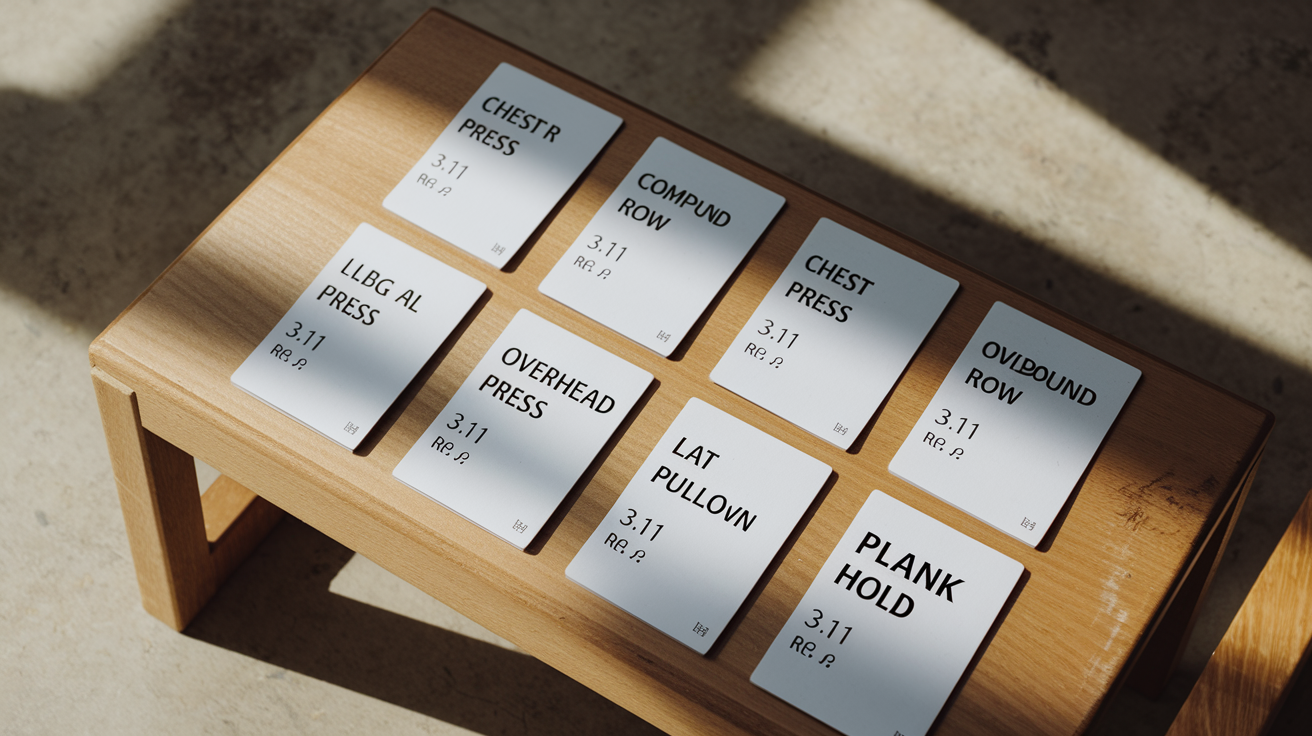
Most slow strength programs cluster around 5–8 exercises per session, hitting every major muscle group with minimal rest in between. The short rest periods keep your heart rate elevated and maintain metabolic stress while your muscles recover just enough to complete the next set. Sessions typically run 20 minutes, twice per week, which gives you plenty of recovery time between workouts. That frequency works because the intensity is high. You’re pushing toward momentary muscle failure on each set, so your body needs time to repair and adapt.
For hypertrophy, shoot for 3–4 sets of 8–12 reps with 40–70 seconds of total time under tension per set. A 2/0/2/0 tempo on 10 reps gives you 40 seconds, right at the lower end. If you want more TUT without adding reps, slow the eccentric to 4 seconds (4/0/2/0) and now those same 10 reps deliver 60 seconds. Strength-focused routines flip the script: 3–5 sets of 1–5 reps with heavy loads, keeping total TUT per set between 2 and 20 seconds. The tempo often settles around 3/1/2/0 because the weight itself forces a controlled pace.
Example Slow-Strength Full-Body Routine
This twice-weekly routine uses 6 exercises, 3 sets each, with a 3/1/2/1 tempo for balanced TUT and form reinforcement. Rest 30–60 seconds between sets, just enough to catch your breath and reset.
- Leg Press – 3 sets of 10 reps at 3/1/2/1 (approximately 70 seconds TUT per set). You should feel this in your quads, glutes, and hamstrings, not your low back.
- Chest Press (machine or dumbbell) – 3 sets of 10 reps at 3/1/2/1. Keep your shoulder blades pulled back and down the entire time.
- Compound Row (cable or machine) – 3 sets of 10 reps at 3/1/2/1. Pull to your lower ribs, not your neck, and squeeze your shoulder blades together at the end.
- Overhead Press (dumbbell or machine) – 3 sets of 8 reps at 3/1/2/1. Brace your core like you’re about to take a light punch to the stomach.
- Lat Pulldown – 3 sets of 10 reps at 3/1/2/1. Focus on pulling with your back, not just your arms.
- Plank Hold – 3 sets of 30–45 seconds (isometric). This isn’t tempo-based, but it complements the other movements by building core endurance.
Start with a weight that lets you complete all reps at the target tempo. When you can finish all 3 sets with clean form, add 5–10 pounds the next session.
Slow Strength Training for Beginners and At‑Home Trainees

If you’re new to resistance training, slow tempos give you time to learn the movement without rushing into bad habits. Start light. Lighter than you think you need. Your goal in the first few weeks is to own the pattern: feel which muscles are working, notice where your joints are in space, and breathe steadily through every rep. A beginner-friendly tempo like 4/2/3/1 adds pauses that let you check your setup and reset between phases. Those extra seconds also fatigue the muscle thoroughly, so even a light dumbbell or resistance band can feel challenging by the end of a set.
At-home training works well for slow strength because you don’t need a gym full of machines. Dumbbells, resistance bands, or even bodyweight movements deliver plenty of stimulus when you control the tempo. A slow push-up at 4/1/3/0 is harder than ten fast ones, and a bodyweight squat at 3/1/2/1 will light up your legs without any added load. The key is matching the resistance to your current strength so you hit that 8–12 rep range with good form. If bodyweight feels too easy, add a pause at the bottom or hold a dumbbell.
Here are five beginner-friendly exercises that translate well to slow training at home:
Goblet Squat – Hold a single dumbbell at your chest; lower for 4 seconds, pause 2 seconds at the bottom, stand in 3 seconds.
Dumbbell Chest Press (floor or bench) – 3/1/2/1 tempo; keep your wrists stacked over your elbows.
Resistance Band Row – Anchor the band at chest height, pull to your ribs, 3/1/2/1.
Dumbbell Shoulder Press (seated or standing) – 3/1/2/1; press straight overhead without arching your low back.
Bodyweight Glute Bridge – 3-second lift, 2-second hold at the top, 3-second lower; add a dumbbell on your hips when bodyweight gets easy.
Advanced Slow Strength Training Protocols and Intensification Methods
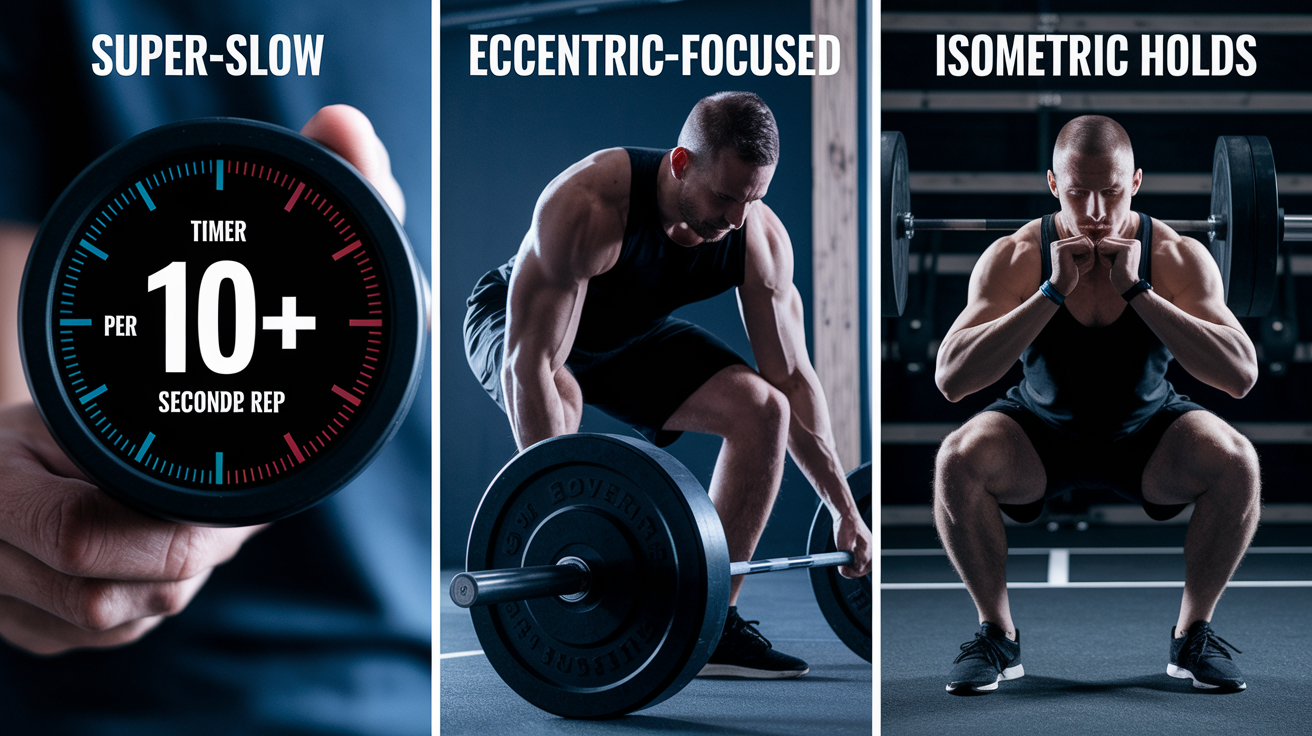
Once you’ve built a solid base of control and strength, super-slow protocols push the intensity higher. Super-slow reps last 10 seconds or more, sometimes 10 seconds up and 10 seconds down, which creates extreme metabolic demand and keeps the muscle under continuous tension for well over a minute per set. You’ll use lighter loads than normal, but the burn and fatigue arrive fast. This method works especially well for hypertrophy and muscular endurance, and it’s a useful variation when you want to challenge your muscles without loading heavy weight onto a recovering joint.
Eccentric-focused sets are another advanced tool. You can use a slightly heavier load than you’d normally handle for a full rep, then take 5–8 seconds to lower the weight while a spotter or machine helps you through the concentric phase. Eccentric training produces high tension with less cardiovascular demand, and it’s particularly effective for building strength in the lengthened position of a muscle. Just know that eccentric work creates more muscle damage, so recovery becomes even more important. Limit eccentric-only sessions to once per week and give yourself extra rest days.
Isometric holds add another layer. After finishing your normal reps, hold the weight at the midpoint or bottom of the range for 10–20 seconds. Finish a set of slow squats, then hold the bottom position for 15 seconds before standing up. That final hold recruits any remaining motor units and teaches your muscles to produce force in a static position, which carries over to real-world tasks like holding a heavy box or stabilizing during a hike. Combine isometrics with your standard slow tempo for a finishing burn that feels harder than it looks.
Recovery, Safety, and Injury Prevention in Slow Strength Training

Slow training is low-impact by design, which makes it a smart choice if you’re managing an old injury or joint sensitivity. The controlled pace eliminates the jarring forces that come with explosive movements, and the emphasis on perfect form keeps the load traveling through the intended muscles instead of dumping stress onto ligaments and tendons. You still need to warm up. Spend 5 minutes on light cardio or dynamic stretches to raise your core temperature and prep your joints. But once you’re moving, the risk of a sudden tweak or strain drops significantly.
Breathing is part of the safety equation. When you hold your breath under tension, your blood pressure spikes and you lose trunk stability. Breathe out during the hard part (usually the concentric phase) and breathe in during the easier part (usually the eccentric). Keep it steady and rhythmic. If you find yourself gasping or holding your breath, the load is probably too heavy or the tempo too aggressive for your current conditioning. Drop the weight or shorten the eccentric phase until your breathing stays controlled.
Recovery after slow sessions is straightforward: give your muscles at least 48 hours before training the same movement pattern again. The twice-weekly structure built into many slow-strength programs handles this automatically. More is not better when intensity is high. If you try to add extra sessions or pile on more sets, you’ll dig into recovery capacity without gaining extra results. Your muscles grow during rest, not during the workout.
Common mistakes to avoid:
Letting tempo drift faster as the set gets hard – Count every rep, even the last ones. If you can’t hold the tempo, the set is over.
Using too much weight – Ego doesn’t build muscle; controlled tension does. Start lighter than you think you need.
Skipping the eccentric – Lowering the weight slowly is half the stimulus. Don’t drop or release the load.
Holding your breath – Breathe consistently throughout the entire set to maintain stability and manage blood pressure.
Monitoring Progress and Long-Term Programming With Slow Strength Training

Progress in slow training shows up in three main ways: you complete more reps at the same tempo, you handle more weight at the same tempo, or your form looks cleaner and more controlled at a given load. All three are valid signs of adaptation. Track your workouts in a simple notebook or app: write down the exercise, weight, tempo, sets, and reps. When you can hit the top of your rep range with solid form, add 5 pounds (for upper body) or 10 pounds (for lower body) the next session. That’s progressive overload in action.
Effort toward momentary muscle failure is another key marker. If your last rep at the target tempo feels impossible to complete with good form, you’ve hit the right intensity. If you could easily do two or three more reps, the load is too light or the tempo too fast. Your training log should reflect that: note when a set felt maximal versus when it felt comfortable, and adjust accordingly. Over weeks and months, you’ll see the weights climb and the perceived effort stabilize, which tells you your strength and work capacity are improving.
| Monitoring Method | What to Track | How Often to Assess |
|---|---|---|
| Time Under Tension (TUT) Tracking | Total seconds per set; compare week to week at the same load | Every session |
| Load Increases | Weight used for each exercise; note when you add 5–10 pounds | Every 1–2 weeks |
| Rep-Quality Scoring | Subjective 1–5 scale: 5 = perfect form, 1 = breaking down | Every session |
Long-term programming with slow strength means cycling through different tempos and TUT zones every 4–8 weeks to keep the stimulus fresh. You might spend a month at 3/1/2/1 for 8–12 reps, then switch to 4/2/2/0 for 6–8 reps with slightly heavier weight, then try a super-slow block at 10/0/10/0 for 4–6 reps. Each phase challenges your muscles in a new way while maintaining the core principle of controlled, deliberate movement. As long as you’re tracking, progressing, and recovering, you’ll continue to build strength and muscle year after year.
Final Words
You learned the core ideas: slow reps, longer time under tension, safer joints, and practical tempos to use today. We gave simple session templates, beginner options, and ways to track progress.
Start small, focus on clean reps, and treat tempo like a tool, not a rule you punish yourself with. Keep sessions short and consistent.
Slow strength training rewards patience and steady progression. Stick with it, track one metric each week, and you’ll see measurable gains.
FAQ
Q: What is the 3 3 3 rule for exercise?
A: The 3-3-3 rule for exercise usually means either 3 sets of 3 reps across 3 sessions for basic strength, or a 3s eccentric/3s pause/3s concentric tempo in slow lifting—context decides.
Q: What is the 3 3 3 rule of lifting?
A: The 3-3-3 rule of lifting commonly refers to a simple strength template: three sets of three reps for each lift, often spread across your weekly sessions to build raw strength safely.
Q: Can I lift weights while taking Zepbound?
A: You can often lift weights while taking Zepbound, but check with your prescriber first; start lighter, monitor energy, stay hydrated, and watch for dizziness or blood-sugar changes if relevant.
Q: Is slow strength training effective?
A: Slow strength training is effective: it raises time under tension, improves muscle recruitment and form, reduces joint stress, and can produce meaningful gains with short, twice-weekly sessions.