


Think you need a fancy gym or hours a day to get stronger?
This 4-week progressive dumbbell strength plan for beginners proves you don’t.
You’ll train 3 to 4 days a week with full-body sessions that take 35 to 60 minutes and get slightly harder each week.
Week 1 builds technique and confidence; Weeks 2–3 add volume and load; Week 4 focuses on heavier sets for strength.
Do the work, track the numbers, rest well, and you’ll finish noticeably stronger with a simple plan you can repeat.
Full 4-Week Dumbbell Strength Plan Overview
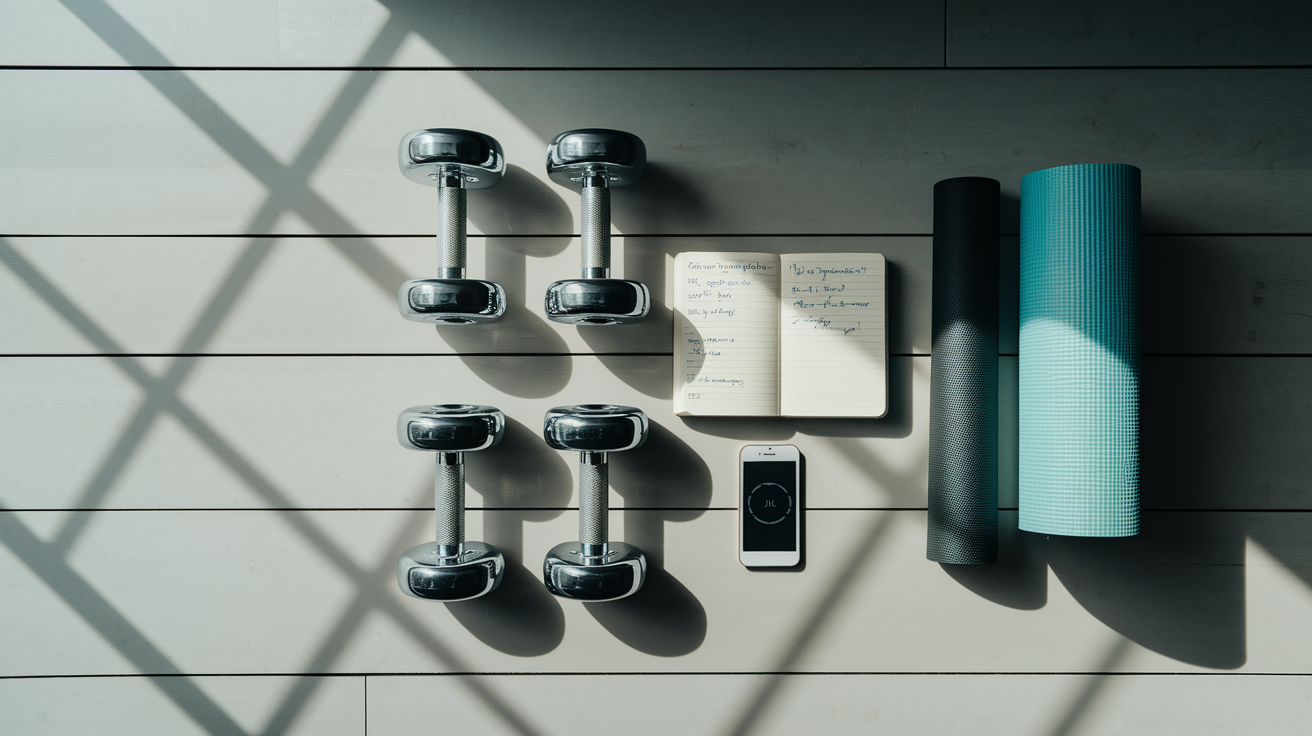
This plan’s built for beginners who want to get stronger using just dumbbells over 4 weeks. You’ll train 3 to 4 days each week with full-body sessions that get harder as you go. Each workout runs 35 to 60 minutes once you include warm-up and cool-down. All you need is a pair of adjustable dumbbells and maybe a bench or sturdy chair.
The whole thing runs on progressive overload. That just means you’ll gradually crank up the challenge each week. Week 1 is about learning how things move and building some confidence. Weeks 2 and 3 bump up reps, sets, or weight by small amounts. Week 4 pushes you into heavier loads for 6 to 8 reps on the big lifts. After 4 weeks, you should feel noticeably stronger, move cleaner, and have a solid baseline for whatever comes next.
Results come down to showing up, using good form, and recovering properly. You can expect better movement quality, some muscle gain, and improved strength endurance. Track every session so you can see the numbers climb and tweak things when you need to.
| Week | Focus | Sessions/Week | Key Exercises | Progression Method |
|---|---|---|---|---|
| 1 | Foundation and technique | 3 | Goblet squat, floor press, one-arm row, RDL, plank | 2–3 sets × 8–12 reps; practice form |
| 2 | Volume build | 3–4 | Same movements; added accessory set or reps | 3 sets × 10–15 reps or +5% load |
| 3 | Load increase | 3–4 | Bulgarian split squat, overhead press, bent-over row, RDL, side plank | 3–4 sets × 6–12 reps; +5–10% load |
| 4 | Strength emphasis | 3–4 | Core lifts at heavier loads; maintain accessory volume | 4 sets × 6–8 reps compound; rest 90–120 sec |
Exercise Technique and Form Cues

Good form keeps you safe and makes every rep actually count. Start lighter while you’re learning each movement. You can always add weight later, but you can’t undo an injury.
Neutral spine means keeping your back in its natural curve, not overly arched or rounded. Brace your core like someone’s about to poke you in the stomach. Firm, not rigid. Keep your shoulders down and back, especially when you’re pressing or rowing. Breathe out as you push or pull against the weight, breathe in on the easier part. Control the weight on the way down instead of just letting gravity take over.
Form reminders that apply to pretty much everything:
Grip: hold the dumbbells firmly without choking them. Wrists stay neutral, not bent backward or forward.
Stance: feet about shoulder width or a bit wider. Knees track over your toes, don’t let them cave inward.
Range of motion: move through whatever range feels pain-free. Don’t force depth if it hurts or your form starts falling apart.
Tempo: lower for 2 seconds, pause if you need to, lift in 1 to 2 seconds. No bouncing.
Breathing: exhale during the hard part (lifting or pressing), inhale during the easier part (lowering).
Joint position: don’t lock out elbows or knees completely at the top. Keep soft joints under tension.
Scapular control: on rows and presses, squeeze your shoulder blades together and down. Don’t shrug.
Head and neck: keep your head neutral, looking forward or slightly down. Don’t crane your neck up.
Warm-Up and Cool-Down Protocol

Same warm-up and cool-down every session. Warm-ups get your muscles and joints ready for load. Cool-downs help cut down soreness and kickstart recovery.
Start with 5 minutes of light cardio to get your heart rate up. Walk fast, jog in place, or bike easy. Then do 4 to 6 dynamic mobility drills that mirror the movements you’re about to train. Finally, knock out 1 ramp-up set for each compound exercise using 50 to 75 percent of your working weight for 5 to 8 reps. This wakes up the movement pattern without tiring you out.
Warm-up sequence (10 minutes total):
Light cardio: 5 minutes brisk walk, jog, or bike
Leg swings: 10 per leg front-to-back and side-to-side
Hip circles: 8–10 each direction
Arm circles: 10 forward, 10 backward
Thoracic rotations: 8–10 per side, standing or kneeling
Bodyweight squats: 10–15 reps, focus on depth and balance
Cool-down sequence (5–7 minutes):
Standing quad stretch: hold 20–30 seconds per leg
Hamstring stretch (standing toe touch or seated): hold 20–30 seconds
Child’s pose or hip flexor stretch: hold 30 seconds each side
Weekly Training Breakdown

Each week follows a Monday/Wednesday/Friday pattern or something similar with at least one rest day between sessions. You can do Tuesday/Thursday/Saturday if that fits your life better. The point is spacing workouts so you get 48 hours of recovery between full-body sessions.
Week 1 introduces the movement patterns with moderate volume. You’ll do 2 to 3 sets per exercise at 8 to 12 reps. Pick weights that feel challenging by the final 2 reps but don’t wreck your form. Rest 60 to 90 seconds between sets.
Week 2 builds volume by adding reps (10 to 15 per set) or an extra set on accessory movements. If you crushed all reps with good form in Week 1, bump the weight by 2.5 to 5 pounds per dumbbell for upper-body lifts and 5 to 10 pounds for lower-body lifts. If your dumbbells don’t allow small jumps, just add 1 to 2 reps per set.
Week 3 shifts to heavier loads with lower reps. You’ll do 3 to 4 sets of 6 to 12 reps on main compound lifts, resting 90 to 120 seconds. Accessories stay at 3 sets of 10 to 15 reps with 60 to 90 seconds rest. If you can complete all prescribed reps, add weight again or toss in an extra set.
Week 4 emphasizes strength. Core lifts move to 4 sets of 6 to 8 reps with 90 to 120 seconds rest. Accessory work holds at 3 sets of 8 to 12 reps. On your final set of one main lift per session, you can try an AMRAP set, pushing to as many reps as possible while keeping good form. Stop 1 rep before failure.
Weekly schedule summary:
Week 1: 3 sessions, 2–3 sets × 8–12 reps, rest 60–90 sec. Focus on technique and controlled tempo.
Week 2: 3–4 sessions, 3 sets × 10–15 reps or add 1 set to accessories. Increase load by around 5% if all reps completed.
Week 3: 3–4 sessions, 3–4 sets × 6–12 reps main lifts, rest 90–120 sec. Accessories 3×10–15, rest 60–90 sec. Add weight or sets.
Week 4: 3–4 sessions, 4 sets × 6–8 reps compounds, rest 90–120 sec. Accessories 3×8–12. Include 1 AMRAP final set per session.
Progression System Explained

Progressive overload means adding a little challenge each week so your body keeps adapting. The simplest way is bumping up weight when you complete all sets and reps with good form for two sessions in a row. If your dumbbells allow 2.5 to 5 pound jumps, use those. If not, you’ve got other options.
For upper-body exercises like presses and rows, add 2.5 to 5 pounds per dumbbell when you hit the top of the rep range. For lower-body moves like squats and deadlifts, add 5 to 10 pounds per dumbbell. If you can’t add weight, increase reps by 1 to 2 per set, toss in an extra set, cut rest by 15 to 30 seconds, or slow down the eccentric (lowering) phase to 3 or 4 seconds. Any of these methods build strength.
5 progression methods:
Increase weight: add 2.5–5 lb per dumbbell (upper) or 5–10 lb (lower) when all sets/reps completed with good form
Add reps: bump target reps by 1–2 per set if weight increments aren’t available
Add a set: move from 3 sets to 4 sets on main lifts once reps feel easier
Reduce rest: shorten rest intervals by 15–30 seconds to increase training density
Slow tempo: stretch the eccentric (lowering) phase to 3–4 seconds for more time under tension
Exercise Modifications and Alternatives

Not every movement will feel right for every person on day one. Adjust exercises to match your current mobility, strength, or equipment. Start with regressions if a full-range movement causes pain or feels too hard. Move up to the standard version when you’re ready.
If a goblet squat bothers your knees or you can’t hit parallel, try a box squat where you sit to a bench set at a comfortable height. For floor presses, prop your torso up slightly on a mat or cushion if shoulder mobility is tight. Single-leg Romanian deadlifts can replace regular RDLs if balance is sketchy, or you can hold a wall for support. Overhead presses can be done seated to cut down on core demand. Farmer carries can be shortened to 20 to 30 seconds if your grip gives out early.
6 common modifications:
Goblet squat to box squat: touch a bench or box at parallel to control depth and build confidence
Bulgarian split squat to reverse lunge: easier balance. Both feet on the ground during each rep.
Overhead press to seated overhead press: cuts lower-back involvement and stabilization demand
One-arm row to two-arm bent-over row: simpler setup. Less anti-rotation demand.
Floor press to incline press on a bench: increases range of motion as shoulder mobility improves
Farmer carry to suitcase carry (one dumbbell): builds unilateral core stability. Use lighter load per hand.
Recovery, Rest, and Common Mistakes

Rest days are when your muscles actually repair and get stronger. Schedule at least 48 hours between full-body sessions. On rest days, do light cardio like a 20 to 30 minute walk, or work on mobility drills. Sleep 7 to 9 hours per night and aim for 1.6 to 2.2 grams of protein per kilogram of bodyweight daily. For a 70 kg person, that’s roughly 112 to 154 grams. Drink 2 to 3 liters of water per day depending on your size and activity level.
Beginners often grab weights that are too heavy too soon. If your form breaks down before the final rep, the weight’s too heavy. Another mistake is skipping warm-ups or rushing through them. A half-done warm-up increases injury risk and makes the first working set feel harder than it should. Inconsistent scheduling also kills progress. Missing sessions or cramming all 4 workouts into 5 days doesn’t give you time to recover.
Expect some muscle soreness in the first 1 to 2 weeks. That’s normal delayed onset muscle soreness (DOMS). If soreness is so bad you can’t move normally, dial back volume or use lighter weights next session. Sharp joint pain is a red flag. Stop the exercise and check in with a professional if pain sticks around beyond 72 hours or gets worse during movement.
5 common mistakes to avoid:
Lifting too heavy too soon: prioritize clean reps over ego. Form breaks mean the weight’s too much.
Skipping rest days: muscle grows during recovery, not during the workout. Rest at least 48 hours between sessions.
Inconsistent tracking: write down every workout (date, exercise, weight, sets, reps, RPE). Progress depends on data.
Rushing through reps: control the weight for the full range. Bouncing or jerking increases injury risk and cuts muscle tension.
Ignoring pain signals: muscle burn is fine. Sharp joint pain or pinching is not. Stop and reassess if something feels wrong.
Final Words
You’re already in the action: three to four full‑body sessions per week, focused warm‑ups, and simple dumbbell moves done with clear form.
The plan lays out week‑by‑week sessions, progression rules (add reps, small weight increases, tempo or sets), and safe regressions so you can keep progressing without guessing.
Stick with the 4-week progressive dumbbell strength plan for beginners, track small wins each session, and rest when you need to. Small, steady steps add up—expect better technique, more confidence, and real strength by week four.
FAQ
Q: What is the purpose and structure of the 4-week dumbbell strength plan?
A: The 4-week dumbbell strength plan is built to increase full-body strength with progressive overload, using 3–4 sessions per week, beginner-friendly moves, and weekly measurable tweaks for steady progress.
Q: Who is this program for and what equipment do I need?
A: This program is for beginners juggling real life who want practical strength. You need a pair of light-to-moderate dumbbells, a bench or sturdy chair, and a little clear floor space.
Q: How often should I train each week and how are sessions scheduled?
A: You should train 3–4 full-body sessions per week, spaced with at least one rest day between heavy days—examples: Mon/Wed/Fri or Mon/Tue/Thu/Fri—so recovery stays consistent.
Q: How does progression work in the plan?
A: Progression works by adding reps, increasing weight in small steps, adding a set, or slightly slowing tempo; pick the smallest change that keeps your form clean and repeatable each week.
Q: What warm-up and cool-down should I use?
A: Use a short warm-up to raise heart rate and activate muscles, then a cool-down with 20–30 second stretches. Example warm-up and cool-down movements are listed in the plan.
Q: What are the key form cues for dumbbell exercises?
A: Key form cues are neutral spine, steady breathing, controlled tempo, full safe range of motion, firm grip, and knees tracking over toes; you should feel work in the target muscles, not joints.
Q: How do I modify exercises if they’re too hard or painful?
A: Modify by reducing range of motion, going seated, lowering weight, cutting reps, or picking an easier variation until you build strength and movement confidence.
Q: What common mistakes should I avoid?
A: Avoid lifting too heavy too soon, skipping warm-ups or rest days, rushing reps, letting posture collapse, and forgetting to track progress—consistency and control matter most.
Q: What results can I expect after 4 weeks?
A: After 4 weeks you can expect clearer movement patterns, measurable strength gains (more reps or slightly heavier weights), and improved confidence with dumbbell exercises when you stick to the plan.
Q: How should I track progress during the program?
A: Track progress by logging sets, reps, weight, and tempo each session. Aim to add one small improvement per week—an extra rep, a tiny weight jump, or an added set.