

Want a stronger, pain-free bench? Fix your rounded upper back first.
If your thoracic spine can’t extend, your shoulders roll forward, your shoulder blades won’t pack, and your torso collapses under the bar.
That leaks power, raises shoulder pain risk, and stalls progress.
This post shows five targeted thoracic mobility drills and simple strengthening cues that restore extension, lock your shoulders down, and clean up your bar path so you can press heavier without the same shoulder trouble.
No fluff. Just movement you can do today.
Why Thoracic Extension Matters for Bench Press Performance

Your mid-back mobility decides whether you can actually set your shoulders right when you bench. When your thoracic spine extends well, your shoulder blades lock down into the bench and stay there. Your shoulders sit in a strong, safe spot. The bar moves where it should. Force goes from your chest straight into the weight instead of leaking out through a wobbly platform.
But if your upper back can’t extend? Your shoulders roll forward. Your scapulae won’t pack. Your ribcage collapses toward your hips instead of staying lifted and firm.
A rounded upper back kills your press. Your shoulder gets jammed into a bad position, which means impingement risk goes up and weight on the bar goes down. The bar path gets sloppy because your torso can’t hold its shape. You lose power through an unstable base instead of driving it upward. You might feel shoulder pain, watch your arch fall apart mid-set, or get stuck at weights that shouldn’t be your limit.
Fix your thoracic extension and your setup immediately feels tighter. Your shoulders stay back and down. Your arch feels controlled, not forced. The bar tracks cleaner because your torso isn’t shifting underneath it.
Five drills that directly improve your thoracic extension and bench mechanics:
Thoracic extensions over a foam roller (targeting stiff segments in your mid-back)
Wall slides with scapular focus (retraining overhead shoulder movement and upper-back engagement)
Prone Y-raises (strengthening lower traps and spinal erectors that support extension)
Quadruped T-spine rotations (improving rotational range and segmental control)
Bench-supported Y-T-W raises (building endurance in the postural muscles that hold your upper back extended)
Key Thoracic Mobility Drills for Upper-Back Alignment

These drills target the exact ranges your thoracic spine needs to work right during bench pressing. Move slowly. Focus on quality and breathing, not speed or rep count.
Foam Roller Thoracic Extensions
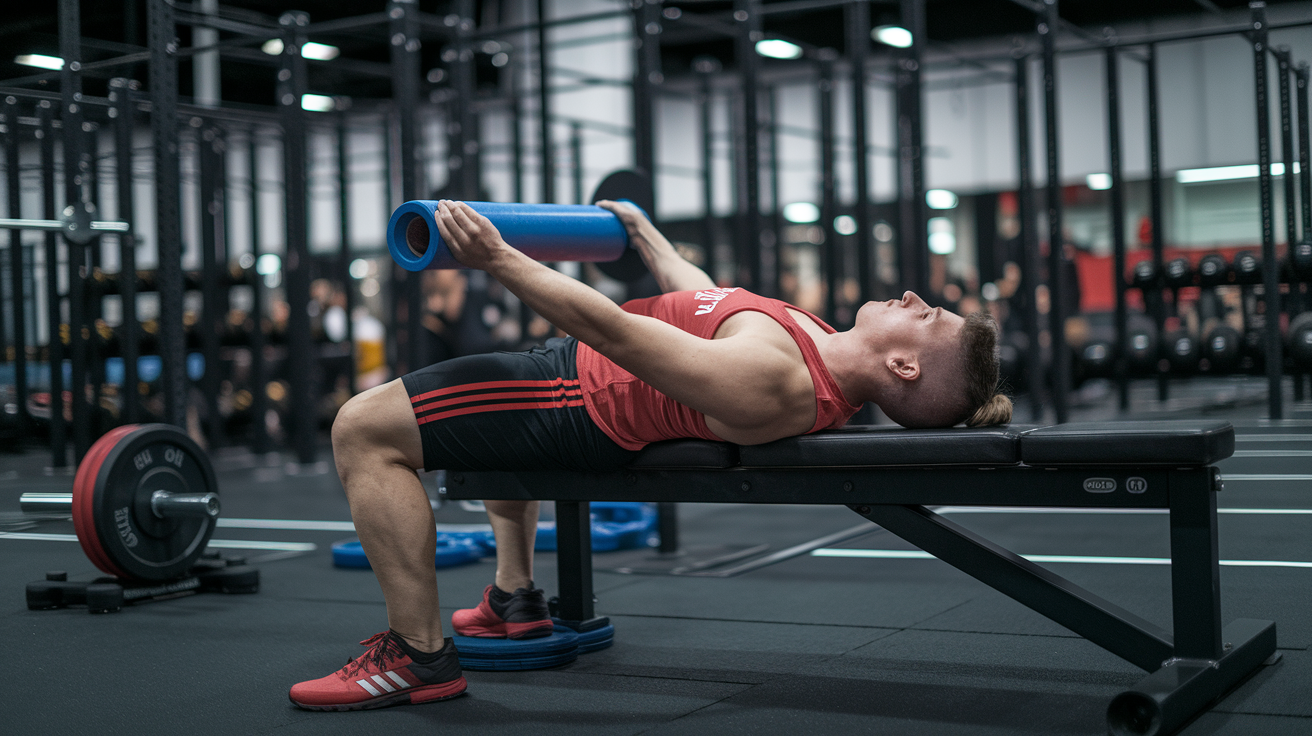
Lie on your back with a foam roller under your mid-back, just below your shoulder blades. Support your head, knees bent, feet flat. Lower your upper back over the roller, extending segment by segment. Inhale as you extend backward, exhale as you return to neutral. Move the roller up one vertebra and repeat. Work through 5 to 8 segments, spending 30 to 60 seconds on tight spots. You should feel a stretch across your chest and the front of your ribs. Not pain in your lower back.
Quadruped Thoracic Rotations (Thread the Needle)
Start on hands and knees. Hands under shoulders, knees under hips. Place your right hand behind your head. Rotate your right elbow toward the ceiling, opening your chest and upper back to the right. Pause at the top, then thread your right arm under your left armpit, rotating your torso down and across. Your right shoulder and ear should touch or nearly touch the ground. Do 8 to 12 controlled reps per side. Keep your hips still and your lower back neutral. The rotation comes from your mid-back, not your lumbar spine.
Wall Slides with Scapular Retraction
Stand with your back against a wall, feet a few inches out. Keep contact between the wall and your head, upper back, and tailbone. Raise your arms into a goal-post position, elbows bent 90 degrees, backs of your hands and elbows touching the wall. Slowly slide your arms overhead while keeping contact with the wall. Retract your shoulder blades down and back throughout. Lower back down with control. Do 10 to 15 reps. If you can’t keep your arms or back on the wall, reduce your range until mobility improves.
Cat-Camel (Quadruped Flexion-Extension)
Start on hands and knees. Slowly round your entire spine upward like an angry cat, tucking your chin and pelvis under. Hold for 2 seconds. Then reverse into extension, dropping your belly toward the floor, lifting your chest and tailbone toward the ceiling. Hold for 2 seconds. Move smoothly between the two positions for 10 to 15 full cycles. Breathe naturally and focus on moving through your entire spine, not just your lower back. This builds segmental control and reinforces the flexion-extension pattern your thoracic spine needs.
Foam Roller Snow Angels
Lie lengthwise on a foam roller so it runs along your entire spine from tailbone to head. Bend your knees, feet flat. Start with your arms at your sides, palms up. Slowly sweep your arms overhead along the floor in a snow-angel pattern, keeping your elbows and backs of your hands in contact with the ground. Reverse back to your sides. Do 12 to 15 reps. This stretches your chest and front shoulders while reinforcing thoracic extension and scapular mobility.
Bench-Supported Thoracic Extensions
Kneel in front of a flat bench. Place your elbows on the bench, hands together, creating a triangle with your forearms. Sit your hips back toward your heels, allowing your chest to drop toward the floor between your arms. Keep your lower back neutral and push your chest down and forward, focusing the stretch through your mid and upper back. Hold for 20 to 30 seconds, breathing deeply into your ribcage. You should feel this in your lats, upper back, and thoracic spine. Not your lower back or shoulders.
Strengthening Protocols for Improving Thoracic Extension

Mobility drills open up range of motion. Strength work locks that new range into place and keeps your upper back stable under load. The muscles that extend and stabilize your thoracic spine (especially your mid and lower traps and spinal erectors) need dedicated strengthening to support a strong bench press arch and prevent your upper back from rounding forward when the bar gets heavy. Strengthening also builds the endurance those postural muscles need to hold position through an entire session, not just one set.
Train these muscles 2 to 3 times per week with moderate volume. You’ll see noticeable improvements in upper-back stability within a few weeks. Use controlled tempos, focus on the squeeze at the top of each rep, and don’t use momentum. These aren’t max-effort lifts. They’re precision work that teaches your body how to hold and reinforce good positions.
Four key strengthening exercises for thoracic extension and upper-back stability:
Prone Y-Raises: Lie face-down on the floor or an incline bench set to 30 degrees. Extend your arms overhead in a Y shape, thumbs pointing up. Lift your arms off the floor by squeezing your shoulder blades together and down, engaging your lower traps and mid-back. Hold for 1 to 2 seconds at the top, then lower with control. Do 3 sets of 12 to 15 reps. Start with no weight or light dumbbells (2 to 5 pounds). You should feel this between your shoulder blades and along your mid-back.
Banded Pull-Aparts: Hold a resistance band with both hands at chest height, arms extended. Pull the band apart by driving your hands out to the sides, squeezing your shoulder blades together. Keep your chest up and your shoulders down. Pause for 1 second, then return to the start position with control. Do 3 sets of 15 to 20 reps. Use a band with light to moderate tension. This strengthens scapular retraction and reinforces the exact upper-back position you need for bench pressing.
Chest-Supported Rows: Set an incline bench to 45 degrees. Lie face-down with a dumbbell in each hand, arms hanging straight down. Pull the dumbbells toward your ribcage by driving your elbows back and squeezing your shoulder blades together. Keep your chest pressed into the bench and don’t shrug your shoulders toward your ears. Lower with control. Do 3 to 4 sets of 8 to 12 reps. This variation removes lower-back involvement and isolates your upper-back muscles.
Trap-3 Raises (Lower Trap Raises): Lie face-down on an incline bench set to 30 to 45 degrees. Hold light dumbbells with your arms angled slightly out from your body, thumbs pointing up. Raise the weights by squeezing your lower traps, lifting your arms in a diagonal line away from your body. Focus on depression and retraction of your shoulder blades. Hold for 1 second at the top, then lower slowly. Do 3 sets of 10 to 15 reps with 2 to 5 pounds. This movement directly targets the lower traps, which anchor your shoulder blades down and back during bench press.
Fixing Rounded Upper Back Posture Outside the Gym

Your posture between training sessions shapes how your thoracic spine moves when you’re under a barbell. Hours slouched over a desk, craning your neck forward at a screen, or sitting with rounded shoulders reinforce the exact kyphotic pattern you’re trying to fix in the gym. Change these daily habits and you create a foundation that supports your mobility and strength work instead of fighting against it.
Start with your workstation setup. Position your monitor so the top third of the screen sits at eye level, preventing forward head posture. Keep your keyboard and mouse close enough that your elbows stay near your ribcage. Sit all the way back in your chair with your lower back supported, feet flat on the floor. Set a timer for every 45 to 60 minutes and stand up, walk around, and reset your posture. During those breaks, do 5 wall slides or 10 scapular squeezes: pull your shoulder blades together and down, hold for 3 seconds, release, and repeat.
When standing, practice stacking your ribcage over your pelvis instead of letting your ribs flare forward. Think about lengthening the back of your neck and gently drawing your chin back, not jutting it forward. Pull your shoulder blades down and slightly back without forcing an exaggerated military posture. This neutral alignment should feel relatively easy to hold for a few minutes at a time. If it feels exhausting, your postural muscles are weak and need the strengthening work outlined earlier. The more you practice this alignment during the day, the more automatic it becomes, and the less your body defaults to a rounded upper-back position when you lie down to bench press.
Bench Press Setup Cues That Reinforce Proper Thoracic Position

A strong bench press starts with a locked-in upper back before you even touch the bar. Your setup determines whether your shoulders stay safe and stable or drift into a compromised position under load. These cues turn thoracic mobility into actual bench press performance.
Pull your shoulder blades down and back into the bench before you unrack. Imagine trying to tuck your shoulder blades into your back pockets. That retraction and depression creates the stable platform your shoulders need. Once you set that position, keep it locked through the entire set. If your shoulder blades slide forward or your upper back flattens out mid-set, you’ve lost your foundation and your press will suffer.
Establish your arch by lifting your chest toward the ceiling and pressing your upper back firmly into the bench. The arch should come from thoracic extension, not excessive lumbar hyperextension. Your lower back will have a natural curve, but the lift and openness should happen through your mid and upper back. Think about creating space between your ribcage and your pelvis while keeping both planted on the bench.
Five bench press setup cues that reinforce thoracic position:
Pin your shoulder blades into the bench by retracting and depressing them before unracking, and maintain that position throughout every rep.
Lift your chest high by extending through your thoracic spine, not by overarching your lower back or flaring your ribs excessively.
Keep your ribcage elevated and your sternum pointing toward the ceiling during the descent and press, preventing your torso from collapsing.
Press your upper traps and the back of your shoulders firmly into the bench to anchor your upper body and create a solid base.
Maintain a consistent bar path by holding your torso position stable. Your scapulae shouldn’t slide or shift as the bar moves up and down.
Frequency and Progressions for Thoracic Mobility Training

Consistency beats intensity when building thoracic mobility. Your thoracic spine responds well to frequent, low-dose work rather than occasional long sessions. Aim for 3 to 5 sessions per week, mixing mobility drills into your warm-ups and strengthening exercises into your regular training days. Most people notice measurable improvements in range of motion and upper-back positioning within 2 to 4 weeks of consistent work.
Progress your mobility drills by gradually increasing range of motion, time under tension, or segmental control. Not by rushing through reps or adding load too soon. For foam roller work, spend more time on restricted segments and work toward smoother, pain-free movement through your entire mid-back. For rotational drills, aim for greater rotation and better control at end ranges. For strengthening exercises, add reps first, then sets, then light external load once you can do 15 clean reps with bodyweight or bands.
| Exercise Type | Frequency | Progression Method |
|---|---|---|
| Mobility Drills (foam rolling, rotations, stretches) | Daily or 5–7× per week | Increase range of motion, add 10–15 seconds per segment, improve segmental control |
| Strengthening Exercises (rows, raises, pull-aparts) | 2–4× per week | Add reps (12 to 15 to 20), then sets (3 to 4), then light load (2 to 10 lbs) |
| Bench Press Setup Practice | Every pressing session | Refine cues, increase time holding retracted position, reassess bar path and shoulder stability |
Simple At-Home Tests to Evaluate Thoracic Mobility

Testing your thoracic mobility gives you a baseline and shows whether your training is working. Retest every 2 to 4 weeks using the same protocols to track progress. If your scores aren’t improving, increase frequency or revisit your technique on the drills.
Wall Angel Test
Stand with your back against a wall, feet a few inches out, head, upper back, and tailbone touching the wall. Raise your arms into a goal-post position, elbows bent 90 degrees. Try to keep your elbows, wrists, and backs of your hands in contact with the wall while sliding your arms overhead. Good thoracic mobility lets you reach full overhead extension without your lower back arching excessively or your arms peeling off the wall. If your hands or elbows lift off the wall before you reach overhead, or if you have to arch your lower back hard to get there, your thoracic extension or shoulder mobility needs work.
Seated Thoracic Rotation Test
Sit on the floor or a bench with your legs locked in place (cross them or wedge your knees against a wall). Place a dowel or PVC pipe across your shoulders behind your neck, holding it with both hands. Rotate your torso as far as you can to one side, keeping your hips still and your spine tall. A healthy range is roughly 50 degrees or more of rotation relative to your starting position. If you can’t rotate that far, or if one side rotates way less than the other, prioritize rotational mobility drills like quadruped rotations and side-lying rib pulls.
Prone Thoracic Extension Test
Lie face-down on the floor with your arms at your sides, palms facing down. Lift your chest and upper torso off the ground by extending through your mid and upper back, keeping your lower back and hips relaxed on the floor. Your gaze should stay toward the floor, not craning your neck upward. You should be able to lift your sternum 2 to 4 inches off the ground smoothly and hold the position for 5 seconds without straining or compensating through your lower back. If you can’t lift your chest, feel pinching in your lower back, or fatigue right away, your thoracic extensors are weak or your mid-back is restricted.
Final Words
You’ve learned why thoracic extension matters for your bench press, how to test it, and which mobility drills and strength moves help your upper back stay tight and stable.
You also got practical posture fixes for daily life and bench setup cues that improve bar path and reduce shoulder stress.
Start adding thoracic mobility exercises to fix rounded upper back for bench press into your warm‑up 3–5 times weekly. Do the simple drills, track a little progress, and your bench will get stronger and safer.
FAQ
Q: How to fix a rounded thoracic spine? / How to correct rounding in the upper back?
A: To fix a rounded thoracic spine, restore thoracic extension with daily mobility (foam‑roller extensions, T‑spine rotations), strengthen mid/lower traps and spinal erectors, and fix sitting and workstation habits for steady progress.
Q: What workout helps upper back rounding and how to self‑mobilize the upper thoracic spine?
A: A workout for upper‑back rounding mixes mobility (foam‑roller extensions, wall slides, T‑spine rotations) with strengthening (prone Y‑raises, band pull‑aparts). Self‑mobilize with 2–3 minutes foam‑roller work and 5–10 slow rotations daily.