


What if tight ankles, not weak hips, are the real reason you can’t hit depth in your squat?
You can fix this with five simple drills that take under 10 minutes and need no fancy gear.
These moves target ankles, hips, and your upper back so you can sit lower with more control.
Do the sequence once or twice before squatting and you’ll notice deeper, safer reps fast.
This routine gives beginners a clear, no-nonsense path to better squat depth.
Essential Mobility Drills That Immediately Improve Squat Depth

You can start improving your squat depth today with a simple five-drill routine that targets ankles, hips, and upper back.
No complicated theory, no special equipment. Just five movements you can do anywhere in under 10 minutes:
- Ankle rocks (kneeling): Drive one knee forward and back, slowly, 8 times per side.
- Wide-stance rocks (on all fours): Shift your hips forward and back with knees wider than hips, 10 slow rocks.
- T-spine rotations (quadruped): Place one hand at your ear, lift the elbow toward the ceiling, and rotate back down. 8 reps per side.
- Split-stance rock: Kneel in a lunge position, sit back toward your rear heel, then drive forward. 8 reps per side.
- Toe touch to squat: Start in a deep squat, slide hands up your legs, straighten your knees into a toe touch, then return to squat. 6 slow transitions.
Run through this sequence once or twice before your next squat session and you’ll feel the difference in your depth and control.
Assessing Squat Mobility Limitations for Better Depth

Before you start drilling mobility, figure out which joint is actually limiting your depth. Most beginners assume tight hips, but ankles and thoracic spine often block depth just as much.
Assessment gives you a starting point. Shows you where to focus your time, and lets you measure progress week to week.
Try these three simple tests:
Ankle wall test: Stand facing a wall, place one foot forward with your big toe 10–12 cm from the wall, and try to touch your knee to the wall without lifting your heel. If your heel lifts or your knee can’t reach, your ankle dorsiflexion is limited.
Deep squat hold: Drop into your deepest squat, hold for 30 seconds, and note if your heels lift, if you tip forward, or if you can’t get your hips below parallel. Time how long you can hold with good form.
Thoracic rotation check: Sit cross-legged, place one hand behind your head, and rotate your chest toward the ceiling. If you can’t rotate much or your lower back does all the work, your thoracic spine is stiff.
Use these three tests every two weeks to track which areas improve and which still need attention.
Ankle Mobility Drills to Deepen Squat Position

Limited ankle dorsiflexion is the silent depth killer. When your shin can’t tilt forward over your toes, your knees stop traveling, your hips can’t drop, and your heels lift off the floor.
You need your tibia to move forward relative to your ankle joint. That forward shin angle is what lets your knees track over your toes without your heels popping up. Most beginners need 10–12 cm of toe-to-wall clearance to squat deep with heels down. If you’re stuck at 5–8 cm, ankle work is your first priority.
Here are four drills that improve dorsiflexion and shin mobility:
Banded ankle mobilization: Loop a resistance band around your ankle (just above the joint), anchor it behind you, step forward into a half-kneeling position, and drive your knee forward over your toes while the band pulls your ankle back. Hold each push for 5–10 seconds. Do 3 sets of 30–60 seconds per side.
Knee-to-wall dorsiflexion: Stand facing a wall, one foot forward, and slowly push your knee toward the wall without lifting your heel. Measure how far your toes can start from the wall. Do 3 sets of 8–12 reps per side, aiming to increase distance each week.
Calf and soleus stretch (knee bent): Step one foot forward, bend both knees, and shift your weight forward to feel a stretch deep in your calf and Achilles. Bent-knee stretches hit the soleus muscle, which restricts dorsiflexion more than the straight-leg gastrocnemius. Hold 3 sets of 30–60 seconds per side.
Heel-elevation regression: If your ankles are very stiff, place a 2–10 mm wedge or small weight plate under your heels during squats. This temporary fix lets you practice depth while you work on improving dorsiflexion. Remove the lift as your ankle range improves over 4–6 weeks.
Spend extra time on whichever drill feels tightest. Ankles respond quickly to consistent work, and most beginners see noticeable improvement in 2–4 weeks.
Hip Mobility Exercises for Lower and More Comfortable Squat Depth

Your hips need to flex deeply, rotate internally and externally, and stay stable at the bottom of a squat. Tight hip flexors tilt your pelvis forward and block full hip flexion. Limited internal or external rotation makes it hard to sit between your knees without your lower back compensating.
Hip mobility work fixes both problems. You’ll open up rotation so your femurs can move freely in the socket, and you’ll lengthen the front of your hips so your pelvis can tilt under you instead of pulling you forward.
Building positional tolerance at the end of your hip range is just as important as stretching. Your nervous system needs to trust the bottom position before it lets you sink into it under load.
90/90 Hip Switch
Sit on the floor with both knees bent at 90 degrees, one leg in front (external rotation) and one behind (internal rotation). Keep your chest up and slowly switch legs by lifting your knees and rotating your hips. Do 3 sets of 8–12 reps per side. This drill trains your hips to move smoothly between internal and external rotation, which is exactly what happens in the bottom of a squat.
Hip CARs
Stand on one leg and slowly move your other leg through its full range of motion in a controlled circle (hip flexion, abduction, extension, back to start). Keep your torso still and your core braced. Do 3–5 slow circles in each direction per side. Controlled articular rotations build active range and help your hips own the positions you’re trying to use in a squat.
Couch Stretch
Kneel with one knee on the ground near a wall or couch, place your back foot up on the surface, and drive your hips forward while keeping your ribcage stacked over your pelvis. You should feel a strong stretch in the front of your hip and quad. Hold 2–3 sets of 45–60 seconds per side. Tight hip flexors are one of the biggest depth blockers for beginners.
Band-Assisted Lateral Hip Distraction
Loop a heavy resistance band around one hip and anchor it to a sturdy post. Step away to create tension, then sink into a deep lunge or half-squat position on that side. The band pulls your femur outward in the socket, creating space and improving hip capsule mobility. Hold 2–3 sets of 30–45 seconds per side. This drill feels intense but helps if your hips feel “pinchy” at the bottom of a squat.
Thoracic Spine Mobility Work for an Upright Squat

A stiff upper back forces you to lean forward during squats. When your thoracic spine can’t extend, your chest collapses, your shoulders round, and your torso tips forward to counterbalance the weight. That forward lean makes it nearly impossible to sit deep without your lower back rounding or your heels lifting.
Thoracic extension and rotation let you keep your chest up and your torso more vertical, which shifts the load back toward your hips and legs where it belongs. Upper-back mobility also helps if you’re planning to front squat or hold a barbell in a high-bar position.
Here are three simple drills that improve thoracic mobility:
Foam-roll thoracic extensions: Lie on your back with a foam roller positioned across your mid-back (just below your shoulder blades). Support your head with your hands, brace your core, and slowly extend backward over the roller. Move the roller up and down your thoracic spine, spending 8–12 reps or about 60 seconds total. Do 2 sets. Focus on extending through your upper back, not your lower back.
Wall slides or band pull-aparts: Stand with your back against a wall, arms raised overhead in a Y position, and slowly slide your arms down the wall into a W shape while squeezing your shoulder blades together. Or use a light resistance band and pull it apart at chest height, retracting your shoulder blades. Do 3 sets of 10–15 reps. Both versions improve scapular control and thoracic posture.
Kneeling thoracic rotations: Start on all fours, place one hand behind your head, and rotate your chest toward the ceiling, following your elbow with your eyes. Pause at the top, then return. Do 2–3 sets of 8–10 reps per side. Make sure the rotation happens in your upper back, not your lower back or hips.
If your thoracic spine is very stiff, add one of these drills to your warm-up every day. You’ll notice better posture in your squats within a week or two.
Integrated Movement Drills to Apply Mobility into the Squat Pattern

Stretching and mobility drills are important, but they don’t automatically transfer into better squat depth. You need to practice moving through the new range with control and stability, or your nervous system won’t trust it under load.
Integrated drills combine mobility with strength. They teach your body to own the bottom position, build positional strength, and reinforce good movement patterns before you add a barbell.
Goblet Squat to Box
Hold a light kettlebell or dumbbell at your chest, stand in front of a box or bench set just below parallel, and slowly lower yourself until your hips touch the box. Pause for one second, then drive back up. Use a box height that lets you maintain good form with heels down and chest up. Do 3 sets of 8–12 reps. Lower the box by 2–4 cm every 1–2 weeks as your depth improves. The goblet position keeps your torso upright and loads the pattern safely.
Assisted Deep Squat Holds
Hold a TRX strap, resistance band, or door frame with both hands, and slowly lower yourself into the deepest squat you can manage. Use your arms for light support to help balance and control the descent. Hold the bottom position for 30–60 seconds, focusing on keeping your heels down, knees tracking over toes, and chest up. Do 3 sets. This drill builds time under tension in your end range and teaches your body that the bottom position is safe.
Dynamic Lunge + Twist
Step forward into a lunge, drop your back knee close to the floor, then rotate your torso toward your front leg and reach your arms overhead or out to the side. Return to standing and repeat on the other side. Do 2–3 rounds of 8 reps per side. This movement combines hip flexor length, thoracic rotation, and balance, all of which support better squat mechanics.
Use these drills in your warm-up or as part of a mobility session. They’re the bridge between stretching and squatting with a barbell.
A Beginner-Friendly Squat Mobility Routine and Weekly Plan

Consistency beats intensity when it comes to mobility. Short, frequent sessions work better than one long painful stretch session per week. Most beginners see real improvement in squat depth within 2–4 weeks if they work mobility 4–7 days per week for 10–15 minutes per day.
Reassess your ankle wall test, deep squat hold time, and squat depth every 2 weeks. Use those numbers to decide which drills to keep and which areas need more focus.
Here’s a simple daily routine you can run before training or on off days:
- Banded ankle mobilization: 30 seconds per side.
- Knee-to-wall dorsiflexion: 8 reps per side.
- 90/90 hip switches: 8 reps per side.
- Deep squat hold (assisted if needed): 30 seconds.
- Wall slides or thoracic rotations: 10 reps.
Run through this circuit twice. Total time: 10–15 minutes. If one area feels much tighter, spend an extra set or 30 seconds there.
| Week | Focus | Progression Target |
|---|---|---|
| 1–2 | Establish baseline mobility; daily ankle and hip drills | Measure ankle wall test and squat hold time; aim for consistency |
| 3–4 | Increase dorsiflexion range; add assisted squat holds | Improve toe-to-wall distance by 1–2 cm; hold deep squat 30+ seconds |
| 5–6 | Lower box height in goblet squats; refine hip rotation drills | Reduce box height by 2–4 cm; improve 90/90 comfort and range |
| 7–8 | Integrate loaded squats; maintain mobility work 3–4×/week | Squat to parallel or below with heels down; reassess and adjust drills |
Stick with the plan for at least four weeks before deciding what’s working. Mobility takes time, but the improvements are measurable and permanent if you keep practicing.
Common Errors That Limit Squat Depth and How to Fix Them
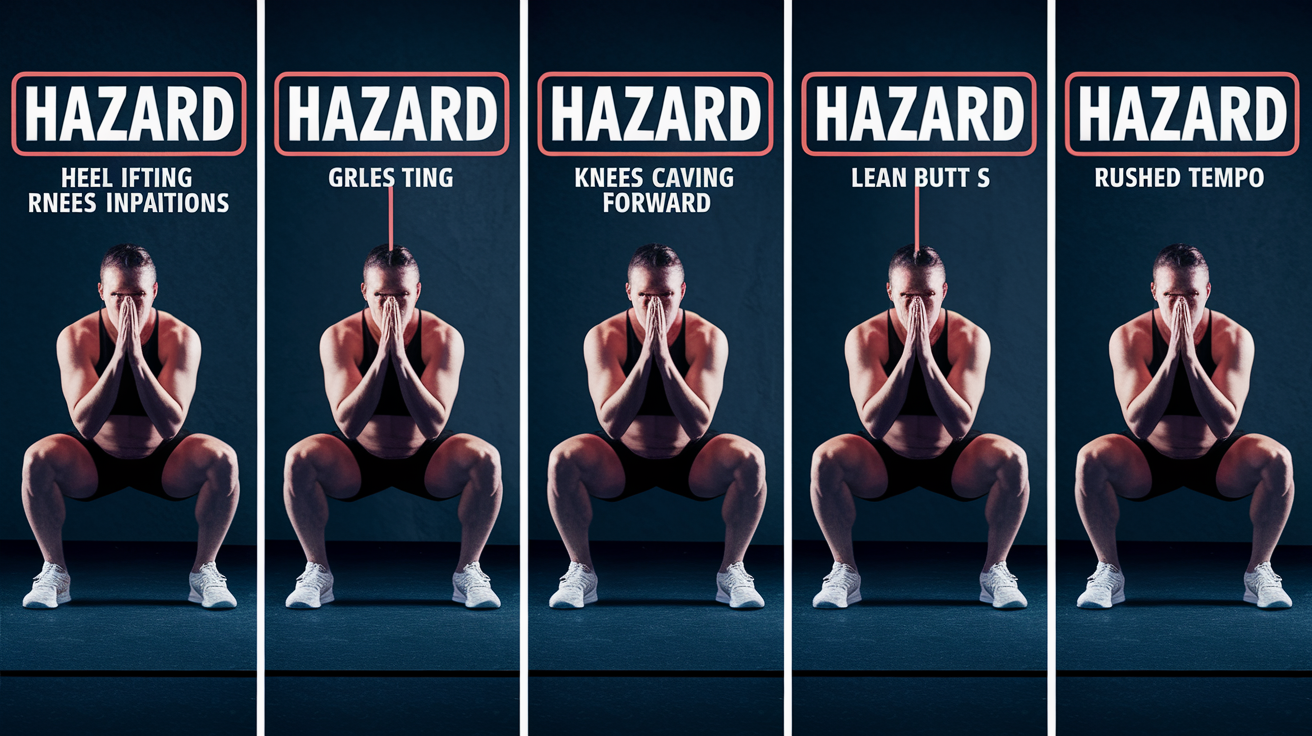
Beginners often make the same handful of mistakes that block depth, reinforce poor movement patterns, and increase injury risk. Catching these early saves weeks of frustration.
Here are five common errors and their fixes:
Heels lifting off the floor: This usually means limited ankle dorsiflexion. Fix it by spending more time on banded ankle mobilizations, knee-to-wall drills, and calf stretches. Use a temporary heel wedge during squats if needed, but don’t rely on it long-term.
Knees collapsing inward (valgus): Weak glutes or poor hip control causes this. Fix it with glute activation drills before squatting, cue yourself to “push knees out” during the descent, and slow down your tempo so you can control the movement. A light resistance band around your knees during warm-up squats can help reinforce the pattern.
Excessive forward lean or chest collapse: Stiff thoracic spine or weak upper back. Fix it with daily foam rolling, wall slides, and thoracic rotations. Also check your core bracing. Inhale before you descend, brace like you’re about to take a light punch to the stomach, and keep that tension through the whole rep.
Lower back rounding (butt wink) at the bottom: This happens when you run out of hip or ankle range and your pelvis tucks under to keep going lower. Fix it by stopping your descent before the rounding starts. Use a box as a depth target. Work on hip mobility drills and ankle dorsiflexion separately, then gradually lower the box as your range improves.
Bouncing or rushing through reps: Speed hides poor control. Fix it by slowing down. Use a 3–1–1 tempo (three seconds down, one second pause, one second up) for bodyweight or goblet squats. Control builds strength in the positions where you’re weak.
Tracking Mobility Progress for Deeper Squats

You can’t improve what you don’t measure. Tracking a few simple metrics every two weeks keeps you honest and shows you which drills are working.
Use your phone to record your ankle wall test and film a set of bodyweight squats from the side. Note your toe-to-wall distance in centimeters, how long you can hold a deep squat with good form, and the lowest box height you can squat to without your heels lifting or your chest collapsing. Write those numbers down or save the video with a date stamp.
Expect to see ankle dorsiflexion improve by 1–2 cm every two weeks if you’re consistent with ankle drills. Your deep squat hold time should increase from 10–15 seconds to 30–60 seconds within four to six weeks. If a number isn’t moving, spend more time on that specific drill or add an extra set. Progress is rarely linear, but the trend over four to eight weeks should be clearly upward.
Final Words
Start today: run the quick ankle, hip, and thoracic drills, then test your squat and apply a goblet or assisted squat. The routines here are plug-and-play and made to fit a busy week.
Track simple metrics—toe-to-wall distance, deep squat hold time, and box height—and correct heel lift or forward lean as you go. Expect measurable change in 2–8 weeks with steady work.
Use these mobility exercises to improve squat depth for beginners, keep sessions short and consistent, and celebrate the small wins. You’ll get deeper, safer squats.
FAQ
Q: How to increase squat depth mobility and deep squat for beginners?
A: Increasing squat depth mobility and learning to deep squat as a beginner starts with daily ankle, hip, and thoracic drills, plus goblet squats or box progressions to build comfort, control, and pain-free range.
Q: Can squatting help sciatica?
A: Squatting can help sciatica when done gently; pain-free mobility work and glute/hamstring strengthening often ease nerve irritation, but stop for sharp pain and consult a clinician before progressing.
Q: Are squats ok with osteoporosis?
A: Squats can be okay with osteoporosis if you use light loads, prioritize perfect form, avoid forward collapse, choose supported or bodyweight variations, and get medical clearance before increasing load.