


Think you need a gym to build a strong back?
You don’t.
Back workouts at home can be just as effective when they’re built around the right movements: vertical pulls and horizontal pulls, plus exercises for spinal stability.
This post lays out simple, proven exercises like bodyweight moves, band work, and dumbbells that target lats, traps, and the lower back.
You’ll get clear cues, rep ranges, and a straightforward plan to progress so your back actually gets stronger, not just looks better.
No fancy gear. Real strength you can measure.
Home-Based Back Training Essentials for Effective Back Workouts
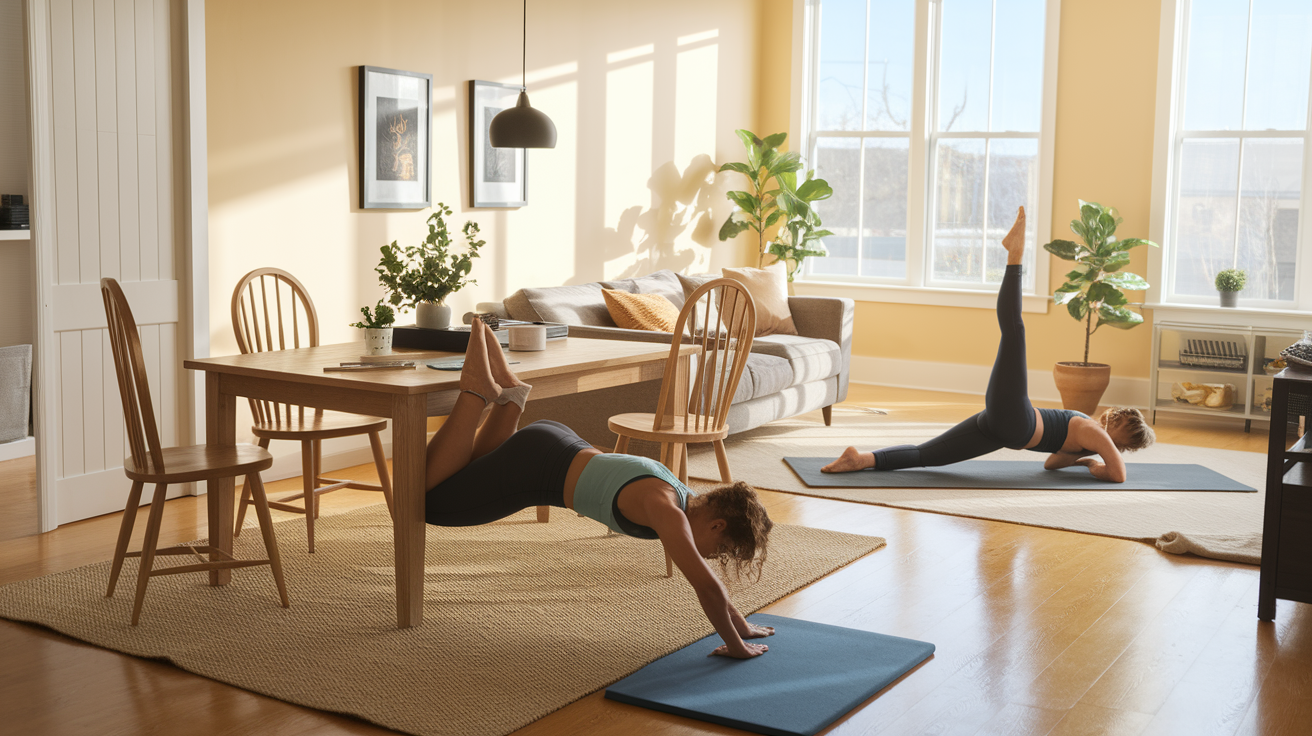
Most people searching for back workouts at home want to know if they can actually build real strength without a gym. You can. The back responds to progressive tension, whether that’s from a barbell or your bodyweight. You can create that tension in your living room with minimal gear or just the floor.
Your back isn’t one muscle. It’s several distinct groups that each respond to different movement patterns. The erector spinae and multifidus run along your spine and handle extension and stability. Your latissimus dorsi creates the wide V-shape and pulls your arms down and in. The trapezius, rhomboids, and teres muscles control your shoulder blades and pull your arms back. Training the back at home means covering two core patterns: vertical pulling (think pull-ups) and horizontal pulling (think rows). Hit both patterns consistently and you’ll strengthen posture, reduce desk-related tension, and build the foundation for heavier lifts later.
Here are eight beginner-friendly at-home back exercises you can start today:
- Inverted row using a sturdy table: Lie underneath, grab the edge, keep your body straight, pull your chest to the table.
- Bird dog: From hands and knees, extend opposite arm and leg, hold 7–8 seconds, switch sides.
- Superman: Lie face-down, lift chest and legs off the floor, squeeze your lower back and glutes, hold 20 seconds.
- Towel rows on a closed door: Loop a towel over the top of a door, grab both ends, lean back and row.
- Scapular pull-ups: Hang from a bar (or sturdy ledge) and pull your shoulder blades down without bending your elbows.
- Reverse snow angels: Lie face-down, arms at sides, sweep arms up and overhead along the floor.
- Cat-Cow: On hands and knees, arch and round your spine slowly for spinal mobility.
- Wide-grip floor press-ups: Standard push-up hand position, but focus on squeezing shoulder blades together at the bottom.
Start with 2–3 sessions per week. Aim for 8–12 reps per movement or 20–30 second holds for static exercises. Rest 60–90 seconds between sets and give yourself at least one full day between back sessions. Consistency over four weeks will improve your control, posture, and work capacity before you add heavier resistance.
Back Muscle Groups Targeted in Back Workouts at Home

Understanding which muscles you’re working helps you pick the right exercises and notice when something feels off.
The erector spinae are the long cables running along your spine from your pelvis to your mid-back. They keep your spine extended and stable when you hinge, lift, or hold a plank. Just below the surface, the multifidus muscles lock each vertebra in place, especially during rotation or single-leg movements.
The latissimus dorsi is the broad, wing-shaped muscle that runs from your armpit to your lower back. It pulls your arm down and back, which is why pull-ups and lat pulldowns feel so different from rows. The trapezius has three sections. Upper traps shrug your shoulders, middle traps pull your shoulder blades together, and lower traps pull them down and in. The rhomboids sit between your shoulder blades and retract them when you row. The teres major and minor assist the lats and help rotate your shoulder. Together, these muscles control posture, support heavy carries, and protect your spine during daily bending and lifting.
Your obliques also contribute to back health. They run diagonally along your sides and connect to the thoracolumbar fascia, a sheet of connective tissue that wraps your lower back. When your obliques engage during a row or deadlift, they brace your spine and transfer force from your legs to your upper body. Training the back at home means training this entire system, not just the muscles you can see in the mirror.
Here’s which exercises best target each muscle group:
- Erector spinae and multifidus: Superman holds, bird dogs, back extensions, Romanian deadlifts.
- Latissimus dorsi: Pull-ups, band lat pulldowns, dumbbell pullovers, inverted rows with feet elevated.
- Middle and lower trapezius: Bent-over rows, face pulls, prone Y-raises, scapular pull-ups.
- Rhomboids: Horizontal rows, single-arm rows, band pull-aparts, reverse flyes.
- Obliques and core stabilizers: Renegade rows, bird dogs, side planks, anti-rotation band holds.
Bodyweight Back Workouts for Home-Based Training
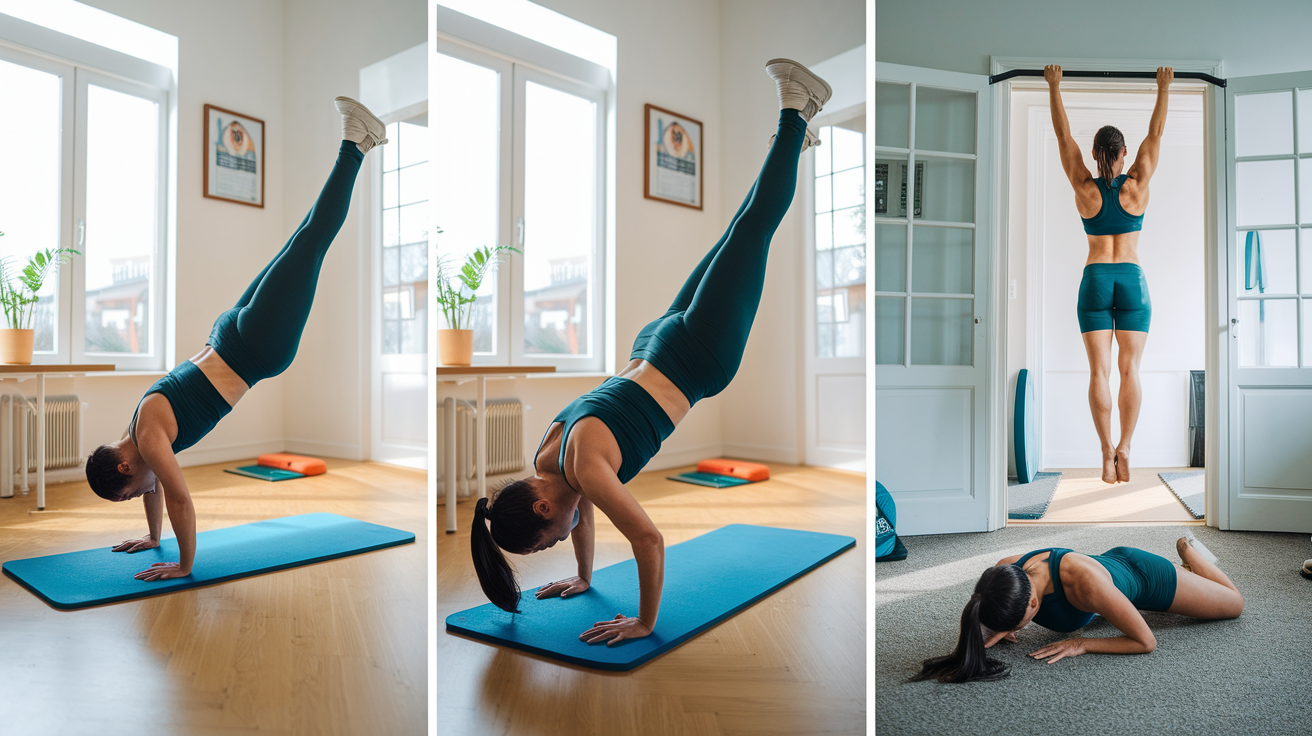
When you train with bodyweight alone, your biggest challenge is creating enough resistance to keep progressing. The solution is leverage. By changing your body angle, foot position, or tempo, you turn simple movements into serious strength builders. An inverted row under a table with your feet on the floor is manageable for most people. Elevate your feet on a chair and suddenly the same row requires much more back and core strength.
Four movements form the core of an effective bodyweight back session at home.
Inverted rows train horizontal pulling. Find a sturdy table or use a broomstick across two chairs, lie underneath with your body straight, and pull your chest to the bar. Keep your shoulder blades pulled back at the top.
Scapular pull-ups teach you to initiate a pull from your back, not your arms. Hang from a pull-up bar or door frame pull-up bar and pull your shoulder blades down without bending your elbows. Hold the bottom position for two seconds, then relax and repeat.
Superman holds build the erector spinae and glutes. Lie face-down, lift your chest and legs a few inches off the floor, squeeze hard, and hold for 20 seconds. Rest 10 seconds, then repeat for up to 12 rounds total.
Bird dogs combine core stability and spinal control. From hands and knees, extend your right arm and left leg, hold for 7–8 seconds without letting your hips rotate, then switch sides.
Progress bodyweight exercises by slowing the tempo, adding pauses at peak contraction, or changing your leverage. For rows, elevate your feet or move to a lower bar height. For Superman, hold a light object in your hands or add a single-leg variation. For bird dogs, increase the hold time to 10–12 seconds or add a small weight in your extended hand. When you can complete 3 sets of 12 reps with control, it’s time to increase difficulty or add external load.
| Exercise | Primary Muscles | Sets/Reps |
|---|---|---|
| Inverted Row (table or bar) | Lats, rhomboids, middle traps | 3 × 8–12 |
| Scapular Pull-Up | Lower traps, lats | 3 × 8–10 |
| Superman Hold | Erector spinae, glutes | 12 rounds: 20s hold, 10s rest |
| Bird Dog | Multifidus, obliques, glutes | 3 × 8–10 total (each side) |
| Wide-Grip Press-Up | Posterior delts, rhomboids | 3 × 8–12 |
| Reverse Snow Angels | Middle/lower traps, rear delts | 3 × 12–15 |
Resistance-Band Back Exercises for At-Home Strength
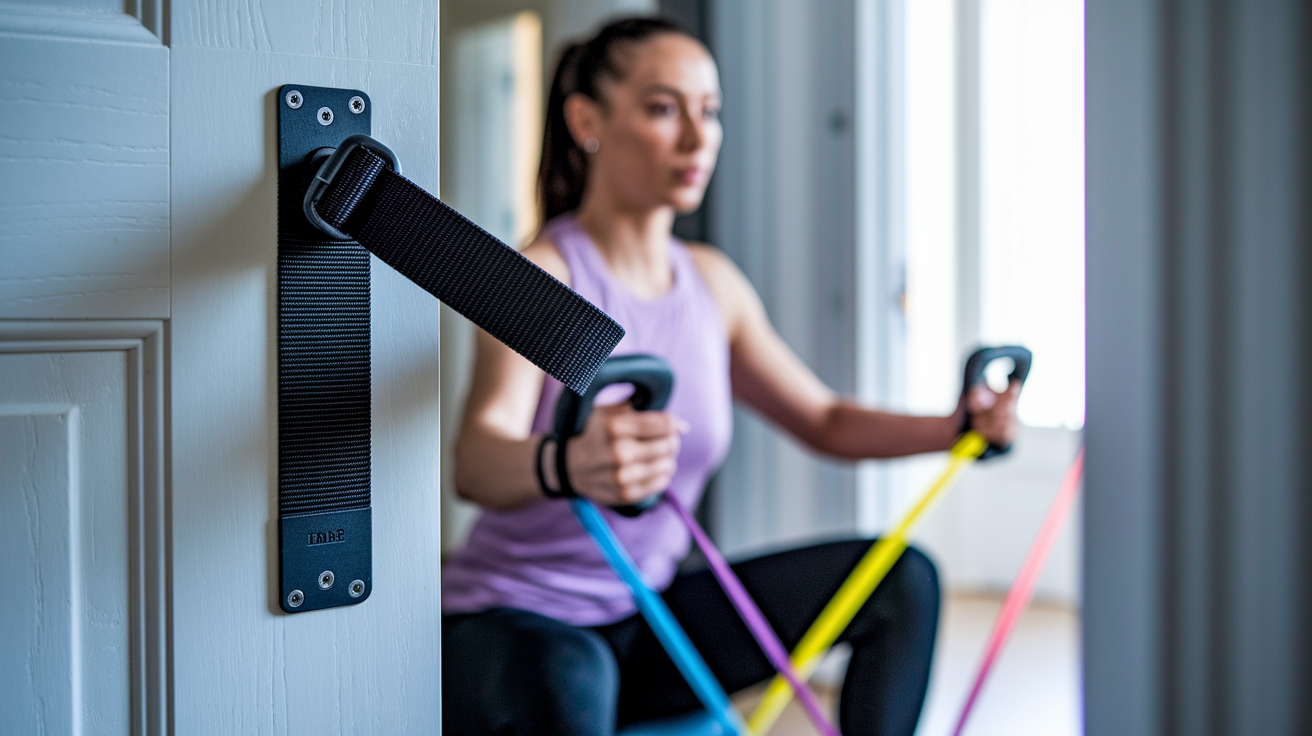
Resistance bands give you variable tension that builds strength through the full range of motion, and they’re portable enough to anchor to a door or loop under your feet. The key to safe, effective band work is a solid anchor point. For overhead exercises like lat pulldowns, loop the band over the top of a sturdy closed door or a ceiling beam. For rows, anchor the band at chest height using a door anchor or wrap it around a post. Always test your anchor with light tension before going heavy.
Band pull-aparts are the simplest upper-back builder. Hold the band in front of your chest with arms straight, then pull your hands out to your sides, squeezing your shoulder blades together. If it’s too easy, double-loop the band or use a thicker band.
Seated band rows mimic cable rows. Sit on the floor with legs extended, loop the band around your feet, and row the handles back to your ribs. Keep your back flat and pull with your elbows, not your hands.
Face pulls target the rear delts and middle traps. Anchor the band at face height, grab both ends, and pull straight back toward your ears, flaring your elbows out.
Band deadlifts load the posterior chain. Stand on the band with both feet, hold the ends in each hand, hinge at the hips until your hands are at knee level, then stand up by driving your hips forward.
Single-arm band rows let you work each side independently. Anchor the band low, step back to create tension, and row from knee height to hip height, squeezing your shoulder blade back.
Banded lat pulldowns replicate the gym movement. Anchor the band overhead, kneel or sit, and pull the band down to your chest with a slight backward lean.
A typical band session follows this structure:
- Band Pull-Aparts: 3 sets of 12–15 reps. Keep constant tension. Don’t let the band go slack.
- Seated Band Row: 3 sets of 10–12 reps. Pull to your lower ribs, pause one second, slow return.
- Face Pulls: 3 sets of 12–15 reps. Pull to eye level, elbows high, squeeze shoulder blades.
- Single-Arm Band Row: 3 sets of 10–12 reps each side. Stand tall. Don’t twist your torso.
- Band Lat Pulldown: 3 sets of 10–12 reps. Control the return. Don’t let the band snap back.
- Band Deadlift: 3 sets of 12–15 reps. Drive through your heels, finish with hips locked out.
To progress tension, start by doubling the band (loop it twice) or step wider on the band to shorten the working length. When 15 reps feels easy, switch to a thicker band or combine two bands. Track your reps each session and add one rep per set when you can complete all sets with good form.
Dumbbell Back Workouts at Home for Strength and Size

Dumbbells unlock the best home-based hypertrophy work because they let you load the back progressively and control the range of motion on every rep. A single pair of adjustable dumbbells can replace an entire rack of fixed weights, and once you own them, you can run strength and size programs for years. The movement patterns stay the same as barbell work, but dumbbells force each side of your back to work independently, which builds balanced strength and catches weak-side imbalances early.
Hip hinge movements like the dumbbell stiff-leg deadlift train the entire posterior chain. Stand with feet hip-width, hold a dumbbell in each hand in front of your thighs, push your hips back while keeping a slight knee bend, lower the weights along your shins until you feel a stretch in your hamstrings, then drive your hips forward to stand. Keep your spine neutral the whole time. Your lower back, glutes, and hamstrings do most of the work here.
Bent-over dumbbell rows load the lats, rhomboids, and middle traps. Hinge forward to about 45 degrees, let the dumbbells hang straight down, then row them to your hips by pulling your elbows back. Don’t yank the weights up with momentum.
Dumbbell pullovers stretch and load the lats. Lie on a bench or stability ball, hold one dumbbell overhead with both hands, lower it back behind your head in a controlled arc, then pull it back over your chest.
Seated rear-delt flyes isolate the posterior shoulder and upper back. Sit on the edge of a chair, hinge forward, let the dumbbells hang, then raise them out to the sides with a slight bend in your elbows.
Dumbbell upright rows hit the upper traps and rear delts. Hold the dumbbells in front of your hips, pull them straight up to chin level, leading with your elbows.
A complete dumbbell back session follows this prescription: 4 sets of 8–12 reps per exercise with 1–2 minutes rest between sets. Control the eccentric (lowering phase) for 2–3 seconds on every rep. When you can complete all 4 sets for 12 reps with clean form, increase the load by 2–5%.
| Exercise | Sets/Reps | Technique Cue |
|---|---|---|
| Dumbbell Stiff-Leg Deadlift | 4 × 8–12 | Push hips back; neutral spine; drive hips forward to stand |
| Bent-Over Dumbbell Row | 4 × 8–12 | Row to hips; squeeze shoulder blades; slow eccentric |
| Dumbbell Pullover | 4 × 8–12 | Keep slight elbow bend; stretch lats at bottom; controlled arc |
| Seated Rear-Delt Fly | 4 × 8–12 | Hinge forward; raise arms out; squeeze at top |
| Dumbbell Upright Row | 4 × 8–12 | Lead with elbows; pull to chin level; control descent |
Quick Back Circuits at Home: 10–20 Minute Back Workouts
When time is short, circuits let you train the back with minimal rest and maximum efficiency. A well-designed 10- or 20-minute circuit keeps your heart rate up, builds work capacity, and still delivers enough volume to trigger adaptation. The key is pairing exercises that use different movement patterns or load different parts of the back so you can move quickly without sacrificing form.
A 10-minute bodyweight circuit might look like this: wide-grip pull-ups or assisted pull-ups for 8 reps with a 3-second eccentric, 15 seconds rest, then horizontal rows under a table for 8 reps with a 3-second eccentric, 15 seconds rest, then Superman holds for 20 seconds, 15 seconds rest, then wide-grip press-ups for 8 reps. Complete that sequence, rest 2 minutes, and repeat for a total of three circuits. The entire session takes 12–15 minutes including rest.
For a 20-minute band circuit, combine band lat pulldowns (12 reps), face pulls (15 reps), single-arm rows (10 reps each side), and band deadlifts (12 reps). Use 30 seconds rest between exercises and 90 seconds rest between circuits. Run four total circuits.
Here are four ready-to-use circuit options:
- 10-Minute Bodyweight Circuit: Pull-up regressions (8 reps, 3s eccentric), Horizontal rows (8 reps, 3s eccentric), Superman (20s hold), Press-ups (8 reps). Rest 15 seconds between exercises, 2 minutes between circuits. Repeat 3 times.
- 15-Minute Band Circuit: Band pull-aparts (15 reps), Seated band rows (12 reps), Face pulls (15 reps), Band deadlifts (12 reps). Rest 30 seconds between exercises, 90 seconds between circuits. Repeat 3 times.
- 20-Minute Mixed Circuit: Dumbbell bent-over rows (10 reps), Inverted rows (10 reps), Bird dogs (8 total), Dumbbell pullovers (10 reps). Rest 45 seconds between exercises, 2 minutes between circuits. Repeat 4 times.
- 10-Minute Restorative Session: Cat–Cow (8 reps), Leg raises (10 reps), Side plank (30s each side), Bird dog (10 total, 7s holds). Perform once through with minimal rest for mobility and light core activation.
Mobility, Warm-Ups, and Cool-Downs for Home Back Workouts

A proper warm-up prepares your spine, shoulders, and hips for loaded work and reduces the risk of strain during pulling movements. Cold muscles don’t contract efficiently and stiff joints limit your range of motion, so spending five minutes on mobility drills pays off in better performance and fewer tweaks. The goal isn’t to stretch your muscles into jelly but to wake up your nervous system, increase blood flow, and rehearse the movement patterns you’re about to load.
Thoracic extension drills open up your mid-back and counteract the forward hunch from sitting. Kneel in front of a chair or bench, place your elbows on the seat, and push your chest toward the floor while keeping your hips over your knees. Hold for two seconds, return, and repeat for 10–15 reps.
Scapular pull-ups activate the muscles that retract your shoulder blades. Hang from a bar and pull your shoulder blades down and together without bending your elbows. Hold for two seconds, relax, and repeat for 8–10 reps.
Cat–Cow mobilizes your entire spine. On hands and knees, slowly arch your back and look up (cow), then round your spine and tuck your chin (cat). Move smoothly for 5–8 reps, breathing in on the arch and out on the round.
After your workout, a short cool-down helps your nervous system downshift and can reduce next-day soreness. Doorway pec stretches restore length to your chest after all the rowing and pulling. Stand in a doorway, place your forearm on the frame at shoulder height, and step forward until you feel a stretch across your chest and front shoulder. Hold for 30–60 seconds per side.
Child’s pose stretches your lats and lower back. Sit back on your heels, reach your arms forward on the floor, and relax your forehead down. Hold for 60 seconds and breathe slowly.
Daily mobility habits that support long-term back health:
- Morning Cat–Cow sequence: 8–10 reps to wake up your spine before sitting down for work.
- Scapular wall slides: Stand with your back against a wall, slide your arms up and down 10–12 reps to reinforce shoulder-blade control.
- Thoracic rotations: Sit or kneel, place one hand behind your head, rotate toward that side 8–10 reps per side.
- Doorway pec stretch: 30–60 seconds per side, once in the morning and once before bed, to offset desk posture.
Back Strength Progression and Programming at Home

Progressive overload is the driver of every strength and size gain, and it works just as well at home as it does in a gym. The principle is simple: slowly doing a little more over time. That “more” can be more weight, more reps, more sets, slower tempo, or harder leverage. Your body adapts to the specific stress you place on it, so if you repeat the same workout with the same load and reps for months, your progress will stall. Track what you do and plan small, consistent increases.
For strength-focused training, use 3–6 reps per set for 3–5 sets with 2–3 minutes rest. Pick one or two heavy compound movements like weighted pull-ups or heavy dumbbell rows and focus on adding load by 2–5% when you hit the top of your rep range across all sets.
For hypertrophy, use 6–12 reps for 3–4 sets with 60–90 seconds rest. Aim for 8–20 hard sets per week spread across 2–3 sessions, mixing compound rows and pulls with isolation moves like pullovers or rear-delt flyes.
For endurance and posture work, use 12–20+ reps or timed holds (30–90 seconds) for 2–3 sets with 30–60 seconds rest. This builds muscular endurance and reinforces the motor patterns that keep your spine safe during daily tasks.
Bodyweight progressions require creativity. When adding weight isn’t an option, you manipulate leverage, tempo, and volume. For inverted rows, start with feet on the floor, then elevate your feet on a chair, then add a pause at the top, then slow the eccentric to 4–5 seconds. For pull-ups, add a weighted backpack, use a slower tempo (3-second up, 3-second down), or progress to archer pull-ups where one arm does most of the work. Tempo-controlled eccentric reps are especially valuable at home. A 2–1–3 tempo (2 seconds concentric, 1-second pause, 3 seconds eccentric) increases time under tension and builds strength even when you can’t increase external load.
Five progression variables you can manipulate at home:
- Load: Increase dumbbell weight, use a thicker resistance band, or add a weighted backpack for bodyweight moves.
- Reps: Add 1–2 reps per set each session until you reach the top of your target range, then increase load.
- Sets: Increase total weekly sets by 1–2 when adaptation slows. Back off every fourth week to recover.
- Tempo: Slow the eccentric to 3–5 seconds or add a 2-second pause at peak contraction to increase mechanical tension.
- Leverage: For bodyweight exercises, elevate feet, move to single-arm variations, or change angles to increase difficulty without adding weight.
Common Mistakes During Back Workouts at Home and How to Fix Them

Most home-training injuries and stalls come from a handful of repeated errors. The first is lumbar rounding during hinge movements. When you bend forward to row or deadlift and your lower back rounds, you shift load off the muscles and onto your spinal discs.
The fix is simple: hinge at the hips, not the spine. Push your hips back, keep your chest up, and maintain a neutral curve in your lower back. If you can’t hold that position, reduce the load or switch to a supported variation like single-arm rows with your free hand braced on a chair.
Lack of scapular control shows up as shoulder shrugging during rows or pull-ups. You should feel your shoulder blades pull down and back before your elbows bend. If your traps take over and your shoulders hike up toward your ears, you’re bypassing the muscles you’re trying to build.
The fix: start every pulling rep by squeezing your shoulder blades together or pulling them down (depending on the exercise), hold that position for a half-second, then complete the pull. Scapular pull-ups and band pull-aparts teach this pattern.
Rushing reps is tempting when you’re tired, but speed kills tension. If you yank the weight up or let it drop on the way down, you reduce time under tension and increase injury risk. The fix: use a controlled tempo on every rep, especially the eccentric. Count to three on the way down. If you can’t control the descent, the load is too heavy or you’re too fatigued to continue safely.
Six common mistakes and their corrections:
- Lumbar rounding on rows or deadlifts: Hinge at hips, not spine. Reduce load if you can’t hold neutral position. Brace your core before each rep.
- Shoulder shrugging during pulls: Initiate every rep by pulling shoulder blades down or back. Perform scapular pull-ups as a warm-up drill.
- Rushing the eccentric phase: Count 2–3 seconds on every lowering phase. If you can’t control it, reduce weight or reps.
- Poor band anchoring: Test anchor points with light tension first. Use a proper door anchor or wrap around a sturdy post. Never anchor to a loose object.
- Overvolume in a single session: Limit hard sets to 4–6 per muscle group per session. Split volume across 2–3 weekly sessions instead of one marathon workout.
- Full relax between reps: Keep constant tension on the target muscles. Don’t let your shoulder blades fully relax at the bottom of a row or pull-up. Stop one rep before full failure to maintain control.
Sample 4‑Week At‑Home Back Workout Plan for Consistent Progress
A structured four-week plan removes guesswork and builds momentum. Each week should include a small progression in reps, load, or difficulty so you finish the month measurably stronger than you started. Beginners should focus on mastering movement quality and building base volume. Intermediate trainees can push closer to failure and add more complex exercises. Advanced lifters benefit from higher intensity, varied rep ranges, and planned deload weeks to manage fatigue.
Beginners start with two sessions per week, focusing on bodyweight and light resistance-band work. Week one establishes your baseline: inverted rows 3 sets of 8 reps, scapular pull-ups 3 sets of 8 reps, Superman holds 3 sets of 12–15 reps, and bird dogs 3 sets of 8 total reps. Rest 60–90 seconds between sets. Week two adds one rep per set: 3 sets of 9 reps for rows and scapular pull-ups. Week three adds another rep or introduces a tempo change (3-second eccentrics on rows). Week four is a deload: drop back to the week-one volume but focus on perfect form and controlled tempo. This cycle builds confidence, reinforces technique, and prepares you for heavier loading.
Intermediate trainees train three times per week with a mix of bodyweight, bands, and dumbbells. Session one: pull-ups or band-assisted pull-ups 4 sets of 5–8 reps, single-arm dumbbell rows 3 sets of 8–10 reps each side, face pulls 3 sets of 12–15 reps. Session two: bent-over dumbbell rows 4 sets of 8–10 reps, inverted rows 3 sets of 10–12 reps, band deadlifts 3 sets of 12–15 reps. Session three: lighter circuit work for recovery and posture, such as the 15-minute restorative session. Progress by adding 1–2 reps per week or increasing dumbbell weight by 2–5% when you hit the top of the range.
Advanced trainees use four sessions per week with higher intensity and varied rep schemes. Session one focuses on heavy vertical pulling: pull-ups 5 sets of 3–5 reps with a weighted backpack, rest 2–3 minutes. Session two trains horizontal pulling: bent-over dumbbell rows 4 sets of 6–8 reps, renegade rows 3 sets of 6–8 reps each side, rest 90 seconds. Session three is a volume day: inverted rows 4 sets of 10–12 reps, band rows 3 sets of 12–15 reps, rear-delt flyes 3 sets of 15 reps. Session four is an active recovery or mobility session. Every fourth week is a planned deload: cut volume by 30–40% and maintain intensity to allow full recovery.
| Week | Focus | Key Exercises |
|---|---|---|
| Week 1 (Baseline) | Establish movement quality and volume | Inverted rows 3×8, Scapular pull-ups 3×8, Superman 3×12, Bird dog 3×8 |
| Week 2 (Volume increase) | Add 1 rep per set to all exercises | Inverted rows 3×9, Scapular pull-ups 3×9, Superman 3×13, Bird dog 3×9 |
| Week 3 (Intensity increase) | Add tempo or elevate difficulty | Inverted rows 3×9 (3s eccentric), Pull-ups (assisted) 3×6–8, Superman 3×15, Rows with pause |
| Week 4 (Deload) | Reduce volume, maintain form | Return to week-1 volume; focus on controlled tempo and perfect technique |
Final Words
Start with the warm-up, pick one mix of bodyweight, band, or dumbbell work, and run a short circuit.
You learned which muscles to target, simple exercises for each, mobility drills, programming tips, and a 4-week plan. Keep reps, tempo, and progression consistent. Watch for lumbar rounding and poor scapular control.
Use the sample sessions, log small wins, and tweak load or reps weekly. These back workouts at home are practical and progressive. Stick with them. Better strength and posture are coming.
FAQ
Q: How do I train my back at home?
A: Training your back at home means focusing on vertical and horizontal pulls, hip-hinge moves, and mobility. Use bodyweight or simple tools (table rows, bands, dumbbells) and train 2–3 times weekly.
Q: What exercises are good for lowering blood pressure?
A: Exercises good for lowering blood pressure include regular aerobic activity like brisk walking, cycling, or swimming, plus twice-weekly strength work. Stay consistent and check with your doctor if you have health concerns.
Q: What are the top 3 back exercises?
A: The top three back exercises are pull-ups (vertical pull), bent-over rows (horizontal pull), and deadlift variations (hip hinge). They build pulling strength, posture, and overall back durability.
Q: Is 4 workouts enough for back day?
A: Four exercises for a back day can be enough if they cover a vertical pull, horizontal pull, hip hinge, and a mobility/stability drill, done with progressive overload 2–3 times per week.