


You don’t need fancy programs or daily gym marathons to get stronger.
Start with a few core moves, steady reps, and small weekly increases.
This four-week beginner plan uses two full-body workouts you alternate three times a week.
Each session takes about 45 to 60 minutes and focuses on squat, hinge, press, and pull patterns.
Follow the plan, nail the form, and add a little more each week.
By the end you’ll have a repeatable routine and real strength to build on.
Four‑Week Beginner Strength Training Schedule

A beginner strength plan works when you stick with the same movements week after week. Your body needs that repetition to adapt and get stronger. The schedule below uses two alternating full-body workouts: Workout A and Workout B. You’ll train three days per week with at least one rest day between sessions. Try Monday (A), Wednesday (B), and Friday (A) for week one, then flip to Monday (B), Wednesday (A), Friday (B) for week two. Each session takes 45 to 60 minutes including a quick warm-up and cool-down.
| Week | Workout A Exercises | Workout B Exercises | Sets/Reps | Rest |
|---|---|---|---|---|
| 1 | Goblet Squat, Push-Up, Dumbbell Row, Plank | Romanian Deadlift, Dumbbell Chest Press, Lat Pulldown, Bicycle Crunch | 3 sets × 8–10 reps (planks: hold 20–30 sec) | 60–90 sec |
| 2 | Goblet Squat, Push-Up, Dumbbell Row, Plank | Romanian Deadlift, Dumbbell Chest Press, Lat Pulldown, Bicycle Crunch | 3 sets × 10–12 reps (planks: hold 30–40 sec) | 60–90 sec |
| 3 | Goblet Squat, Push-Up, Dumbbell Row, Plank | Romanian Deadlift, Dumbbell Chest Press, Lat Pulldown, Bicycle Crunch | 4 sets × 8–10 reps (planks: hold 30–40 sec) | 60 sec |
| 4 | Goblet Squat, Push-Up, Dumbbell Row, Plank | Romanian Deadlift, Dumbbell Chest Press, Lat Pulldown, Bicycle Crunch | 4 sets × 10–12 reps (planks: hold 40–50 sec) | 60 sec |
Notice the rep ranges and sets increase bit by bit while rest stays steady. This setup builds repetition consistency so you can really dial in the movement before adding too much weight. If you miss a session, just pick up where you left off and keep your three sessions per week rhythm going. Consistency across four weeks matters way more than one perfect workout.
Essential Form Fundamentals for Key Lifts
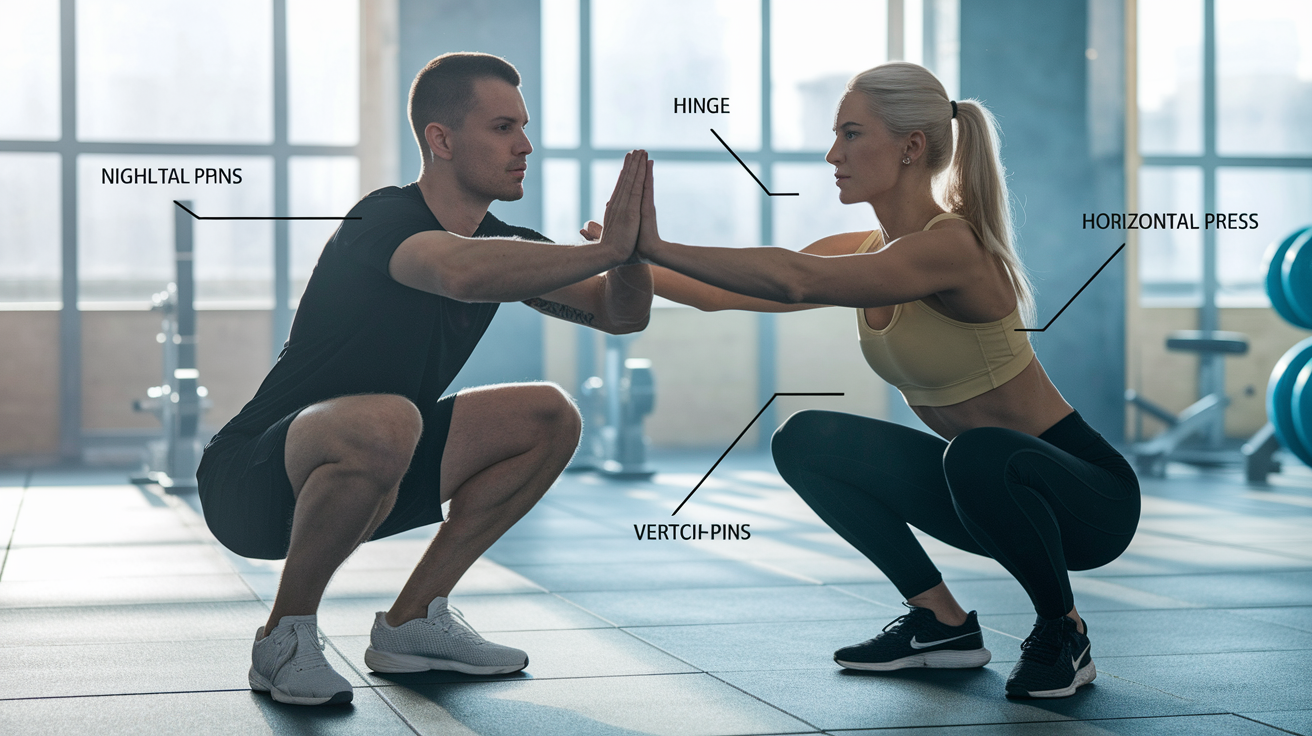
Squat: Stand with feet shoulder width apart and toes pointed slightly out. Brace your core like you’re about to take a light punch to the stomach. Firm, not stiff. Push your hips back first, then bend your knees to lower until your thighs are parallel to the floor. Keep your chest tall and your weight balanced mid-foot. Drive through your heels to stand. You should feel this in your glutes and legs, not your low back.
Hinge/Deadlift: Start with feet hip width apart and a slight bend in your knees. Hinge at the hips by pushing them straight back while keeping your spine neutral from head to tailbone. Your chest should point forward, not down. Grip the weight (or imagine gripping it if you’re practicing unloaded), squeeze your shoulder blades, and stand by driving your hips forward and squeezing your glutes. If you feel it in your lower back instead of your hamstrings and glutes, your hips aren’t moving back far enough.
Horizontal Press: Lie flat on a bench or the floor with feet planted. Hold dumbbells or a barbell directly above your chest with your wrists stacked over your elbows. Lower the weight under control until your elbows form a 90 degree angle or the bar lightly touches your chest. Press straight up without flaring your elbows too wide. Keep your shoulder blades pinched together the whole time to protect your shoulders.
Vertical Press: Stand or sit with your core tight and your ribs stacked over your hips. Press dumbbells or a barbell straight overhead, finishing with your biceps next to your ears and your elbows fully extended. Don’t lean back or arch your lower back to get the weight up. Lower the weight under control to shoulder height and repeat. You should feel this in your shoulders and triceps, not your neck.
How to Apply Progressive Overload
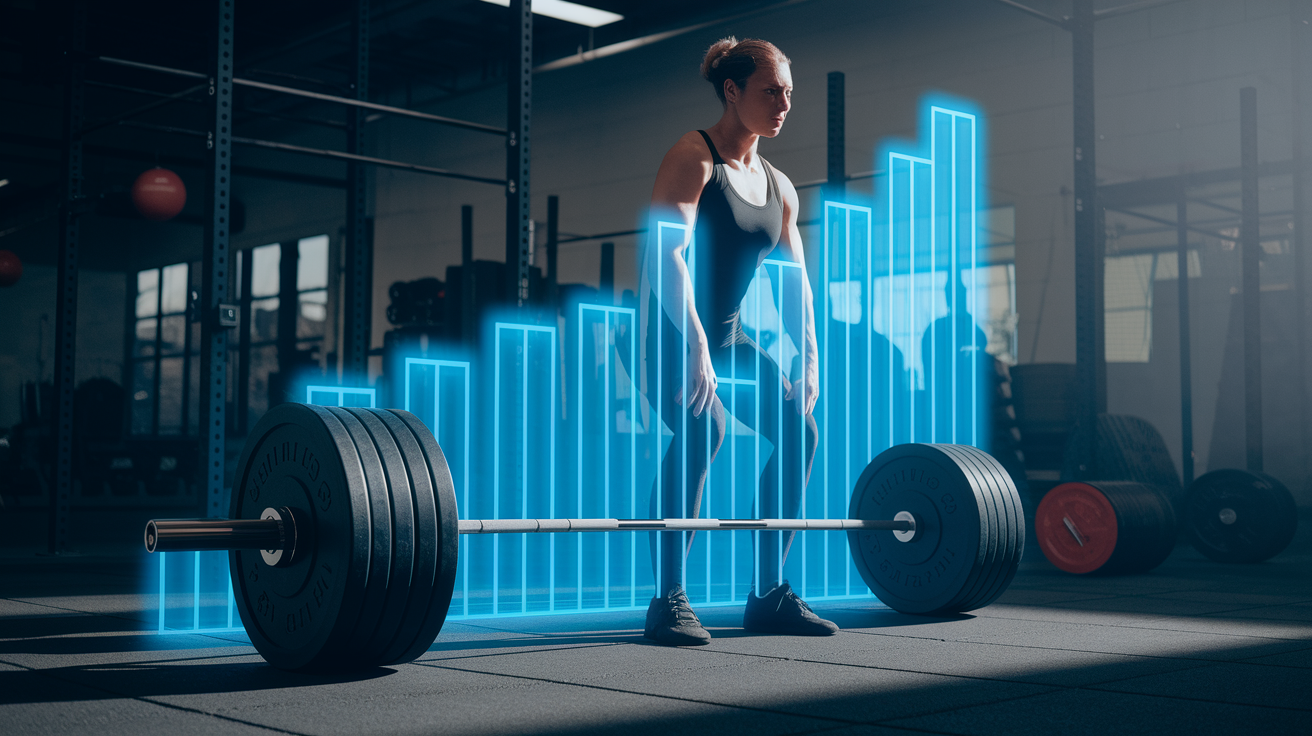
Progressive overload means doing slightly more work over time so your muscles keep adapting. Beginners respond quickly to small, steady increases. You can track improvement every single session if you pay attention. The simplest method is adding one or two reps each week until you hit the top of your rep range, then increase the weight by the smallest increment available and drop back to the lower rep count.
Here are five ways to apply overload without guessing:
Add weight: Increase the load by 2.5 to 5 pounds on upper body lifts and 5 to 10 pounds on lower body lifts when you complete all prescribed reps for two sessions in a row.
Add reps: If you can’t increase weight yet, add one rep per set each week until you reach 12 to 15 reps, then increase load and reset to 8 reps.
Add sets: Once you consistently complete three sets with good form, add a fourth set to increase total volume.
Reduce rest: Shorten rest periods from 90 seconds to 60 seconds between sets to increase workout density and conditioning.
Increase time under tension: Slow down the lowering phase of each rep to three or four seconds to create more muscle tension without adding weight.
Equipment and At‑Home Alternatives
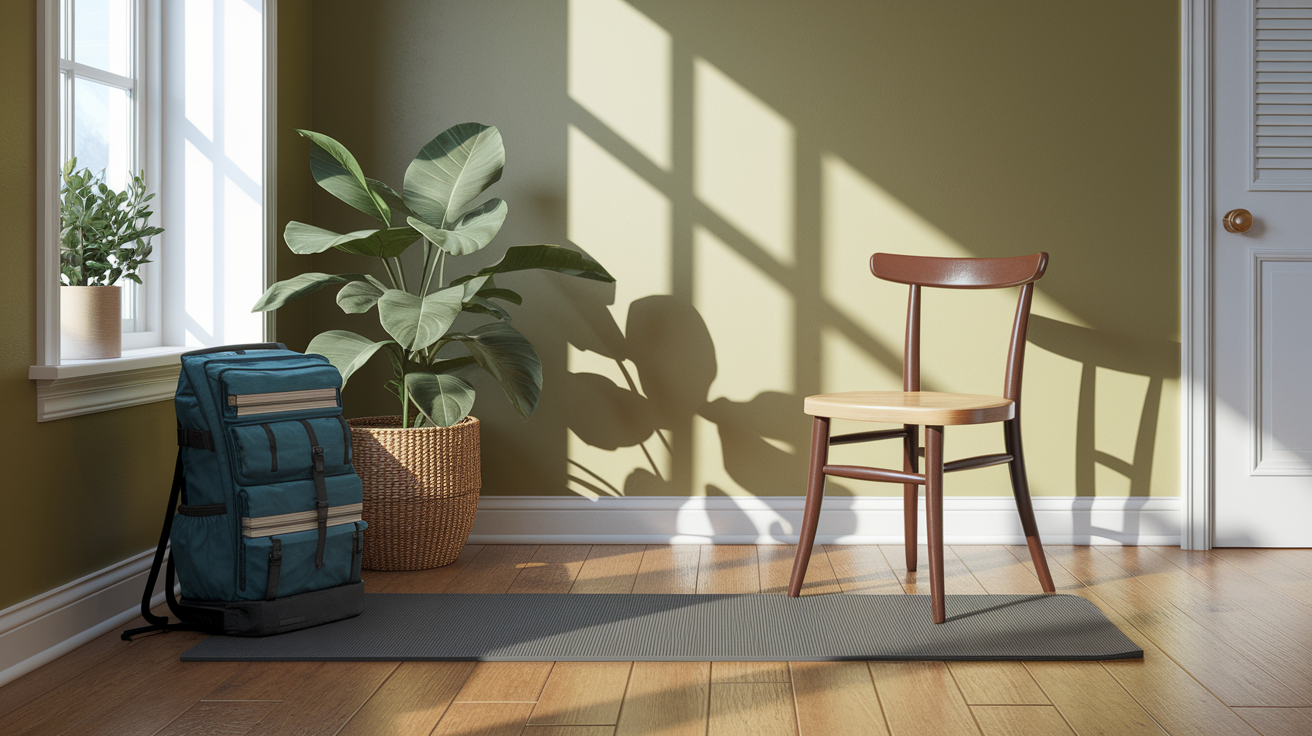
You don’t need a full gym to follow a beginner strength program. Many effective compound movements can be done at home with minimal or zero equipment. A backpack loaded with books or water bottles works as a substitute for dumbbells or a weighted vest. A sturdy chair or countertop can replace a barbell for support during bodyweight rows.
Goblet squat (no equipment): Perform bodyweight squats holding a heavy object like a gallon jug or a filled backpack at chest height.
Dumbbell row (no equipment): Use a loaded backpack or water jug in one hand while bracing against a chair or table with the other.
Dumbbell chest press (no equipment): Do push-ups on the floor or elevate your hands on a bench or chair to adjust difficulty.
Lat pulldown (no equipment): Perform pull-up negatives (jump to the top position and lower slowly) or resistance band pull-downs anchored above a door.
Romanian deadlift (no equipment): Hold a backpack or jug in both hands and perform single leg deadlifts for balance and hamstring work.
Overhead press (no equipment): Use pike push-ups (hands and feet on the floor, hips high) to mimic the pressing angle without weights.
If you have access to resistance bands, loop them around a door anchor or sturdy post to replicate cable and machine exercises. The movement pattern matters more than the exact tool, so practice the same hinge, press, and pull mechanics with whatever you have available.
Common Mistakes Beginners Should Avoid
New lifters often rush progression or skip foundational habits that protect long term progress. Avoiding these errors early builds better training habits and keeps you training consistently without setbacks or frustration.
Skipping the warm-up: Jumping straight into heavy sets without five to ten minutes of light cardio or dynamic stretching increases injury risk and reduces performance during the session.
Adding weight too fast: Increasing load every session feels productive, but your connective tissue adapts slower than your muscles. Stick to small weekly jumps to avoid joint pain and burnout.
Ignoring rest days: Training every day without recovery prevents muscle rebuilding and leads to fatigue, poor form, and plateaus. Rest at least one full day between full body sessions.
Chasing soreness: Muscle soreness isn’t a reliable measure of workout quality. Focus on lifting slightly more weight or completing more reps over time, not on how stiff you feel the next morning.
Copying advanced programs: Programs designed for experienced lifters include higher volume, frequency, and intensity than beginners need. Stick to simple full body routines until you’ve trained consistently for at least three to six months.
How to Progress Beyond the First Four Weeks

After completing your first four weeks, your nervous system has adapted to the movement patterns. Your muscles are ready for slightly more work. The simplest next step is adding one or two accessory exercises per session that target smaller muscle groups or address weak points you noticed during the main lifts. For example, add lateral raises after your pressing work to build shoulder stability, or include glute bridges after squats to strengthen hip extension.
You can also increase training frequency from three days per week to four by splitting your workouts into upper body and lower body sessions. This shortens each session to 30 to 45 minutes and lets you add more total volume across the week without making individual workouts exhausting. Keep using the same core movements and progression rules, track your sets and reps, and increase load only when you complete the top of your rep range for two consecutive sessions. Strength builds through repeatable habits, not program hopping.
Final Words
You’ve got a clear four-week plan in front of you: a simple schedule, form basics for squat, hinge, and presses, progressive overload options, and home-friendly substitutions.
Start with the schedule, prioritize proper bracing and a neutral spine, and add small, measurable overload each week. Track sets, reps, and rest so progress is real.
Follow this beginners strength training program for four weeks, then add one accessory or a bit more volume. Small, steady steps build real strength—keep going.
FAQ
Q: What is the four-week beginner strength training schedule?
A: The four-week beginner strength training schedule uses two full-body workouts (A and B), done two to three times weekly, focusing on compound lifts with 8–12 reps, 2–3 sets, and 60–90 seconds rest.
Q: How many sessions per week should a beginner do?
A: A beginner should do two to three strength sessions per week to build strength while allowing recovery; pick three if you recover well and two if time or recovery is limited.
Q: What are the core lifts I should master first?
A: The core lifts to master first are the squat, hinge (deadlift), horizontal press (bench or push-up), and vertical press (overhead press), since they build general strength and transfer to other moves.
Q: How should I brace and protect my spine during lifts?
A: To brace and protect your spine, brace like you’re about to take a light punch (firm but not rigid), keep a neutral spine, and exhale on the effort to maintain safe tension.
Q: How do I apply progressive overload as a beginner?
A: Progressive overload as a beginner means gradually increasing challenge over time by adding weight, reps, sets, slower reps (more time under tension), or reducing rest—one change at a time.
Q: What equipment can I use at home instead of gym gear?
A: At home you can use backpacks filled with books, water jugs, heavy suitcases, chairs for step-ups, towels for rows, and bodyweight variations to mimic common gym lifts and movements.
Q: How do I choose starting weights?
A: Choose starting weights that let you complete 8–12 reps with solid form, where the last one or two reps feel challenging but doable; adjust up or down based on that feedback.
Q: What common mistakes should beginners avoid?
A: Common mistakes beginners should avoid include rushing load increases, skipping warm-ups, skimping on sleep or recovery, using poor form to lift heavier, and inconsistent training.
Q: How do I progress after the first four weeks?
A: After the first four weeks, progress by adding small volume, one accessory per session, slightly more weight, or small rep increases, while tracking performance and keeping form clean.
Q: How long should rest between sets be?
A: Rest between sets for beginner strength work should be about 60–90 seconds to balance recovery and training quality; adjust slightly for heavier lifts or conditioning needs.