


Random heavy days won’t make you stronger.
A plan will.
This 12-week bench press program uses percentage-based loading to build muscle, force, and a reliable peak for a max single.
It starts with volume to groove your setup, shifts to heavier strength work, then a peaking block that sharpens technique under near-max loads.
Use an accurate 1RM for calculations, follow the weekly percentages and rest rules, and stop sets one or two reps before failure so bar speed stays quick.
Follow this plan and the small weekly jumps add up to a real PR on test day.
Your 12-Week Bench Press Program (Sets, Reps, Percentages)

This is the full 12 weeks. Each one builds on what you did before, moving from volume work through strength and into peaking. Stick to the percentages, sets, and reps shown. If something feels way too heavy or your form starts breaking down, knock your 1RM down a bit and keep going.
| Week | Sets | Reps | % of 1RM | Notes |
|---|---|---|---|---|
| 1 | 4 | 8 | 65% | Build capacity, focus on bar path |
| 2 | 4 | 8 | 70% | Add small load, maintain reps |
| 3 | 5 | 6 | 72% | Volume increase, slightly heavier |
| 4 | 5 | 6 | 75% | Last week of hypertrophy block |
| 5 | 4 | 5 | 78% | Strength phase starts, lower reps |
| 6 | 4 | 4 | 80% | Heavier loads, reduce reps |
| 7 | 5 | 4 | 82% | Add one set, keep intensity |
| 8 | 4 | 3 | 85% | High intensity, controlled reps |
| 9 | 3 | 3 | 88% | Deload volume, keep intensity |
| 10 | 5 | 2 | 90% | Peaking starts, very heavy doubles |
| 11 | 4 | 1 | 93% | Heavy singles, test technique |
| 12 | 1 | 1 | 100%+ | PR attempt or competition day |
You need an accurate 1RM to make this work. Say your max is 300 lb and the program calls for 4×8 at 70%. That’s 210 lb on the bar. If the weight feels way too heavy in Week 1 or 2, drop your entered max by 5 to 10 lb and recalculate. The program assumes you can finish all sets and reps with solid form. Stop each set one or two reps before failure so bar speed stays quick and your technique doesn’t fall apart.
Weekly Progression and Training Structure

Every week pushes either intensity or volume up, sometimes both. Early weeks use moderate percentages with higher reps to build work capacity and clean up your setup, leg drive, and bar path. Middle weeks drop the reps and raise the percentages, shifting from muscle building to heavier strength work. The final weeks are all about very heavy loads with minimal reps, prepping your nervous system and technique for a max single.
The progression is deliberate. Adding 2.5 to 5 lb each week, or tossing in one extra set, won’t feel dramatic right away. But it stacks up. Week 4 at 75% for six reps might feel manageable. Week 8 at 85% for three will feel much heavier, but your body will have adapted through the earlier volume. This slow build prevents burnout, keeps your joints happy, and lets technique improvements settle in before the load gets truly challenging.
Rules to follow through all 12 weeks:
- Add weight only when the program says so. Don’t jump ahead because you’re feeling good or impatient.
- Treat every rep like practice for your 1RM attempt. Keep your shoulder blades pinched, chest up, feet planted.
- Rest 3 to 4 minutes between working sets in strength and peaking weeks. 2 to 3 minutes during the higher rep weeks.
- Bar speed should stay controlled and smooth. If reps start grinding before the final one, the load’s too heavy for that day.
- Track your recovery session to session. Watch soreness, sleep quality, whether warm-up sets feel normal or off.
Periodization Phases Explained
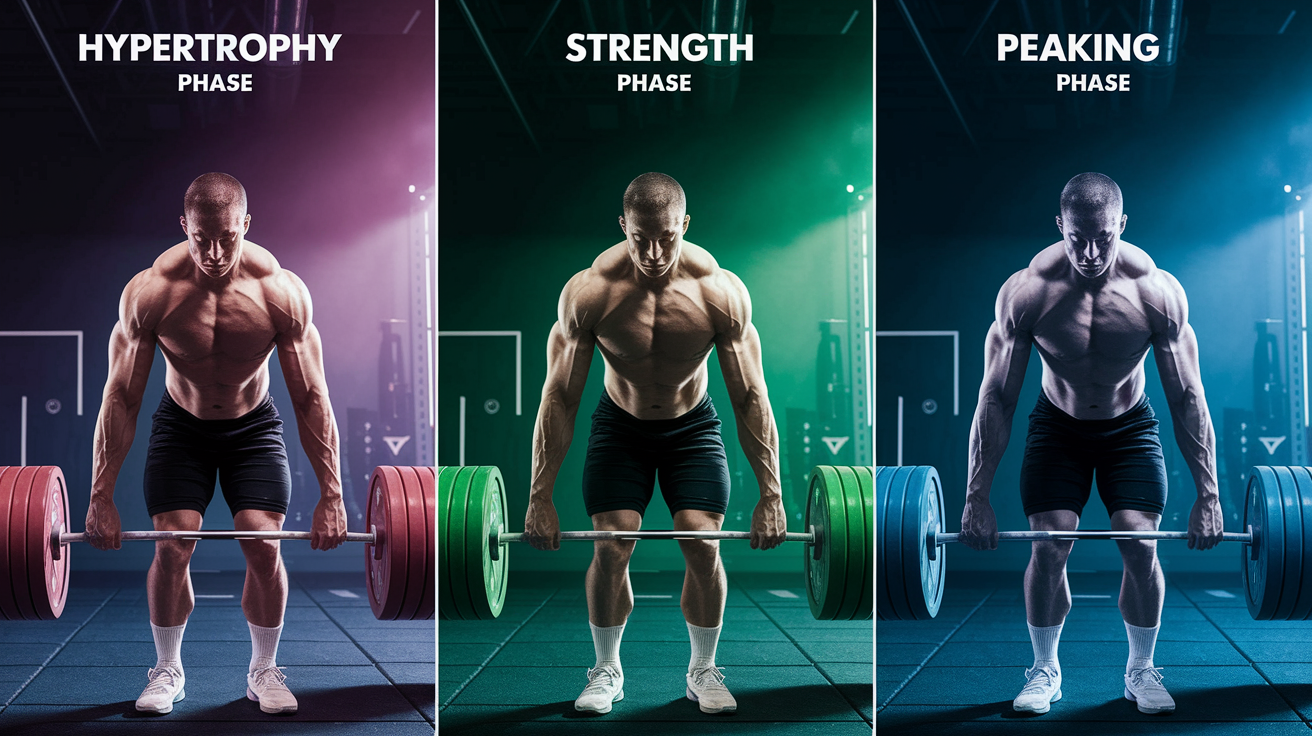
Periodization organizes training into blocks, each with its own job. Instead of going heavy every week and hoping for the best, you build a foundation first, then turn that into heavier strength, then sharpen it into a peak. This cuts injury risk, prevents staleness, and produces bigger long-term gains than random heavy days.
Hypertrophy Phase
Weeks 1 through 4 sit at 60 to 70% of your 1RM for sets of six to eight reps. You’re not testing your max here. You’re adding muscle to your chest, shoulders, and triceps, and grooving your technique under moderate loads. Higher reps mean more time under tension, which drives muscle growth and improves your ability to handle volume. Finish each set feeling like you could do one or two more reps, but stop there to keep quality high across all sets.
Strength Phase
Weeks 5 through 9 shift to 75 to 88% of your 1RM for sets of three to five reps. Volume stays moderate but intensity climbs. Your muscles can now handle the workload, so the focus moves to recruiting more motor units and building force production. Reps drop because heavier loads need more recovery between sets and more mental focus per rep. This is where you start feeling genuinely strong, and where small technique flaws become obvious under heavier weight.
Peaking Phase
Weeks 10 through 12 use 90 to 100%+ of your 1RM for sets of one to three reps. Volume drops hard because intensity is very high. The goal is prepping your nervous system to produce maximum force in a single rep and fine-tuning your setup, unrack, descent, and press under near-maximal loads. Week 12 is your test day. If you followed the program and recovered properly, your body will be primed to press more than your starting 1RM.
Key Accessory Exercises for Bench Strength
Accessory work fills gaps that the main bench press doesn’t fully cover. Your bench recruits your chest, front delts, and triceps, but weak points in any of those will limit your progress. Accessories also build the upper back and rear delts, which stabilize the bar during the descent and give you a solid base to press from. Smart accessory choices make your weak points stronger and your strong points more durable.
Movements to include in your training week:
- Close-grip bench press: emphasizes triceps lockout strength, reduces shoulder strain compared to wide-grip pressing.
- Dips (weighted when possible): builds pressing power through chest and triceps with a slightly different angle than flat bench.
- Barbell rows or chest-supported rows: strengthen your upper back to control bar path and create a stable shelf to press from.
- Overhead press (standing or seated): improves shoulder strength and stability, carries over to the lockout portion of the bench.
- Rolling dumbbell triceps extensions: isolates the triceps through full range of motion, builds elbow extension strength.
- Face pulls or band pull-aparts: target rear delts and upper-back health, prevent shoulder imbalances from too much pressing.
- Paused bench press: teaches you to stay tight at the bottom position, builds starting strength off the chest.
- Floor press or pin press: isolates the lockout portion, builds triceps strength in the top half of the range.
Pick two to four accessory movements per session. Do them after your main bench work for three to four sets of eight to twelve reps, or follow the specific set and rep guidance from your program’s accessory block. The goal is building capacity and fixing weak points, not destroying yourself. If your triceps are always the limiting factor in your bench, prioritize close-grip pressing and extensions. If your upper back rounds forward under heavy loads, add more rowing volume.
Training Frequency, Rest, and Recovery Guidelines

Most lifters will bench two to three times per week during this program. One session focuses on the main percentage-based work from the table. A second session can include lighter technique work, a supplemental variation like close-grip or paused bench, or additional volume at lower intensity. Three sessions per week works well for advanced lifters who recover quickly, but two sessions per week is enough for most intermediates and allows more recovery time between heavy pressing days.
Rest at least 48 hours between bench-focused sessions. If you bench on Monday, your next pressing session should be Thursday at the earliest. Pressing heavy two days in a row doesn’t give your muscles, tendons, or nervous system enough time to adapt. You can train lower body or do light accessory work on off days, but skip shoulder-intensive movements like heavy overhead press or dips the day before a programmed bench session.
Recovery determines whether the program works. Sleep 7 to 9 hours per night so your body can repair muscle tissue and rebuild strength. Eat enough total calories to support muscle growth. Aim for a small surplus if you want to maximize gains. Keep protein intake high, around 0.8 to 1 gram per pound of bodyweight daily. Track how you feel during warm-ups. If the bar feels heavy at 50% of your 1RM, you’re likely under-recovered and should consider an extra rest day or a slight reduction in volume for that session.
Deload Week Structure and How to Use It

A deload week reduces training stress so your body can catch up with the fatigue you’ve built up. Without it, you risk plateauing or getting injured as fatigue piles up faster than adaptation. Week 9 in this program serves as a built-in deload, dropping volume while keeping intensity relatively high. This maintains your strength adaptations while giving your joints, tendons, and central nervous system a break.
Deload adjustments to apply during Week 9 or any additional deload week you need:
- Cut total working sets by 40 to 60%. If your normal session includes five sets, drop to two or three.
- Lower intensity by 5 to 10%. If the program calls for 88%, use 80 to 83% instead to keep the movement feeling sharp without taxing recovery.
- Keep training frequency the same. Still bench two to three times that week so you don’t lose the movement pattern or feel rusty afterward.
- Cut accessory volume in half or skip higher-fatigue accessories like heavy dips or close-grip bench. Stick to lighter isolation work or mobility drills.
After the deload week, return to full programmed training in Week 10. Your first working set back should feel noticeably easier than it did before the deload. Bar speed will be faster, reps will feel crisper, and your confidence under heavy loads will improve. If you feel flat or sluggish coming out of a deload, you likely didn’t rest enough or your nutrition and sleep were lacking during the deload itself.
Final Words
Start week 1 and follow the 12-week layout exactly: sets, reps, and percentage targets for each phase. You’ve got the weekly progression rules to add weight safely, the periodization plan (hypertrophy → strength → peaking), and a clear list of accessory lifts to support your pressing.
Rest and deload guidance helps you recover and keep getting stronger. Track your lifts, tweak small steps, and stay consistent.
This bench press program for strength is built to give steady, proven gains. You’ve got this.
FAQ
Q: What does the 12-week bench press program include?
A: The 12-week bench press program gives a full weekly layout with sets, reps, and % of 1RM across 12 weeks, moving from hypertrophy to strength to peaking for steady overload and focus.
Q: How do I read and apply the % of 1RM in the program?
A: The % of 1RM in the program means percent of your one‑rep max; test a recent heavy single or estimate from a 3–5RM, then use that weight as the baseline and adjust weekly.
Q: How should I progress week to week?
A: Weekly progression means adding about 2.5–5 lb per week or tweaking volume, keeping technique and bar speed consistent, and letting recovery or form problems slow your increases.
Q: What are the periodization phases and their loads/reps?
A: The periodization phases are hypertrophy (60–70% 1RM, 8–12 reps), strength (75–85% 1RM, 4–6 reps), and peaking (85–95% 1RM, 1–3 reps), each shifting volume and intensity.
Q: Which accessory exercises should I use for bench strength?
A: Accessory exercises for bench strength include close‑grip bench, dips, dumbbell bench, barbell or dumbbell rows, overhead press, triceps extensions, face pulls, and rotator cuff work for stability.
Q: How many accessory movements per session and how should I structure them?
A: Aim for 2–4 accessory movements per session: one pressing/triceps, one upper‑back row, one shoulder stability, and an optional isolation. Keep sets 3–4 and reps 6–12 depending on phase.
Q: How often should I bench press and how long to rest between sessions?
A: You should bench press 2–3 times per week with 48–72 hours between focused sessions, adjusting frequency based on fatigue, session intensity, and life stressors.
Q: What are the deload week instructions?
A: A deload week reduces volume 40–60% and intensity 10–20%, lowers accessory work and frequency, focuses on technique and recovery, then resumes planned training the following week.
Q: How do I pick a starting 1RM safely?
A: To pick a starting 1RM safely, estimate from a recent 3–5RM or use a calculator, or test singles with a spotter and stop before technical breakdown to avoid risky attempts.
Q: What should I do if I miss a session or hit a plateau?
A: If you miss a session, return to the planned workload or slightly reduce load; if plateaued, check technique, add a deload, adjust accessory work, or make smaller, more consistent jumps.