
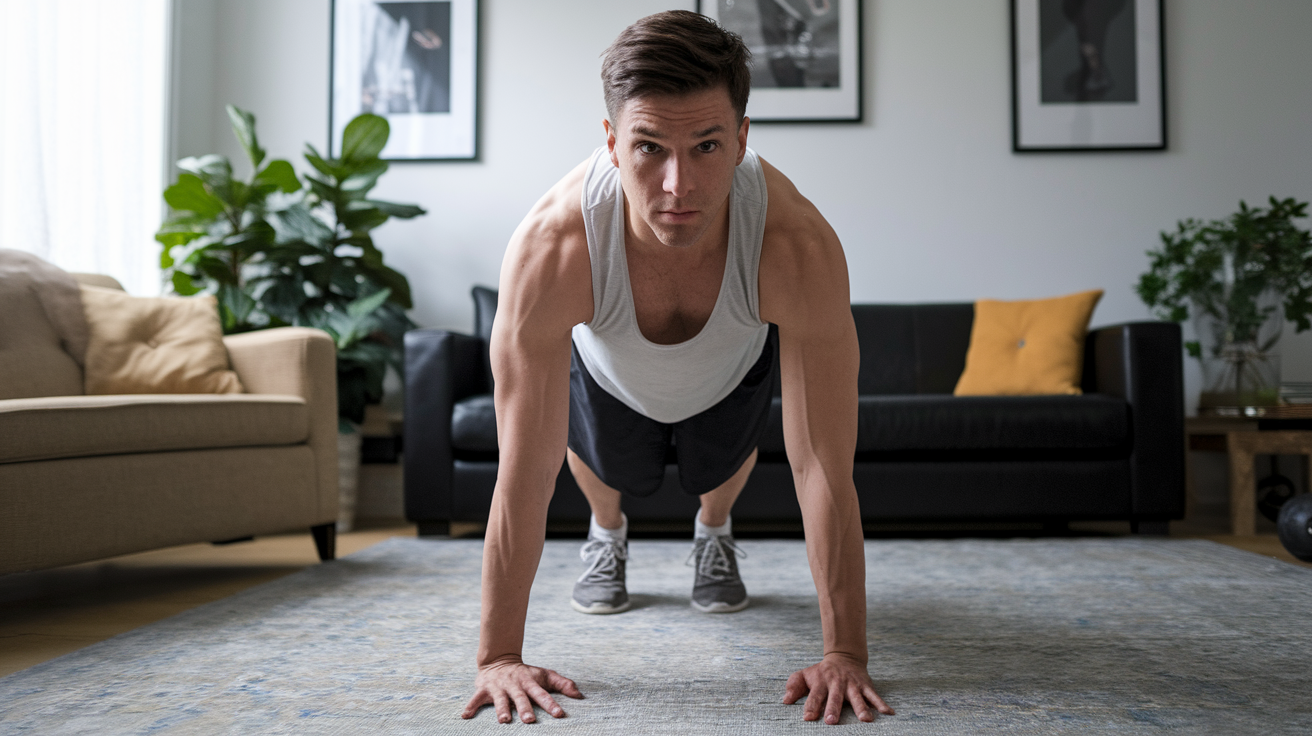

You don’t need to live at the gym or split your training into five days to get stronger.
A smart full-body beginner routine hits legs, back, chest, shoulders, arms and core in one 30–40 minute session.
This plan gives you 8 simple moves—squat, push-up, glute bridge, dumbbell row, step-up, overhead press, dead bug and plank—that you can do at home with light dumbbells and a chair.
Do it 2–3 times a week, start with 1–2 sets of 8–12 reps, and you’ll build balanced strength and better movement without burning out.
Beginner Full‑Body Workout Overview
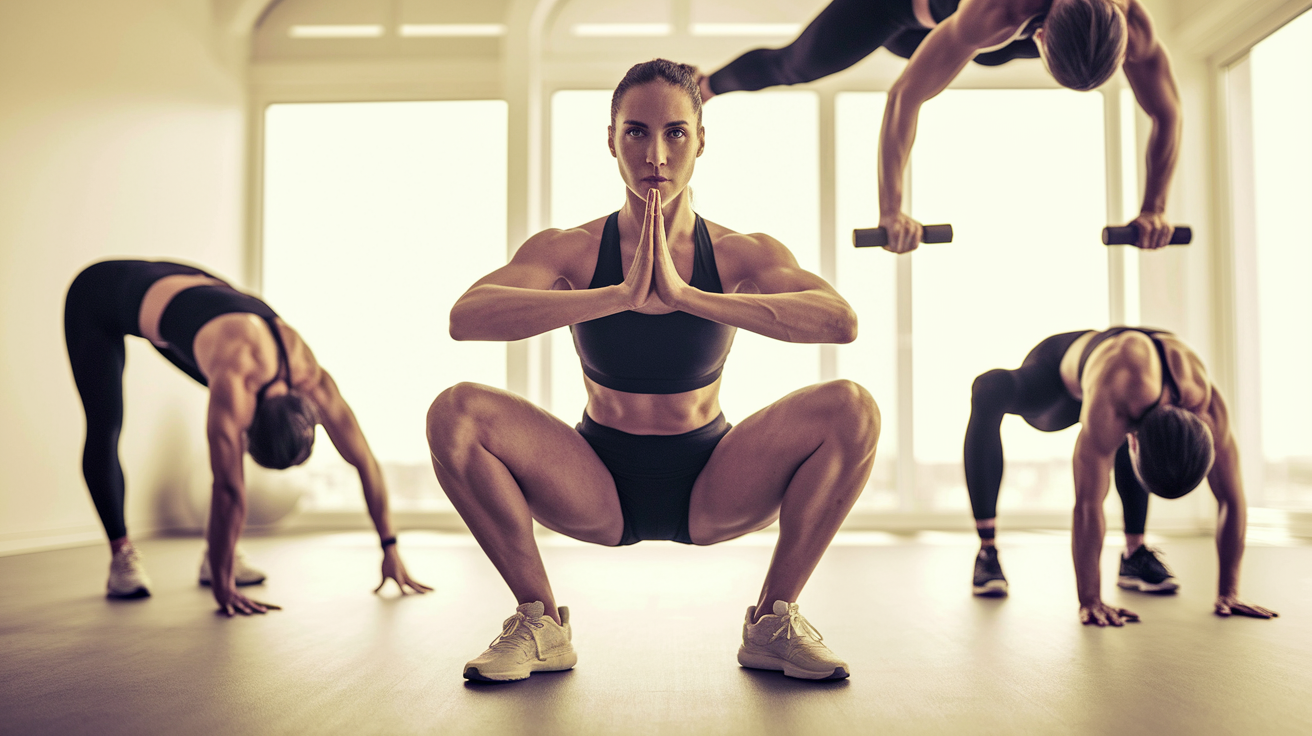
A full‑body beginner workout hits all your major muscle groups in one session using simple, foundational movements. Instead of splitting exercises across different days, you train legs, back, chest, shoulders, arms and core together. It’s efficient, builds balanced strength, and doesn’t require you to live at the gym.
This routine covers 8 exercises that work every important muscle group. You can do most of it at home with a pair of light dumbbells and a sturdy chair. The exercises rely on bodyweight or minimal resistance, so you’re learning correct form before adding serious load. Every movement is a building block that carries over to everyday tasks and sets you up for more advanced training down the road.
The 8 exercises:
- Squat
- Push‑Up
- Glute Bridge
- Dumbbell Row
- Step‑Up
- Overhead Press
- Dead Bug
- Plank
Start with 1 to 2 sets of 8 to 12 reps per exercise. Rest 60 to 90 seconds between sets. Train this 2 to 3 times per week with at least one full rest day between sessions. Total workout time runs around 30 to 40 minutes, including a quick warm‑up. Stick with it for 4 to 8 weeks and you’ll see noticeable strength gains plus better movement quality.
Step‑By‑Step Instructions for Each Exercise

Squat
The squat builds your quads, glutes and core. It teaches you to move through a full hip and knee range safely.
- Stand with feet shoulder‑width apart, toes angled slightly out.
- Brace your core like you’re about to take a light punch to the stomach.
- Lower yourself by bending your knees and pushing your hips back. Keep your chest up and weight in your heels.
- Go down until your thighs are at least parallel to the floor, or as low as you can manage with a flat back.
- Drive through your heels and stand up. Squeeze your glutes at the top.
- Breathe in on the way down, breathe out as you stand.
Push‑Up
Push‑ups train your chest, triceps, front shoulders and core in one go.
- Start in a plank with hands slightly wider than shoulder‑width, arms straight.
- Keep your body in a straight line from head to heels. Core tight, glutes engaged.
- Lower your chest toward the floor by bending your elbows at roughly 45 degrees to your torso.
- Stop when your chest is 1 to 2 inches from the ground, or as low as you can control.
- Push back up to the starting position, fully extending your arms.
- If a floor push‑up is too hard, place your hands on a bench, step or countertop.
Glute Bridge
The glute bridge targets your glutes and hamstrings. It teaches hip extension without stressing your lower back.
- Lie on your back with knees bent and feet flat on the floor, hip‑width apart.
- Place your arms by your sides, palms down.
- Squeeze your glutes and push through your heels to lift your hips off the floor.
- Raise your hips until your body forms a straight line from shoulders to knees.
- Pause at the top for one second. Keep your core tight and don’t arch your lower back.
- Lower your hips back to the floor with control and repeat.
Dumbbell Row
The dumbbell row strengthens your upper back, lats and biceps. It teaches you to pull with control.
- Hold one dumbbell in your right hand and place your left hand and left knee on a bench for support.
- Keep your back flat and roughly parallel to the floor, spine neutral.
- Let the dumbbell hang straight down from your shoulder, arm fully extended.
- Pull the dumbbell toward your hip by driving your elbow back, keeping it close to your body.
- Squeeze your shoulder blade at the top, then lower the weight slowly.
- Finish all reps on one side, then switch arms.
Step‑Up
Step‑ups build single‑leg strength in your quads and glutes. They improve balance.
- Stand in front of a sturdy bench, box or step that’s roughly knee height.
- Place your right foot fully on the step, heel firmly planted.
- Push through your right heel to step up, bringing your left foot to meet your right on top of the step.
- Step back down with your left foot first, then your right, returning to the starting position.
- Complete all reps leading with your right leg, then switch and lead with your left.
- Keep your chest up and don’t push off hard with your back foot. The top leg does the work.
Overhead Press
The overhead press targets your shoulders, triceps and upper chest. It trains core stability.
- Stand with feet shoulder‑width apart, holding a light dumbbell in each hand at shoulder height, palms facing forward.
- Brace your core and squeeze your glutes to keep your torso stable.
- Press the dumbbells straight overhead until your arms are fully extended, keeping your elbows slightly in front of your body.
- Don’t lean back or arch your lower back as you press.
- Lower the weights back to shoulder height with control.
- Breathe out as you press up, breathe in as you lower.
Dead Bug
The dead bug teaches core control and coordination. You move opposite limbs while keeping your lower back pressed to the floor.
- Lie on your back with arms extended straight up toward the ceiling and knees bent at 90 degrees, shins parallel to the floor.
- Press your lower back firmly into the floor by engaging your core.
- Slowly lower your right arm overhead and extend your left leg straight, stopping just above the floor.
- Keep your lower back pressed down the entire time.
- Return your right arm and left leg to the starting position, then repeat on the opposite side.
- Move slowly and with control. One rep is one arm‑and‑leg pair on each side.
Plank
The plank builds total‑core stability and endurance.
- Start in a forearm plank with elbows directly under your shoulders, forearms flat on the floor.
- Extend your legs straight back, balancing on your toes. Your body forms a straight line from head to heels.
- Engage your core, squeeze your glutes and keep your hips level. Don’t let them sag or pike up.
- Keep your neck neutral by looking at a spot on the floor a few inches in front of your hands.
- Hold this position for 20 to 60 seconds, breathing steadily.
- If holding a full plank is too hard, drop to your knees while keeping your core tight.
Safety Guidelines for Beginners

The biggest risks? Doing too much too soon and using poor form under fatigue. Jumping into heavy weights or high volume before your body’s ready leads to soreness that lasts for days, joint pain and a higher chance of pulling or straining something. Start with 1 to 2 sets per exercise and add volume slowly. Better to feel like you could have done a bit more than to wreck yourself in week one.
Warm up for at least 5 to 10 minutes before every session. A brisk walk, light jog in place, or a few minutes of dynamic movements like arm circles, leg swings and bodyweight squats will raise your heart rate and prepare your joints and muscles. After your workout, spend 5 to 10 minutes cooling down with light movement and simple stretches for your quads, hamstrings, chest, back and shoulders. Hold each stretch for 15 to 30 seconds. This helps your body recover and reduces next‑day stiffness.
Stop immediately if you feel sharp, stabbing or unusual pain in a joint or muscle. Soreness the next day is normal. Pain during a movement is not. If something hurts, drop the weight, reduce your range of motion or skip that exercise and try a simpler variation. Rest at least one full day between full‑body sessions. If you’re still very sore or fatigued, take an extra rest day. Progress happens during recovery, not during the workout itself.
Progression Options for the First 8 Weeks

The simplest way to get stronger? Do a little more each week. Add 1 to 3 reps to each set when the current rep count feels comfortable. When you can hit 12 reps cleanly for 2 sessions in a row, either add another set or increase the resistance slightly. For weighted exercises, add roughly 2.5 to 10 percent more load.
After your first 2 to 3 weeks, you’ll notice exercises that used to feel hard now feel manageable. That’s your signal to progress. Don’t rush to add weight or reps every single workout. Small, steady improvements over 8 weeks add up to real strength and confidence.
Six ways to progress safely:
- Add 1 to 3 reps per set each week until you reach 12 to 15 reps.
- Add one extra set to each exercise after week 3, moving from 2 sets to 3 sets.
- Increase dumbbell weight by 2.5 to 5 pounds when you can complete 2 extra reps above your target for two sessions.
- Reduce rest intervals from 90 seconds to 60 seconds between sets to increase workout density.
- Switch from an easier variation to a harder one. Move from incline push‑ups to floor push‑ups, or from a two‑leg glute bridge to a single‑leg bridge.
- Slow down the lowering phase of each rep to 3 seconds to increase time under tension and muscle stimulus.
Beginner Weekly Training Schedule
A simple 3‑day weekly schedule gives you enough training stimulus to improve while leaving plenty of time to recover. Monday, Wednesday and Friday is a classic layout because you get a full rest day between sessions. If your week is unpredictable, aim for any three non‑consecutive days. The exact days matter less than consistency and recovery time.
If you want to add light activity on rest days, go for a walk, do some gentle stretching or try 10 to 15 minutes of mobility drills. Don’t do another full‑body strength session or any high‑intensity work that taxes the same muscle groups. Your muscles grow and adapt during rest, not during the workout. Treat rest days as part of the program, not wasted time.
| Day | Activity |
|---|---|
| Monday | Full‑body workout (30–40 minutes) |
| Tuesday | Rest or light walk / stretching |
| Wednesday | Full‑body workout (30–40 minutes) |
| Thursday | Rest or mobility drills |
| Friday | Full‑body workout (30–40 minutes) |
| Saturday | Rest or optional light cardio |
| Sunday | Rest |
Minimal Equipment Guide

You can complete this entire routine with almost nothing. A yoga mat or towel for floor exercises, a single pair of light dumbbells (5 to 15 pounds depending on your current strength) and a sturdy chair or step for step‑ups and incline push‑ups will cover everything. If you don’t have dumbbells yet, start with bodyweight‑only versions of every exercise and add resistance in week 3 or 4.
Buying a pair of adjustable dumbbells gives you the most flexibility as you get stronger. A set that adjusts from 5 to 25 pounds per hand will last you through your first few months and costs roughly 50 to 100 dollars. If that’s out of budget right now, use household items like water bottles, canned goods or a loaded backpack for exercises like rows and overhead presses. The goal is progressive resistance, and anything that adds a bit of controlled load works.
Essential and optional equipment:
- Yoga mat or exercise mat, around 10 to 40 dollars. Provides cushioning and grip for floor work.
- Pair of light dumbbells (5 to 15 lb each), roughly 20 to 60 dollars, or adjustable dumbbells 50 to 150 dollars.
- Sturdy chair or low bench. Use what you already have at home (free).
- Resistance band, 10 to 25 dollars. Useful for adding assistance or resistance to rows, presses and bridges.
- Step or box (12 to 18 inches high), 15 to 50 dollars, or use a stable outdoor step or low porch (free alternative).
Final Words
Start the workout now. Use 6–8 compound and bodyweight moves, done 2–3 times weekly. You’ve got clear cues for squats, push‑ups, glute bridges, rows, presses, dead bugs, planks, and step‑ups so form stays solid.
We covered safety, warm‑ups, and an eight‑week progression so you can add reps or light weight safely. There’s a short weekly schedule and a minimal equipment list to keep it realistic.
Pick the default plan, track small wins, and keep showing up. This steady path is the best full body workout for beginners and gets results.
FAQ
Q: Should a beginner do a full-body workout?
A: A beginner should do a full-body workout because it trains all major muscles, builds strength quickly, fits 2-3 sessions per week, needs little equipment, and offers simple progress options.
Q: What’s the best exercise for type 2 diabetes?
A: The best exercise for type 2 diabetes combines regular aerobic activity and resistance training, like walking plus squats and rows, to improve blood sugar control; check with your healthcare provider first.
Q: What is the 3-3-3 rule for workout?
A: The 3-3-3 rule for workouts is an easy beginner framework: three sets per exercise, about three core moves per session, and three workouts per week for steady, manageable progress.
Q: What is a good beginner full-body workout routine?
A: A good beginner full-body workout routine is 6-8 compound and bodyweight moves—squats, push-ups, dumbbell row, glute bridge, step-ups, overhead press, dead bug, plank—1-2 sets of 8-12 reps, 2-3 times weekly.