


You don’t need fancy programs or long sessions to make real progress in the gym.
Start with a clear, repeatable plan, safe movements, and three short workouts a week.
In this guide you’ll get a beginner-friendly routine that fits 30-45 minute sessions, shows exactly what to do for cardio, lower- and upper-body days, and teaches how to add weight safely.
No guesswork. No ego lifts.
Just simple progress you can track and repeat so you start strong and stay consistent.
The Complete Starter-Friendly Gym Routine Overview for New Lifters
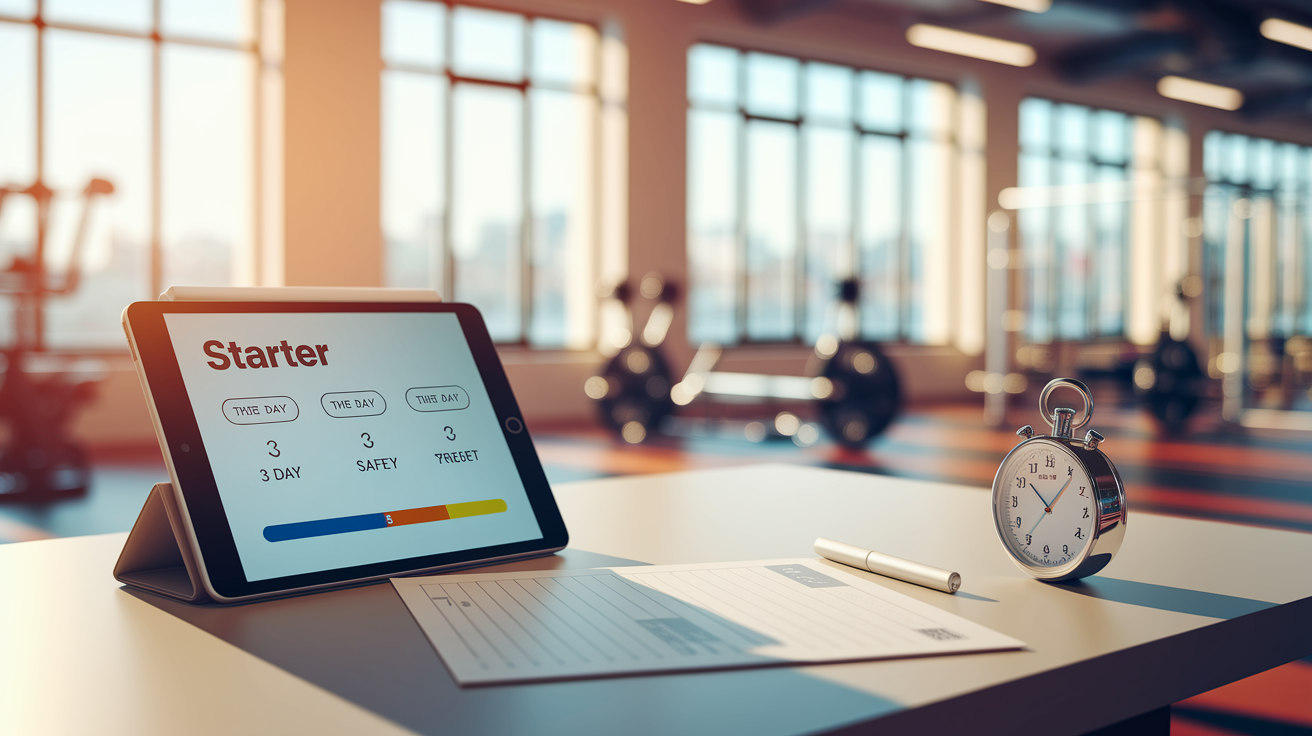
Walk into the gym for the first time and you need three things: a clear plan, a safe starting point, and simple steps you can repeat. A beginner gym routine isn’t about doing everything at once or copying advanced programs. It’s about building the habit, learning basic movements, and making steady progress without getting hurt or burned out.
Most beginners do well with three short gym visits per week. That gives your body time to adapt, your schedule room to breathe, and your mind space to learn what works. A typical first week includes one cardio session, one lower body strength session, and one upper body strength session. Each visit builds on the last. Every workout teaches you something new about how your body moves under load.
Plan on spending about 30 to 45 minutes per session when you’re starting out, including warm up and cooldown. You don’t need fancy programs or marathon sessions. Consistency wins, and short sessions you can stick to beat perfect plans you skip.
Here’s what a simple first week routine looks like:
- Day 1 – Cardio session (20–25 minutes on a machine you can sustain, like a treadmill, bike, or elliptical)
- Day 2 – Rest or light movement
- Day 3 – Lower body strength (3 sets of 10–20 reps for exercises like box squats, lunges, glute bridges)
- Day 4 – Rest or light movement
- Day 5 – Upper body strength (3 rounds of exercises like lat pulldowns, dumbbell chest press, planks)
- Day 6 – Optional light cardio or full rest
- Day 7 – Full rest
Every session starts with a warm up (think brisk walking and light movement) and ends with a cooldown (easy cardio and stretching). You’ll use basic equipment like machines, dumbbells, or just your bodyweight. Track what resistance or weight you use and how it feels so you can add a little more next week.
Warm-Up Essentials for a Beginner-Friendly Gym Routine

A proper warm up gets blood flowing, wakes up your nervous system, and prepares your joints and muscles to handle weight safely. Start with a brisk 3 to 5 minute walk on the treadmill or around the gym. You should feel your heart rate pick up slightly and your breathing deepen.
After that, add simple dynamic stretches like leg swings (forward and side to side) and ankle rotations. These movements take your joints through their range of motion without forcing anything.
If you’re using foam rollers, spend about 30 seconds per side on areas like your calves, quads, or upper back. Dynamic movements like arm circles or walking knee hugs should be done for about 5 reps per side. If you prefer cardio style warm ups, try 30 seconds each of movements like jumping jacks or mountain climbers at an easy pace. The goal isn’t to exhaust yourself before you even start lifting. It’s to signal your body that work is coming.
Here are four simple warm up formats you can rotate:
- Foam rolling – 30 seconds per muscle group (calves, quads, glutes)
- Dynamic stretches – 5 reps per side (leg swings, hip circles)
- Light cardio drills – 30 seconds each (jumping jacks, high knees, mountain climbers)
- Machine cardio – 5 minutes at very low resistance (elliptical at resistance 1–3, or treadmill at a brisk walk)
Full-Body Beginner Gym Routine Structure and Exercise Selection
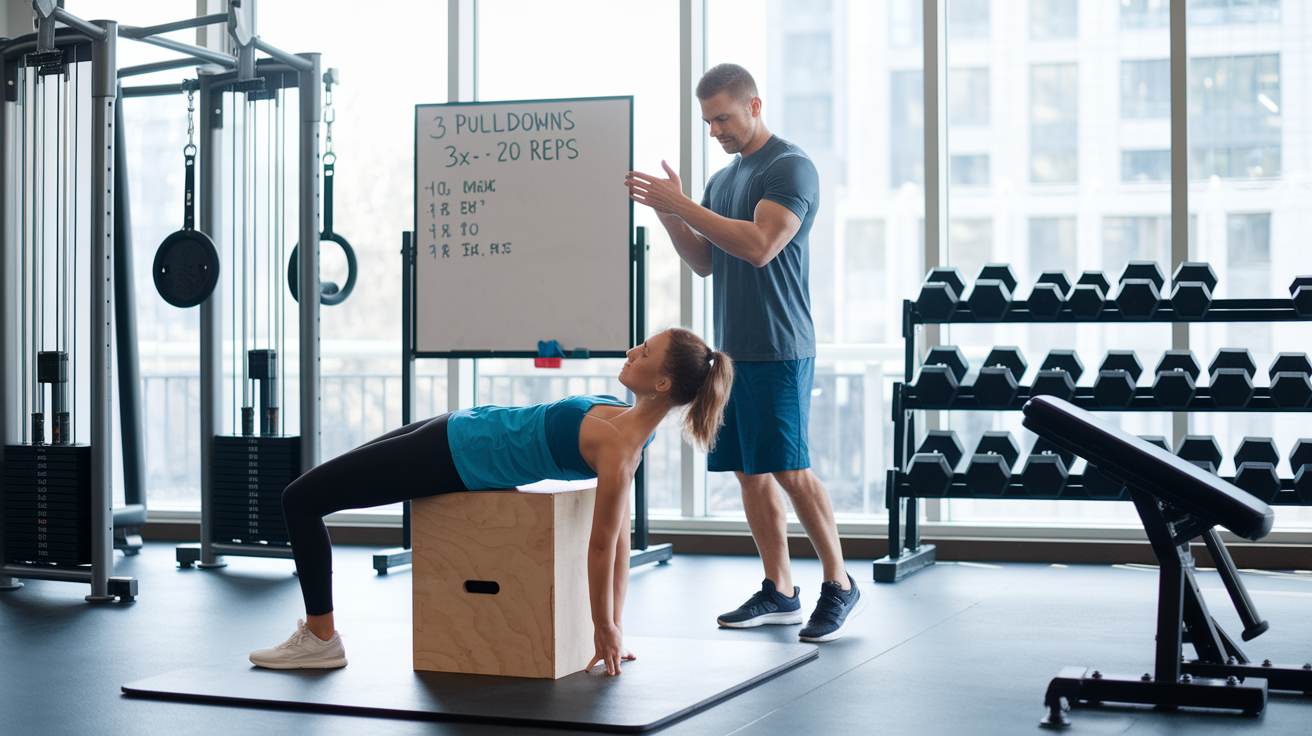
A full body beginner routine hits all your major muscle groups in a single session. You’ll work legs, back, chest, shoulders, and core using compound movements (exercises that use multiple joints and muscle groups at once). These movements give you the most return on your time and teach you the foundation patterns you’ll use for years.
Your lower body workout might include 3 sets of 10 to 20 reps for exercises like box squats, stationary lunges, calf raises, and glute bridges. Your upper body session uses 3 rounds of movements like lat pulldowns, dumbbell chest press, and high planks. Start light. The first few sessions are about learning the movement pattern and staying safe, not testing your limits.
Pay attention to form cues every rep: keep your core engaged, maintain a neutral spine (don’t arch your lower back or round your shoulders), align your knees with your toes on squats and lunges, push through your heels on squats, and control the lowering phase on presses and rows. Slow and controlled beats fast and sloppy every time.
| Exercise | Target Muscle | Beginner Sets/Reps |
|---|---|---|
| Box Squat | Legs (quads, glutes) | 3 sets × 10–20 reps |
| Stationary Lunge | Legs (quads, glutes, hamstrings) | 3 sets × 10–20 reps per leg |
| Glute Bridge | Glutes, hamstrings | 3 sets × 10–20 reps |
| Lat Pulldown | Back (lats, biceps) | 3 sets × 6–10 reps |
| Dumbbell Chest Press | Chest, triceps, shoulders | 3 sets × 10–15 reps |
| High Plank | Core (abs, shoulders, back) | 1 set, hold as long as possible |
Strength Training Basics and Progressive Overload for Beginners

Strength training for beginners is about picking a weight you can control and adding a little more over time. That steady increase is what builds muscle and improves strength. Start with a weight that lets you complete 8 to 12 reps with good form, and make sure the last couple reps feel challenging but not impossible.
Write down what you lift. Log your sets, reps, and weights in a notes app or on paper so you know what to beat next week. When you can complete all your prescribed reps cleanly, bump the weight up by about 10 to 20 percent. That might mean moving from a 10 pound dumbbell to a 12 pound dumbbell, or adding one more plate on a machine. Small jumps keep you safe and give your joints and tendons time to adapt alongside your muscles.
Never push through pain. Effort and discomfort are normal. Sharp pain, joint pain, or anything that makes you wince is a stop sign. Drop the weight, check your form, or rest.
Machines are a smart choice early on because they guide the movement path and provide stability. Free weights like dumbbells require more balance and core control, so save those for after you’ve built a solid base with bodyweight training (usually the first 1 to 4 weeks). Once your form is clean with no weight, adding light dumbbells or plates becomes much safer and more effective.
Machine vs. Free Weight Options in a Beginner Gym Routine
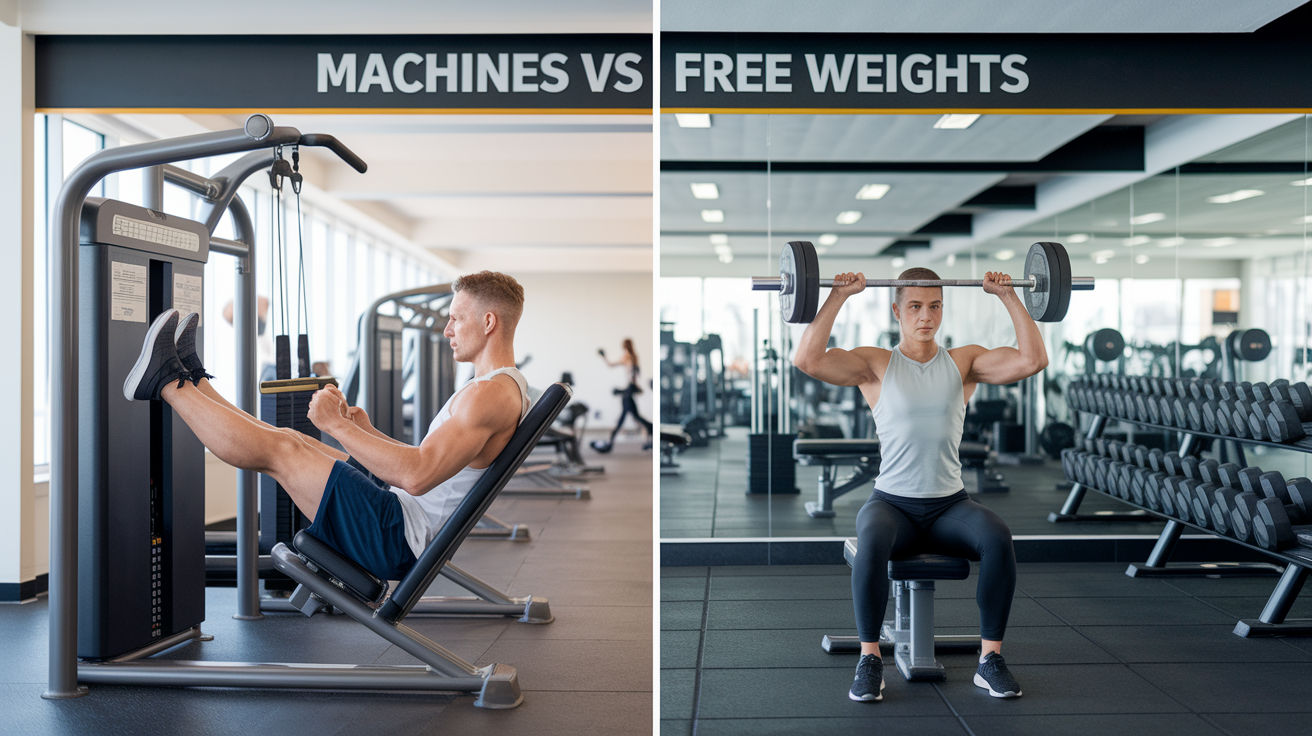
Machines and free weights both have a place in a beginner routine, and choosing between them comes down to support and stability. Selectorized machines (the kind with a pin you move to adjust weight) guide the bar or handle along a fixed track, so you don’t have to worry about balancing the weight in three dimensions. That makes them easier to learn and safer when you’re still figuring out how your body moves under load.
Dumbbells and barbells require you to stabilize the weight yourself, which recruits more core and stabilizer muscles but also demands better coordination and body awareness.
A typical beginner setup starts with machines like the leg press, shoulder press machine, and lat pulldown. Once those feel solid and you’ve practiced bodyweight squats, lunges, and push ups with clean form, you can mix in dumbbells for exercises like chest press or goblet squats. Resistance bands and yoga mats are also great low cost, low intimidation tools for mobility work and lighter accessory exercises at home or in the gym.
Cardio Options to Add to a Beginner Gym Routine

Cardio improves your heart health, helps you recover between strength sessions, and burns calories if fat loss is part of your goal. The elliptical is a popular beginner machine because it’s low impact (easier on your knees than running) and works your whole body if you use the moving handles. Start every cardio session with a 5 minute warm up at very low resistance, like resistance level 1 to 3 on an elliptical, to ease your heart rate up gradually.
For steady state cardio, pick a comfortable pace you can sustain and stay there for 30 to 60 minutes. This builds endurance and works well on active recovery days.
For interval training, you alternate short bursts of hard effort with longer recovery periods. A simple beginner interval protocol is 30 seconds of hard effort (sprint or high resistance) followed by 1 minute of easy recovery. Repeat that cycle for 10 rounds, which takes about 15 minutes after your warm up. A full elliptical interval session might last 30 to 40 minutes and use a resistance scale of 1 to 9, cycling through moderate effort (resistance 4–6), high effort (resistance 7–9), and recovery (resistance 1–3).
Here are five cardio workout styles you can rotate:
- Steady state – 30 to 60 minutes at a consistent, moderate pace (great for endurance and active recovery)
- Interval training – 30 seconds hard, 1 minute easy, repeat 10 rounds (burns calories fast, builds conditioning)
- Incline walk or incline elliptical – bump the incline to target glutes and hamstrings more
- Resistance intervals – cycle resistance up and down every few minutes without changing speed
- Cross training cardio – mix treadmill, bike, rower, or elliptical across the week to keep things fresh
Calorie burn depends on your intensity and body size, but you can expect roughly 300 to 600 calories per hour of cardio depending on how hard you work.
Cooldown, Mobility, and Recovery for Beginner Gym Progress

After your last set, don’t just grab your bag and leave. Spend 5 minutes doing easy cardio at very low resistance to bring your heart rate down gradually. Follow that with 5 to 10 minutes of stretching while your muscles are still warm. This is when stretching actually improves flexibility, not before you train when muscles are cold and stiff.
Foam rolling after your workout can help reduce soreness and improve tissue quality over time. Focus on your glutes, upper back (thoracic spine), and quads. Spend enough time on each area to feel the muscle soften slightly under pressure.
If you want a quick way to downshift your nervous system and aid recovery, try box breathing: inhale for 4 seconds, hold for 4 seconds, exhale for 4 seconds, hold for 4 seconds, and repeat for 5 to 10 cycles or longer if it feels good.
Deep core training (exercises that target the muscles around your spine and pelvis, not just surface abs) can be done 2 to 3 times per week as a beginner. These sessions help protect your lower back and improve your ability to brace under load.
Delayed onset muscle soreness is normal in the first few weeks. It usually peaks 24 to 48 hours after a new workout and fades as your body adapts. Stay hydrated, move lightly on rest days, and don’t skip your cooldowns. Recovery is when your body actually gets stronger.
Weekly Beginner Gym Schedules and Time-Efficient Routines

How often should you train? Most beginners do well with 3 to 4 gym sessions per week, leaving at least one full rest day between full body workouts. That gives your muscles time to repair and grow. A simple first week schedule looks like this: one cardio day, one lower body strength day, one upper body strength day, and the rest of the week filled with rest or optional light activity.
Session length depends on your schedule and energy. A focused 30 minute workout beats an unfocused 90 minute session every time. If you have more time, 45 to 60 minutes lets you add warm up, cooldown, and a bit more volume without rushing.
Two simple planning templates help you build balance into your week: the 3-3-3 rule (3 strength days, 3 cardio days, 3 active recovery or mobility days) and the 4-2-1 rule (4 strength days, 2 cardio days, 1 mobility or rest day). Neither is perfect for everyone, but both give you a starting framework you can adjust as you learn what your body responds to.
Here are six sample weekly structures to choose from:
- 3 day beginner split – Monday (cardio), Wednesday (lower body), Friday (upper body); about 30–45 minutes per session
- 4 day beginner split – Monday (lower body), Tuesday (cardio), Thursday (upper body), Saturday (light cardio or mobility); 30–45 minutes each
- Full body 3×/week – Monday/Wednesday/Friday full body strength; 45–60 minutes; rest or light cardio on off days
- Time efficient 30 minute plan – 3 days strength (compact circuits), 2 days cardio (20–25 minutes), 2 days rest
- Mixed cardio and strength – alternate strength and cardio every other day; 6 training days, 1 full rest day
- Beginner 3-3-3 template – 3 strength sessions, 3 cardio sessions, 3 active recovery or mobility sessions spread across the week (some days include two short sessions)
Nutrition and Hydration Fundamentals Supporting a Beginner Gym Routine

You can’t out train a poor diet, but you also don’t need to be perfect to make progress. As a beginner, focus on simple, whole food meals that include protein, carbs, and vegetables. Protein helps repair and build muscle. Carbs fuel your workouts and recovery. Vegetables provide the vitamins and minerals your body needs to adapt to training stress. Aim to eat a balanced meal within a couple hours after your workout to support recovery.
Hydration matters more than most beginners realize. Drink water before, during, and after your sessions. If you feel thirsty mid workout, you’re already slightly dehydrated. Keep a water bottle with you and sip regularly.
One note: it’s normal to gain a little weight in your first month of training even if you’re eating well. That’s usually increased muscle mass, bone density, and water stored in your muscles as they adapt. Monthly body composition scans can show you what’s actually changing under the surface and help you stay focused on real progress instead of just the number on the scale.
Tracking Progress, Staying Consistent, and Building Beginner Confidence

Progress in the gym is built on small, measurable improvements over time. Write down what resistance or weight you used, how many reps you completed, and how hard it felt. Next week, try to do one more rep, add a little more weight, or finish the same work in less time. That’s what keeps you moving forward.
Consistency beats intensity when you’re starting out. Training at the same time of day helps your body adapt and makes it easier to build the habit. If mornings work, do mornings. If evenings fit your schedule better, stick with evenings. The best workout plan is the one you’ll actually follow.
Monthly body composition scans (if your gym offers them) can track muscle gain and fat loss more accurately than a regular scale, which helps you see progress even when the scale doesn’t move much.
Working with a certified trainer, even for a few sessions, can teach you proper form and give you confidence on the gym floor. Many gym memberships include a free orientation or one complimentary training session. Use it.
Small wins count. Did you add one rep this week? Did your squat feel more controlled? Did you show up three times like you planned? That’s progress, and that’s what builds long term strength.
Here are four tracking and consistency tools that work:
- Training log – write sets, reps, weights, and how you felt in a notes app or notebook after every session
- Weekly check in – pick one day each week to review your log and plan small increases for the next week
- Monthly body scan – use a 3D body composition scanner or progress photos to track real changes in muscle and fat
- Consistent training time – pick the same days and times each week to make gym visits automatic, not optional
Final Words
Hit the gym three times a week: one cardio day, one lower-body day, and one upper-body day. Begin each session with a brisk warm-up and end with a short cooldown and mobility work.
Keep it simple—use basic compound moves, machines or dumbbells as needed, and log sets, reps, and effort so you can progress safely.
This gym routine for beginners fits busy lives. Add weight slowly, stay consistent, and celebrate the small wins. You’re building real strength.
FAQ
Q: What is a good gym schedule for beginners?
A: A good gym schedule for beginners is three short sessions per week—one cardio day, one lower-body day, one upper-body day—30–60 minutes each, prioritizing safety, simple progress, and tracking.
Q: What is the 3-3-3 rule for working out? What is the 3/2/1 rule in gym?
A: The 3-3-3 rule for working out means three workouts weekly, three main exercises per session, three sets each. The 3/2/1 rule is a simple split template—three cardio, two strength, one mobility or rest day.
Q: What to start with at the gym as a beginner?
A: To start at the gym as a beginner, begin with a warm-up, then basic compound moves (squat, hip hinge, push, pull) using bodyweight or machines, light weight, and log sets, reps, and effort.