

What if the number of reps matters more than the weight on the bar?
Stop guessing and start measuring.
Pick a baseline load, log every rep, and keep rest the same.
Use rep ranges as targets, and total reps per session tell you when to add weight, when to hold, and when to change the plan.
This post shows how to set your baseline, track totals, apply progressive overload, and fix plateaus so your training stops being random and starts giving steady, provable progress.
Establishing Baseline Rep Ranges for Measuring Training Progress

Pick a weight you can lift for a reasonable number of reps with good form, record every single rep across every set, and keep your rest intervals the same every time. That’s your baseline. Without a clear starting point, you can’t measure anything.
Choose one exercise and do three sets at the same load. Write down how many reps you complete in each set. For example, if you’re testing hip thrusts and you use 65 pounds, you might get 20 reps on the first set, 15 on the second, and 15 on the third. Total reps: 50. That number becomes your reference. Next time you use 65 pounds with the same rest, you’ll know whether you improved. If you’re working with heavier loads and lower reps, you might use rep bands like 3 to 6, 6 to 9, and 9 to 12. An example session: 405 pounds for 3 reps, then drop to 365 pounds for 6 reps, then 325 pounds for 9 reps. Each band gives you a separate data point.
Rest matters as much as the reps. If you rest 90 seconds between sets one week and 3 minutes the next, the numbers won’t compare. Use 90 to 120 seconds for moderate loads and up to 180 seconds on heavier work. Lock in your rest intervals from the start and don’t change them unless you’re deliberately adjusting the program. Consistency turns your log into a measurement tool instead of random notes.
Critical baseline data to log every session:
- Weight used (pounds or kilograms)
- Reps completed in each set (write them separately, not just the total)
- Rest interval between sets (in seconds)
- Target rep range or total rep goal for that exercise
Using Rep Ranges to Track Workout Performance Over Time
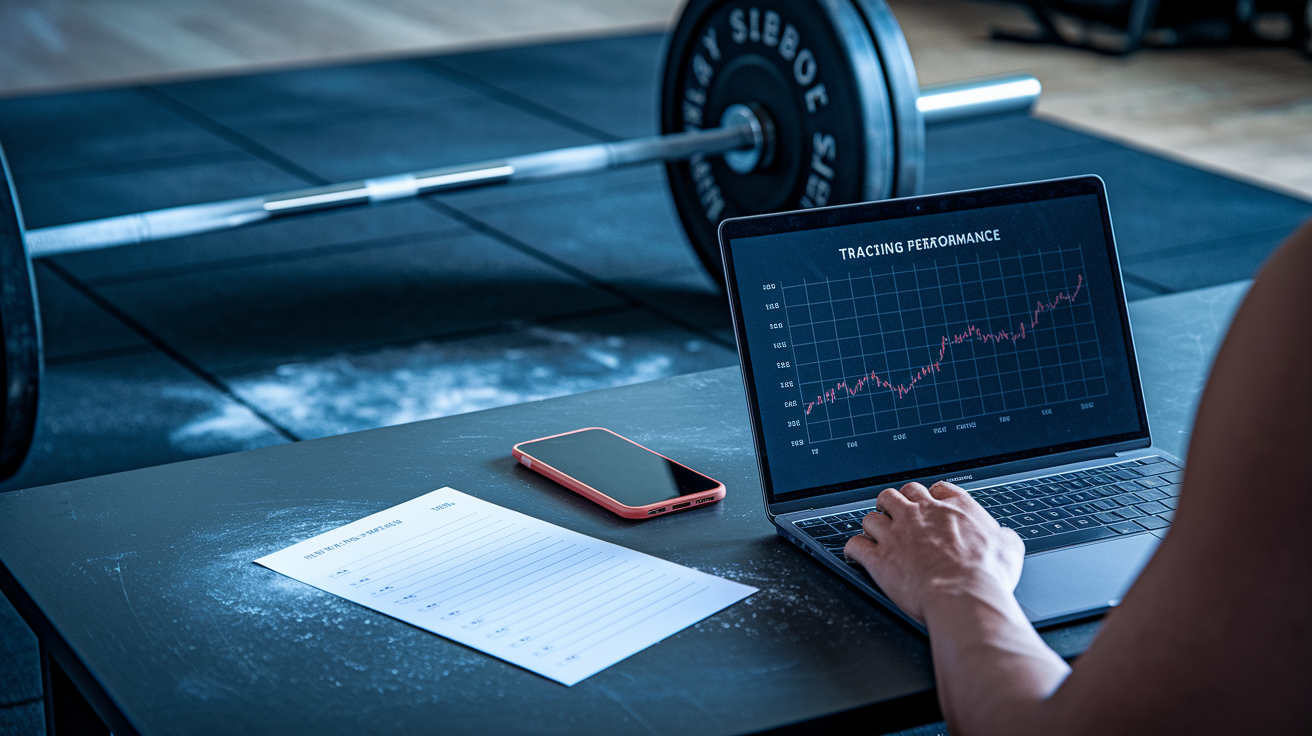
Every session, you record the same details: exercise name, weight, reps per set, total reps, and how hard it felt. Over a few weeks, patterns show up. Maybe your first set stays around 12 reps but your second and third sets creep from 10 and 8 up to 11 and 9. That’s measurable progress at the same load. When you see the total reps rise across multiple sessions, you know the training is working.
Use a simple format for your log. Write the date, the lift, the load, and the reps for each set in order. Add a column for total reps and another for your RPE or reps in reserve if you want to track effort. Example: on March 10th you did hip thrusts at 95 pounds and hit 12, 12, 12 for a total of 36 reps. The next session you’re aiming to either add reps at 95 or increase the weight. When you hit your target total, the log tells you it’s time to move up. The decision is written right there in the data.
| Exercise | Weight | Reps per Set | Total Reps |
|---|---|---|---|
| Hip Thrust | 85 lb | 16 / 14 / 12 | 42 |
| Hip Thrust | 95 lb | 12 / 12 / 12 | 36 (target hit) |
| Hip Thrust | 115 lb | 10 / 10 / 8 | 28 |
| Squat (3–6 band) | 405 lb | 3 / – / – | 3 |
Applying Progressive Overload Using Rep Range Targets

When you hit your target total reps at a given weight, increase the load for the next session. That’s the core rule. If your goal is 36 total reps and you get there, add weight. If you’re using rep bands and you reach the top of the range (for example, 6 reps in a 3 to 6 band), add weight and reset to the bottom of the range.
How much weight you add depends on where you are in the progression. If you’re far from your target (you got 42 reps when aiming for 36, meaning the weight was too light), jump up by 20 pounds or more. Once you’re closer, use 10 pound jumps. When you’re fine tuning near your limit, 5 pound increments work best. The key is to keep rest periods identical. If you rest 90 seconds one week and 2 minutes the next, the rep counts won’t mean the same thing. Lock in your rest and let the reps tell the truth.
Example: you bench press 270 pounds and hit 5, 4, 3 reps across three sets for a total of 12. That matches your 12 rep target, so next session you move to 275 pounds. You get 4, 3, 3 for a total of 10. Two sessions later you’re back to 11 total, then 12. When you hit 12 again at 275, you jump to 280. Each time you reach the target, the weight goes up and the process repeats.
Session to session decision protocol:
- If you hit your target total reps, increase weight by 5 to 20 pounds (bigger jumps early, smaller jumps as you advance).
- If you miss the target but show an upward trend across sessions (for example, 10, then 11, then 12), stay at the same weight until you hit the target.
- If you stall for two sessions in a row with no improvement in total reps, either reduce the weight jump size or hold the current load and focus on perfect form.
- Keep rest intervals identical every session so the rep data stays comparable.
- When using rep bands (like 3 to 6), add weight and reset to the bottom of the range once you hit the top end.
Recognizing Plateaus and Adjusting Rep Ranges for Continued Progress

A plateau shows up when you can’t reach your target total reps across two or three sessions despite consistent rest and solid form. The numbers stop moving. You’re putting in the work, the effort feels hard, but the reps stay flat or drop slightly. That’s the signal to change something.
First option: reduce your weight jumps. If you’ve been adding 10 pounds each time, try 5. If 5 pound jumps aren’t working, hold the same load for another session and zero in on bar speed and technique. Sometimes a small form tweak or an extra week at the current weight lets you break through.
Second option: temporarily drop the load by 10 to 15 percent, rebuild your reps back up to the target total, then push past your old sticking point with better momentum.
Third option: switch your rep total target for about 8 weeks. If you’ve been chasing 36 total reps, spend the next block working toward 24 total reps with heavier loads. The change in stimulus often restarts progress. You can also rotate to a different exercise variation (swap high bar squats for safety bar squats, for example) and build new momentum there.
Effective plateau responses:
- Make smaller weight jumps (cut increment in half) and allow more sessions to hit targets.
- Drop load 10 to 15% and rebuild reps with stricter form, then exceed previous totals.
- Periodize by switching rep total targets every 8 weeks or so to avoid boredom and stimulate different adaptations.
Using Multi Rep Range Testing to Measure Strength Gains Accurately

Instead of risking injury with a true one rep max or wasting time on multiple testing attempts, test with any weight you can lift for 1 to 6 reps and use a percentage formula to estimate your max. The formula is simple: divide the weight you lifted by the percentage that corresponds to the number of reps you completed. One rep equals 100 percent, two reps equals 95 percent, three reps equals 92.5 percent, four reps equals 90 percent, five reps equals 87.5 percent, and six reps equals 85 percent.
Example: you lift 185 pounds for 4 reps. Divide 185 by 0.90 and you get 205.5 pounds. Round it to 206. That’s your estimated one rep max. You can test again a week later with a different rep count (say, 2 reps at a heavier weight or 6 reps at a lighter weight) and the formula should land you within a pound or two of the same max. This method has been used for almost 25 years with high school athletes and consistently produces accurate results as long as you stop at 6 reps. Once you go past 6 reps (into 8, 10, 12+ territory), the estimation loses accuracy because you’re testing muscular endurance, not strength.
Estimated Max Table
| Reps Completed | Percentage of Max |
|---|---|
| 1 | 100% |
| 2 | 95% |
| 3 | 92.5% |
| 4 | 90% |
| 5 | 87.5% |
| 6 | 85% |
Plot your estimated max on a chart every 4 to 8 weeks. Put the test dates on the bottom (x axis) and the estimated max in pounds on the side (y axis). Over months, you’ll see whether the line trends up, stays flat, or dips. An upward trend confirms your training is building strength. A flat line tells you to adjust volume, intensity, or exercise selection. Clear numbers, clear feedback.
Implementing Rep Ranges for Hypertrophy, Strength, and Endurance Phases

Different training goals need different rep total targets, and adjusting those targets across phases is how you measure whether each phase is working. For heavy main lifts focused on strength, use a lower total like 12 reps across 3 sets. For assistance lifts that support the main movement, 18 total reps works well. When you want more hypertrophy stimulus on an exercise like goblet squats, aim for 24 total reps. Beginner friendly exercises like hip thrusts might start at 36 total reps with moderate load, and high volume accessory work (banded hip thrusts, back extensions, seated abductions) can go up to 60 total reps.
Every 8 weeks or so, switch the rep total target to keep your body adapting and your mind engaged. Spend two months chasing 36 total reps, then drop the total to 24 and increase the load. The higher weight at lower reps builds a different kind of strength, and when you cycle back to higher totals later, you’ll often blow past your old numbers. This isn’t random variety. It’s structured periodization using rep ranges as the measurement. You’re not guessing whether a phase worked. You’re comparing totals and loads across cycles.
If you’re training for maximum strength, mix rep totals strategically across your lifts. Use 12 total reps on your main compound movements (squat, bench, deadlift variations), 18 total reps on primary assistance lifts (rows, overhead press, front squats), and 30 to 36 total reps on targeted hypertrophy assistance (leg curls, tricep work, rear delts). That spread lets you push hard on the heavy stuff without accumulating too much fatigue, while still getting enough volume to grow muscle and support the main lifts.
Common rep targets by exercise category:
- Heavy main lifts (squat, bench, deadlift): 12 total reps across 3 sets
- Assistance lifts (rows, overhead press, front squat): 18 total reps
- Moderate hypertrophy movements (goblet squat, dumbbell press): 24 total reps
- Beginner friendly or volume focused lifts (hip thrust, lunges): 36 total reps
- High volume accessory work (banded exercises, back extensions, abductions): 60 total reps
Logging Rep Range Progress with Apps and Spreadsheets

Use a spreadsheet or any training log app that lets you record the essentials: date, exercise name, load, reps for each set, total reps, rest time between sets, RPE or reps in reserve, quick notes on form or fatigue, and your decision for the next session. That’s the minimum viable log. You can export the data to a CSV file and build simple charts: put session dates on the bottom and either total reps at a fixed weight or the weight at which you hit your target total on the side. Over time, you’ll see lines trending up (progress), flat (plateau), or down (fatigue or program mismatch).
Keep it simple. You don’t need fancy dashboards. A basic spreadsheet with one row per work set and a few calculated columns (total reps, next session load change) will show you everything. The act of writing the numbers forces you to pay attention, and when you scroll back a month, the improvement is obvious. Or the lack of improvement is obvious, which is just as useful because it tells you what to fix.
Required spreadsheet or app columns:
- Date (to track sessions over weeks and months)
- Exercise name and any variation note (high bar squat vs. safety bar squat)
- Load in pounds or kilograms
- Reps for set 1, set 2, set 3 (or however many sets you did)
- Total reps across all sets
- Rest interval in seconds (to ensure consistency session to session)
- RPE or reps in reserve (to track effort and whether you’re improving at the same RPE)
- Notes (bar speed, form breakdown, fatigue level, assistance work changes)
- Next session decision (increase load, hold weight, reduce load, switch movement)
Final Words
Start by testing fixed loads and logging set-by-set reps, rest, and totals — that gives you a clear baseline to compare from.
Use those baselines to track workouts, apply the total-reps progression rule, run multi-rep tests, and adjust rep ranges when you stall. Keep rest consistent so comparisons stay valid.
Do this consistently and you’ll see trends, not guesswork. Practice how to use rep ranges to measure progress, celebrate small wins, and keep moving forward.
FAQ
Q: What is the 3 3 3 rule at the gym?
A: The 3 3 3 rule at the gym is three sets of three reps (3×3) using heavy but controlled weight to build strength. Rest 2–3 minutes between sets and add weight when reps stay clean.
Q: What is the 5-3-1 rule in gym?
A: The 5-3-1 rule in the gym is a weekly strength cycle: a 5-rep week, a 3-rep week, then a 1-rep week, increasing weight each week and testing a near-max top set on week three.
Q: What is the 2 2 2 rule in gym?
A: The 2 2 2 rule in the gym is usually three sets of two reps (2x2x2) used for heavy doubles—great for practicing near-max loads, using long rest and focusing on tight technique.
Q: How many reps should I do to see progress?
A: The number of reps you should do to see progress depends on your goal: strength 1–6, hypertrophy 6–12, endurance 12+. Track total reps and increase weight or reps over time.