

Think you need a full gym to build real strength?
You don’t.
One kettlebell and about 15 minutes can hit your legs, back, shoulders, and core.
This simple circuit uses five practical moves, short rests, and two to three rounds so you get a full-body strength session without fuss.
You’ll also get quick setup tips, form cues, and easy progressions to keep getting stronger and simple tracking ideas.
Perfect for apartments, travel, or busy days.
A Practical Full Body Routine You Can Do Anywhere With One Kettlebell
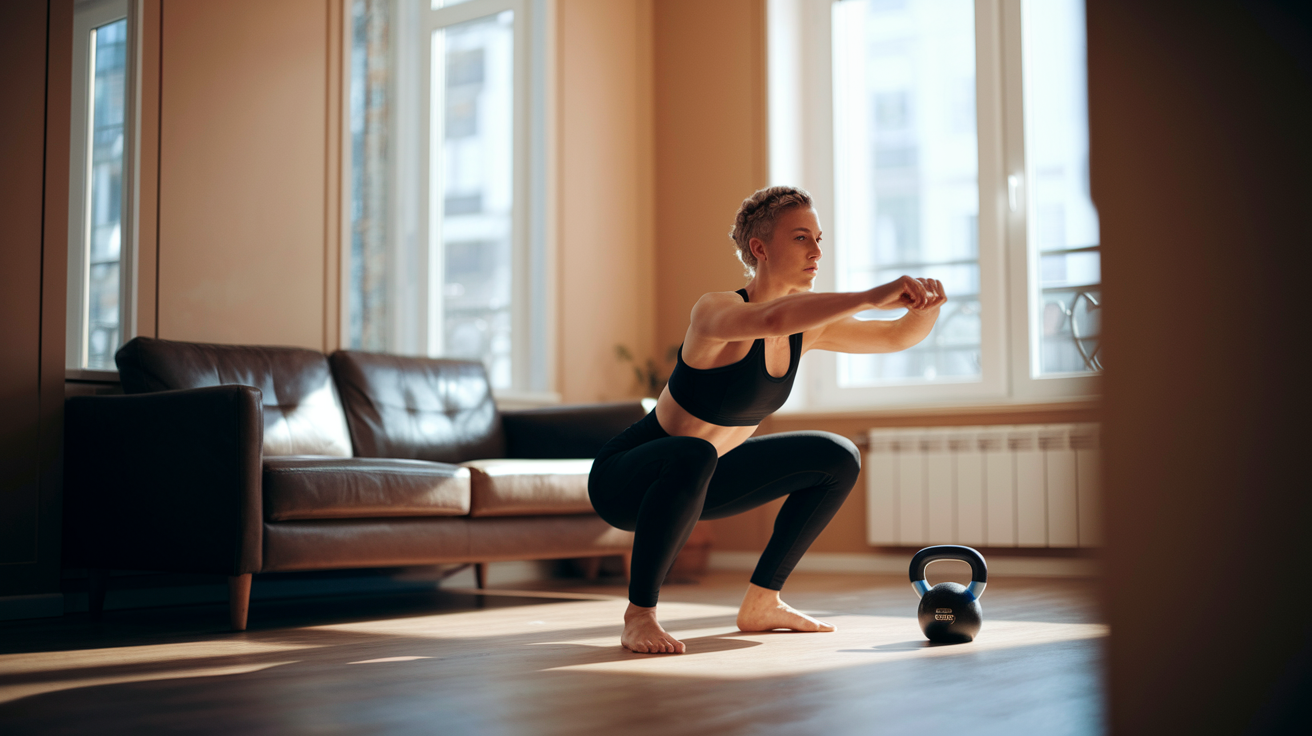
You need one kettlebell and maybe 15 minutes. That’s it. This workout hits your legs, back, shoulders, and core without turning your apartment into a gym. Bedroom, garage, hotel room. Doesn’t matter. The setup is dead simple: five exercises, back to back, short rest, repeat. Two or three rounds total and you’re done. If you’re busy and don’t want to waste time figuring out what to do, this is the routine.
Start with a kettlebell that feels moderately heavy. If you’re new, 12 pounds is safe. If you’ve lifted before, somewhere between 8 and 24 kilograms works for most people. Pick a weight where the last rep of each set feels tough but you can still keep your form clean. Before you jump in, spend 90 seconds warming up. Circle your hips a few times, roll your shoulders, do a couple bodyweight squats or easy hinges. You’re not trying to break a sweat yet. Just waking things up.
Here’s how the circuit works. Do 10 to 12 reps of each exercise, then go straight to the next one. Rest about 15 seconds between moves. Once you finish all five exercises, that’s one round. Rest 20 to 30 seconds. Then start again. Get through two or three rounds depending on how you feel and what your schedule allows. If 12 reps feels easy, use a heavier kettlebell next time. If you can’t finish 10 reps without your form falling apart, go lighter.
Here’s one sample workout:
- Kettlebell goblet squat: 10–12 reps
- Kettlebell single arm row: 10–12 reps each side
- Kettlebell reverse lunge: 10–12 reps each side
- Kettlebell swing: 10–12 reps
- Kettlebell weighted heel tap: 10–12 reps each side
- Kettlebell halo: 10–12 reps each direction
Key Kettlebell Movements That Build Full Body Strength

Foundational exercises recruit multiple muscle groups at once. Your legs, back, shoulders, and core all work together. When you’re training with one piece of equipment, choosing movements that give you the most bang per rep matters. You’re building your posterior chain, your quads, your lats, and your shoulders with the same hunk of iron. That’s why kettlebell training fits into real life without taking over your schedule.
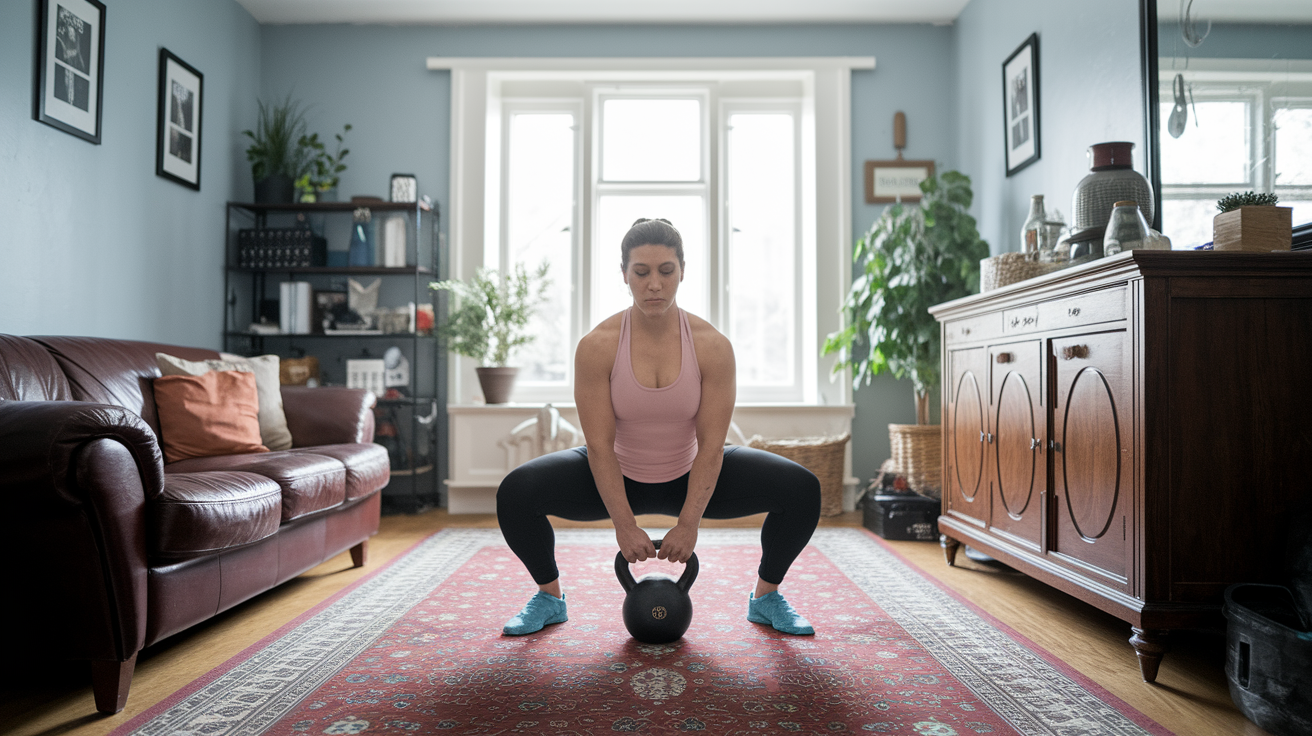
The goblet squat is your main lower body move. Hold the kettlebell by the handle at chest height. Stand with your feet about hip width apart. Before you bend your knees, push your hips back like you’re reaching for a chair behind you. This hinge first cue protects your knees and turns on your glutes. Then bend your knees and drop until your hips are roughly level with your knees. Pause. Keep your chest tall and your feet flat. Push through your whole foot to stand back up. If squatting to full depth feels wobbly at first, use a chair as a target and tap it lightly with your glutes before you stand. Gives you a depth reference and builds confidence.
The kettlebell swing is your power builder. This is a hinge movement, not a squat. Stand with feet slightly wider than hip width, kettlebell on the floor a foot or so in front of you. Hinge at the hips, reach down, grip the handle. Hike the kettlebell back between your legs like you’re snapping a football. Then drive your hips forward hard. The kettlebell should float up to about chest height, but your arms are just guiding it. Your hips do the work. Let the kettlebell swing back down, hinge again, repeat. This builds explosive strength in your glutes and hamstrings and gets your heart rate up quick.
The single arm row and single arm press balance out your upper body and expose strength gaps between your left and right sides. For the row, stagger your stance, lean your torso forward, rest your free hand on your thigh or the seat of a chair for support. Pull the kettlebell toward your hip, elbow close to your body, spine neutral. Squeeze your shoulder blade back at the top. For the press, hold the kettlebell at shoulder height in the rack position (handle resting against your forearm, bell on the back of your wrist). Press straight overhead, ribs down, core braced. Lower with control. If the weight feels too heavy for a strict press, use both hands to help the kettlebell overhead, but still count the reps as written.
Form Cues and Technique Tips for Safe One Kettlebell Training
Good technique protects your joints and makes every rep count. When you’re training at home without a coach watching, your form is your only safety net. Sloppy reps don’t just waste time. They set you up for lower back tweaks, shoulder irritation, knee pain. The goal is to move the kettlebell with control, not survive the set. If your form starts breaking down, stop the set, rest, and either drop the weight or call it.
Bracing and breathing are foundational. Before you hinge, squat, press, or row, take a breath into your belly and brace your core like you’re about to take a light punch to the stomach. Firm, not stiff. Hold that tension through the hardest part of the lift, then exhale as you finish the rep. Neutral spine means your lower back isn’t rounded or overextended. During rows, keep your back flat. During swings, don’t let your lower back arch at the top. During presses, don’t lean back to push the weight overhead. The rack position (holding the kettlebell at your shoulder) should feel stable. The handle rests against your forearm and your wrist stays straight. If your wrist bends backward or the kettlebell pulls your elbow away from your ribs, adjust your grip or use a lighter bell.
When your form starts slipping, that’s your signal to regress the movement or reduce the load. If your knee collapses inward during a lunge, use a chair for balance or shorten the range of motion. If you can’t finish a swing without rounding your back, practice the hinge pattern with no weight first. If your shoulder shrugs during a halo, use a lighter kettlebell and focus on keeping your traps relaxed.
Common mistakes:
- Rounding your back during swings or rows instead of hinging at the hips with a neutral spine
- Letting your front knee collapse inward during lunges instead of tracking over your mid foot
- Shrugging your shoulders during halos instead of keeping your traps down and shoulders stable
- Overextending your lower back during overhead presses instead of keeping ribs down and core braced
- Swinging the kettlebell with your arms during swings instead of driving with your hips and letting the bell float
A Simple Warm Up and Cooldown for a One Kettlebell Strength Session
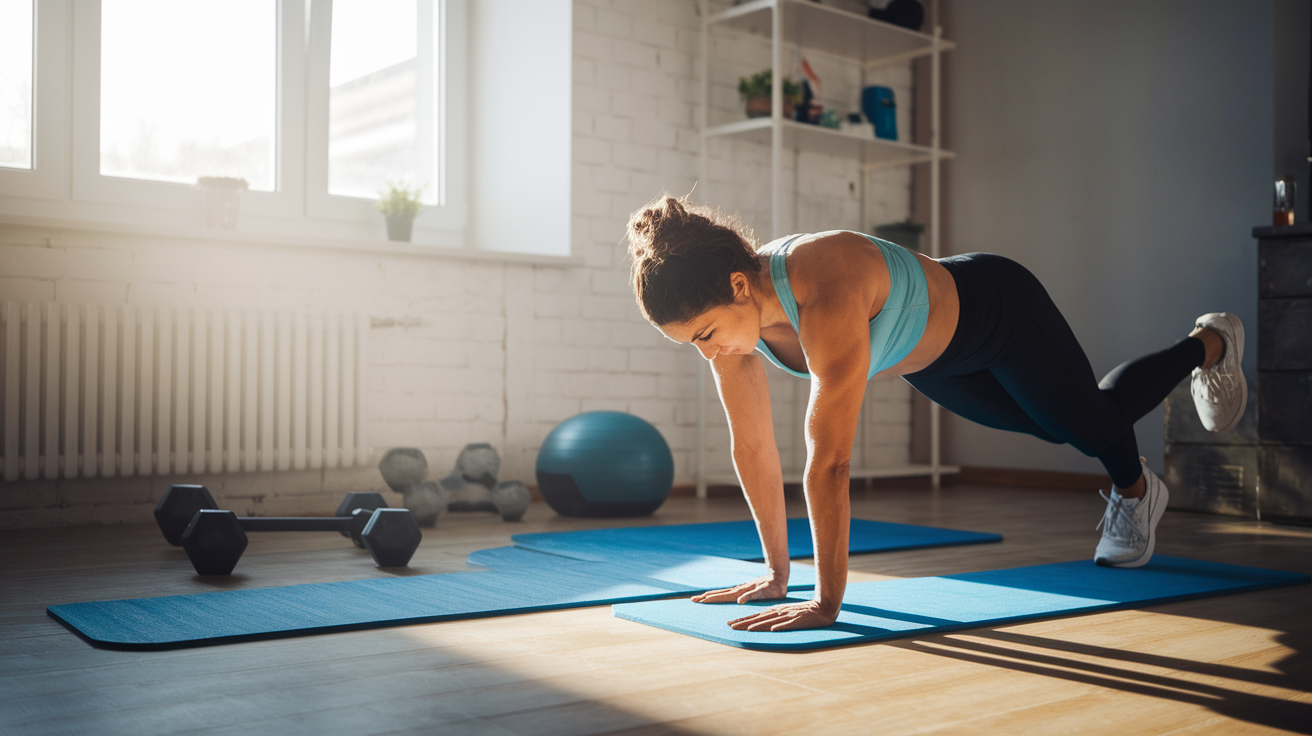
A short warm up prepares your hips and shoulders for loaded movement. You’re not trying to stretch cold muscles or wear yourself out. You’re lubricating the joints, waking up your nervous system, rehearsing the movement patterns you’re about to load. Spend about 90 seconds to two minutes on this. If you’re doing overhead work like presses or halos, add a few extra shoulder circles and some light thoracic rotation. If you’re doing swings and squats, make sure your hips feel open and your ankles feel mobile. A good warm up makes the first working set feel smoother and cuts down the risk of tweaking something in the first few reps.
After your last round, take two or three minutes to cool down. This doesn’t need to be a full yoga session. Slow your breathing. Walk around for 30 seconds. Then do some gentle stretches for the muscles you just worked. Hold each stretch for about 20 seconds. Focus on your hip flexors, glutes, shoulders, and lats. The goal is to signal to your body that the work is done and it’s time to start recovering. If you skip the cooldown, you’ll recover anyway, but a few minutes of controlled breathing and light stretching helps your heart rate come down gradually and can reduce next day stiffness.
Quick warm up sequence (90 seconds to 2 minutes):
- Bodyweight hip hinges: 8 reps, focusing on pushing hips back and keeping a flat back
- Glute bridges: 10 reps, squeezing glutes at the top to activate posterior chain
- Shoulder circles: 10 forward, 10 backward, keeping motion smooth and controlled
- Thoracic rotation: 6 reps each side, hands behind head, rotating from mid back not hips
Progressions and Variations for a Stronger One Kettlebell Routine

Progressive overload is how you get stronger over time. That means you slowly do a little more than you did last session. Simplest way to progress is to add one or two reps per exercise each week until you reach 15 reps. Once 15 reps feels manageable, bump the kettlebell weight and drop back to 10 reps. Another option is to add one more round. If you’ve been doing two rounds comfortably, move to three rounds with the same reps and weight. You can also cut rest periods slightly to increase the conditioning demand. Track what you did last time, then aim to beat it by a small margin this time. Small, consistent progress builds real strength.
Timing methods add variety and can push your conditioning without changing the exercises. An AMRAP (as many rounds as possible) means you set a timer for 10 or 15 minutes and see how many complete rounds you can finish. An EMOM (every minute on the minute) means you start a new exercise or set at the top of each minute, rest for whatever time is left in that minute, then go again. A ladder starts with low reps and climbs (for example, 5 reps, then 7, then 9, then back down). These formats keep your mind engaged and create different demands compared to straight sets. If you’ve been doing the same circuit for a few weeks, try an AMRAP version to see how it feels.
Kettlebell complexes are an advanced option where you do multiple exercises back to back without setting the kettlebell down. For example: clean, press, squat, swing, and row, all for 5 reps each, then rest. Complexes demand grip endurance, core stability, and mental focus. They’re efficient and brutal. If you’re new to kettlebells, stick with straight circuits first. Once you can finish three or four rounds of a basic circuit with good form, try a short complex as a finisher.
| Method | Description | Beginner Friendly? |
|---|---|---|
| Load progression | Add 1–2 reps per week until you hit 15 reps, then increase kettlebell weight and drop back to 10 reps | Yes |
| AMRAP | Set a timer (10–15 min) and complete as many full rounds as possible with good form | Yes, with conservative weight |
| EMOM | Start a new set or exercise at the top of every minute; rest for remaining time in that minute | Moderate, requires pacing skill |
| Complex | Chain multiple exercises together (clean, press, squat, etc.) without setting the kettlebell down between moves | No, for experienced lifters |
Full Body Single Kettlebell Sample Workouts for Every Level
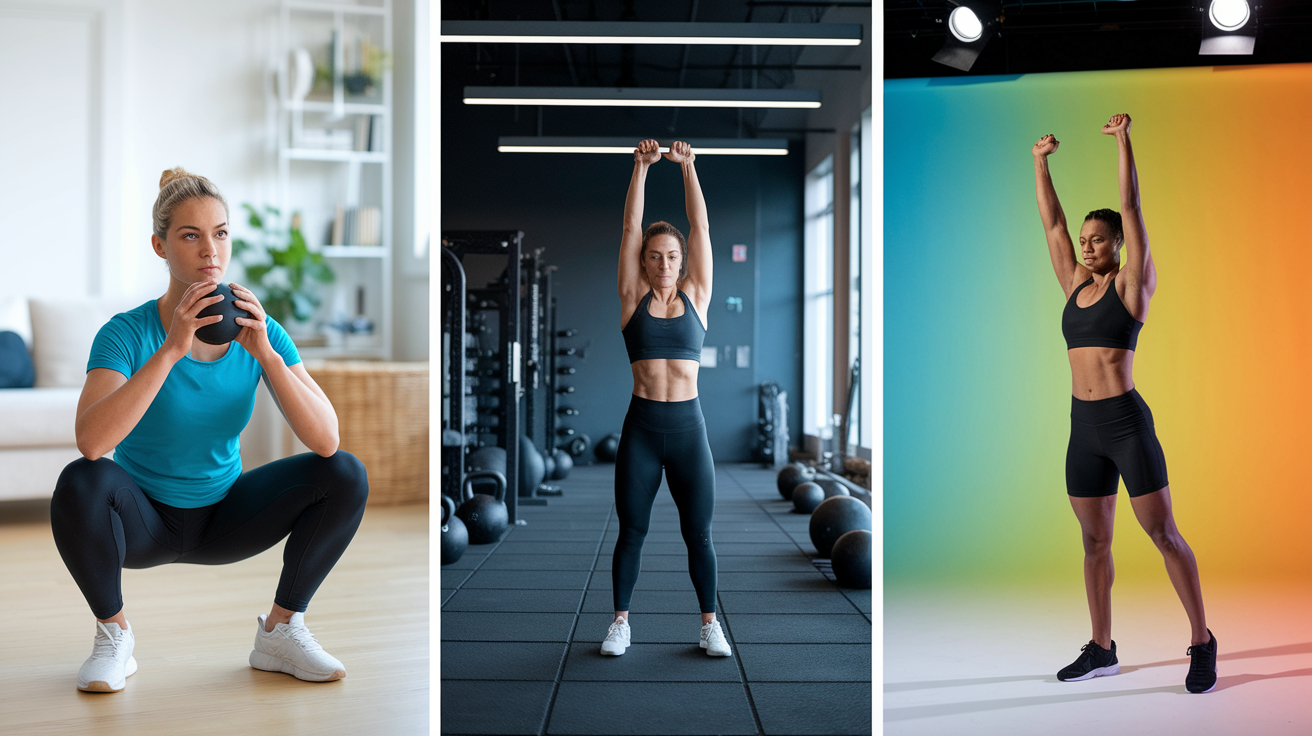
Beginner One Kettlebell Full Body Circuit
This circuit introduces the core movement patterns without crushing your grip or conditioning. Use a 12 pound or 8 kilogram kettlebell. Focus on learning the hinge, squat, and press mechanics. Rest 20 to 30 seconds between exercises and about 45 seconds between rounds. Complete two full rounds. If you finish both rounds with energy left and good form, add a third round next session. If the weight feels too heavy to finish 10 reps on any exercise, drop to a lighter kettlebell. Your goal is to build a strong foundation, not rush progress.
- Kettlebell goblet squat: 10 reps
- Kettlebell single arm row: 10 reps each side (do all reps on one side, rest briefly, then switch)
- Kettlebell reverse lunge: 10 reps each side
- Kettlebell halo: 10 reps each direction (alternate direction each rep)
- Kettlebell deadlift: 10 reps (hinge pattern, two hands on handle)
Intermediate One Kettlebell Strength + Conditioning Circuit
This circuit bumps reps, adds a swing for power, and shortens rest to raise your heart rate. Use a 16 to 20 pound or 12 to 16 kilogram kettlebell. Do 12 to 15 reps per exercise. Rest about 20 seconds between exercises and 30 seconds between rounds. Complete three full rounds. If you can finish all three rounds without your form breaking down, increase the kettlebell weight by one increment next week. This session should feel challenging but sustainable. You should be breathing hard by the end of round two.
- Kettlebell goblet squat: 12–15 reps
- Kettlebell single arm row: 12–15 reps each side
- Kettlebell swing: 12–15 reps
- Kettlebell reverse lunge: 12–15 reps each side
- Kettlebell weighted heel tap: 12–15 reps each side (lying supine, lower one heel at a time while holding kettlebell overhead at chest)
Advanced Full Body Strength & Power Session
This session uses heavier load, lower reps, and higher volume. Use a 20 to 32 kilogram kettlebell depending on your strength. Do 8 to 10 reps per exercise with a weight that challenges you but still allows crisp, powerful reps. Rest about 15 seconds between exercises and 30 to 45 seconds between rounds. Complete four full rounds. For an EMOM variant, do one exercise per minute (for example, goblet squat at minute 0, row at minute 1, swing at minute 2, press at minute 3, snatch at minute 4, rest at minute 5, then repeat). This format forces you to work quickly and rest smartly.
- Kettlebell goblet squat (one hand hold): 8–10 reps each side
- Kettlebell single arm row: 8–10 reps each side
- Kettlebell swing: 8–10 reps
- Kettlebell single arm press: 8–10 reps each side
- Kettlebell snatch: 8–10 reps each side (advanced move, substitute clean and press if you haven’t practiced snatches)
Tracking Progress and Staying Consistent With One Kettlebell Training

Track your workouts in a simple notebook or notes app. Write down the date, the kettlebell weight you used, the number of reps you finished for each exercise, and how many rounds you completed. Note how the session felt using a rate of perceived exertion (RPE) scale from 1 to 10. An RPE of 7 means the workout was hard but you could’ve done one more round if pushed. An RPE of 9 means you were close to your limit. Tracking these details shows you when you’re ready to progress. If you hit 12 reps on goblet squats for three sessions in a row and your RPE stays at 6 or 7, it’s time to increase the weight or add reps. Progress happens in small, measurable steps. Tracking helps you see those steps.
Start with one or two sessions per week if you’re new to strength training. As your body adapts and recovery improves, add a third session. Space sessions at least 48 hours apart to allow muscle repair. Consistency beats intensity. Two sessions per week for six months will build more strength than four sessions per week for three weeks followed by a month off. Pick specific days and times, treat them like appointments. If you miss a session, don’t double up the next day. Just get back on schedule.
When 12 reps feels easy and your form stays tight, increase the kettlebell weight by one increment. When you can finish three rounds with 20 seconds rest and still have energy left, add a fourth round or cut rest to 15 seconds. To rotate circuits for periodization, program one lower body focused circuit one week, an upper body circuit the next week, then a full body power circuit the week after that. This rotation keeps training fresh, prevents overuse, and builds balanced strength across all movement patterns. Your one kettlebell can carry you through months of progress if you track, adjust, and stay consistent.
Final Words
In the action: you’ve got a 10–15 minute, single-kettlebell routine, the core moves, a quick warm-up, and simple progressions so you can train in a small space.
Use the sample workouts, follow the form cues, and track reps and weight. Progress by adding a rep, another round, or a slightly heavier kettlebell. Small steps win.
Try the minimal equipment full body strength workout with one kettlebell this week, note what improved, and keep it steady. Little wins become real strength.
FAQ
Q: Can you do a full body workout with one kettlebell?
A: A full-body workout with one kettlebell is very doable; you can hit legs, back, shoulders, and core in 10–15 minutes using swings, goblet squats, rows, lunges, presses, for 2–3 rounds.
Q: Is a kettlebell good for osteoporosis?
A: A kettlebell can help with osteoporosis by providing weight-bearing resistance that stimulates bone; start light, focus on safe form, and check with your doctor or physical therapist first.
Q: Can you build muscle with a single kettlebell?
A: You can build muscle with a single kettlebell by using progressive overload. Add reps, rounds, slower tempo, or heavier weight, and prioritize moves like goblet squats, swings, rows, and presses.
Q: Are kettlebells good for sciatica?
A: Kettlebells can help with sciatica by strengthening hips and glutes, but they may aggravate symptoms if form is poor. Stop if pain worsens, choose controlled movements, and consult a clinician.