


Stretching alone won’t fix your movement, and lifting heavy won’t make you more flexible.
If you want to move better and keep power, you need mobility-strength exercises that train range and force together.
In this post you’ll get the best drills to start today: deep squat holds, hip airplanes, loaded carries, controlled spinal rotations, and deep lunge isometrics.
I’ll show how to string them into 20–40 minute sessions, how often to do them, and simple progress steps so you actually get stronger through your new range.
The Best Mobility-Strength Exercises You Can Start Today

Deep squat holds with reach hit your hips, ankles, core, and shoulders all at once. Feet shoulder-width apart, drop into the deepest squat you can manage while keeping your heels down. Now reach one arm overhead and rotate your torso to follow your hand. Hold that bottom spot for 5 seconds, switch sides, repeat for 6 reps each. You should feel this in your hips, ankles, and upper back. Not your knees. When it gets easy, try holding a light kettlebell in the goblet position or stretch the hold to 8 seconds.
Hip airplane variations test your single-leg stability while opening up rotation at the hip. Stand on your right leg, hinge forward until your torso’s parallel to the floor, then rotate your pelvis and left leg together in a controlled arc. Open the left hip out, then close it across your body. Move slow. Do 6 rotations per leg. Your glutes and deep hip stabilizers should be working. Can’t balance yet? Hold a wall or chair. Ready for more? Add a light dumbbell in the opposite hand.
Loaded carry mobility isn’t just walking around with weight. It’s a chance to own end-range shoulder and thoracic positions under real tension. Grab one moderate kettlebell or dumbbell, hold it overhead in your right hand with your arm fully extended. Walk forward for 30 seconds, ribs down and core tight. Switch sides, repeat for 30 seconds. Do 2 rounds per side. Want to level up? Increase the weight slightly or add a forward lunge every 3 steps while keeping that overhead hold locked in.
Controlled spinal rotations build rotation strength and motor control through your thoracic spine, which most people lose the more they sit. Lie on your left side, knees bent at 90 degrees, arms extended straight in front of you. Keep your knees stacked, rotate your right arm across your body, and try to touch the floor behind you with your right hand. Hold for 3 seconds at the end, return slowly, repeat for 8 reps per side. Ready to progress? Add a light weight plate in the rotating hand or slow the tempo to 5 seconds each direction.
Deep lunge isometrics with reach teach hip flexor length, knee stability, and full-body coordination at the same time. Step into a deep lunge, back knee hovering an inch off the floor. Reach both arms overhead and hold the position for 20 seconds. You should feel a stretch in the back hip flexor and tension in the front leg. Do 3 holds per side. When that’s too easy, add a light weight overhead or pulse gently at the bottom for the final 5 seconds of each hold.
Lower Body Mobility-Strength Movements
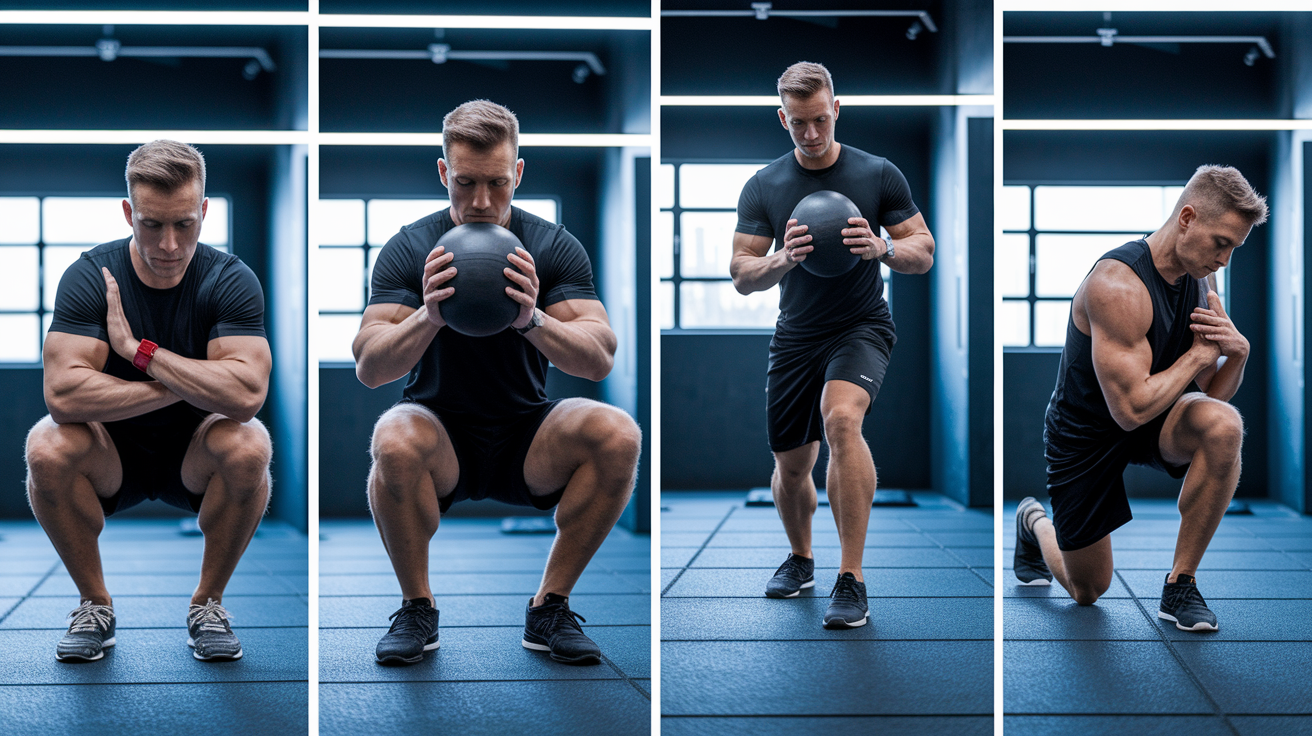
Here are four lower-body movements that build both range and strength:
- Cossack squats
- Elevated heel goblet squats
- Single-leg step-downs with pause
- Deep lunge iso-holds with rotation
Cossack squats open up hip adduction, ankle dorsiflexion, and knee tracking all in one lateral shift. Stand wide, shift your weight to one leg, bend that knee while keeping the other leg straight and toes pointed up. Go as deep as you can while keeping your heel down and chest up. Elevated heel goblet squats use a small plate or wedge under your heels to let you descend deeper while holding a kettlebell at your chest. This loads the end range of your squat and trains ankle and hip mobility under tension. Single-leg step-downs with a pause at the bottom train eccentric knee control and hip stability in a stretched position. They’re one of the best ways to reduce knee pain while building strength.
To scale intensity, start by slowing the tempo to 3 seconds down and 2 seconds up. Once that feels controlled, add a 2 second pause at the deepest point of each rep. When you own the pause, increase load slightly. An extra 5 to 10 pounds in a goblet hold or a light dumbbell in each hand. Can’t hit full range yet? Reduce the depth and work your way down over a few weeks. Range beats load every time when you’re building new movement capacity.
Upper Body Mobility-Strength Movements

Upper-body mobility-strength work focuses on shoulder rotation, scapular control, thoracic extension, and wrist stability under light to moderate loads. The goal is to own end-range positions while creating tension, not just passively stretching into them.
| Exercise | Primary Joint | Suggested Load |
|---|---|---|
| Overhead carry with rotation | Shoulder, thoracic spine | Light kettlebell or dumbbell (10–20 lb) |
| Scapular wall slides with band | Scapulae, shoulders | Light resistance band |
| Turkish get-up (half or full) | Shoulder, thoracic, hip | Moderate kettlebell (12–25 lb) |
| Quadruped wrist rocks | Wrist, forearm | Bodyweight |
How to Build a Mobility-Strength Training Program

Most people see real progress with 2 to 4 sessions per week, each lasting 20 to 40 minutes. You can use these sessions as standalone workouts or attach a 10 minute mobility-strength circuit before or after your main lifting. Either way, the key is consistency and controlled movement. Brand new? Start with 2 sessions per week and add a third after two weeks if recovery feels smooth.
Order matters. Lead with dynamic warm-up drills that prep the joints you’re about to load, then move into your mobility-strength exercises while you’re still fresh. Save static stretching or cool-down breathing for the end. Tempo is just as important as load. Aim for 2 to 3 seconds on the way down, a 1 to 2 second pause at the deepest or most stretched position, then 1 to 2 seconds back up. When that tempo feels easy across all reps, you can increase difficulty by adding 5 pounds, extending the pause to 3 seconds, or increasing range slightly.
Here’s how to build a simple weekly plan:
- Pick 3 to 5 exercises that hit different joints and movement patterns.
- Assign each exercise 2 to 3 sets of 6 to 8 reps, or 20 to 30 second holds for isometric work.
- Schedule your sessions on non-consecutive days if you’re just starting. Monday, Wednesday, Friday works well.
- Track one metric each week: deeper range, longer hold, or slightly heavier load.
- After 3 weeks, rotate in 1 or 2 new movements to keep variety and prevent adaptation plateaus.
Warm-Up Drills That Support Mobility-Strength Work

World’s Greatest Stretch is a full-body primer that opens hips, thoracic spine, and ankles in one flowing sequence. Start in a deep lunge, drop your back knee to the floor, place both hands inside your front foot, then rotate your torso and reach one arm toward the ceiling. Hold for 2 seconds, return your hand to the floor, and step the back leg forward into the next lunge. Do 6 reps per side. This drill increases synovial fluid in the hip joint, activates hip flexors and glutes, and wakes up rotation through your mid-back.
Quadruped thoracic rotations prepare your spine to move under control before you load it. Start on hands and knees, place your right hand behind your head, and rotate your right elbow down toward your left wrist. Then open your chest and rotate your right elbow up toward the ceiling as far as you can without shifting your hips. Move slowly and breathe into the stretch. Do 8 reps per side. You should feel this through your ribs and upper back. Your lower back should stay quiet.
Ankle rockers with holds activate the muscles around your ankle and prepare your lower leg for loaded squats or lunges. Stand facing a wall with your toes a few inches away, shift your weight forward, and try to touch your knee to the wall without lifting your heel. Hold that end position for 3 seconds, return, and repeat 10 times per side. This drill improves dorsiflexion range and primes the calf and shin muscles for eccentric loading.
Common Mistakes to Avoid

Forcing range before you own the prerequisite strength is one of the fastest ways to turn mobility work into a compensation fest. If you drop into a deep squat by rounding your lower back or letting your knees collapse inward, you’re not building mobility. You’re reinforcing a faulty pattern. Stop at the point where you can still control your alignment, and work there until your body adapts. Progress happens when you add range while keeping quality, not when you chase depth at any cost.
Skipping the tempo and moving too fast strips away the neuromuscular benefit. Mobility-strength exercises work because you spend time under tension in challenging positions, which trains your nervous system to recognize and stabilize new ranges. If you bounce or use momentum, your muscles never learn to produce force at end range. Stick to the prescribed tempos. 2 to 3 seconds down, 1 to 2 second pause, controlled return. Treat every rep like a skill drill.
Progressing load too soon is tempting, especially if you come from a pure strength background. But adding weight before your joints are ready to handle that load in a full range will limit your progress and increase injury risk. If you can’t complete a full set with perfect form using just your bodyweight or a light load, you’re not ready to add more. Master the movement, own the pause, film yourself to check alignment, then add 5 pounds and reassess.
Final Words
in the action you learned five practical mobility-strength movements, lower- and upper-body drills, warm-ups, programming tips, and common mistakes to avoid. Each piece was built to help you move better and handle load with control.
Use the drills in 20–40 minute sessions, progress by load or range, and keep tempo slow when you’re learning. Keep a simple plan and track what improves.
Try the mobility strength exercises a few times this week. Small wins add up, and you’re on the right track.
FAQ
Q: What are mobility strength exercises?
A: Mobility strength exercises are movements that combine joint range with load and control, like loaded carries, deep squat holds, hip airplanes, spinal rotations, and shoulder drills to build flexibility and strength.
Q: What is the 3-3-3 rule for exercise?
A: The 3-3-3 rule for exercise is a simple programming guide: pick three movements, perform three sets of each, and train them three times per week to build consistency and manageable volume.
Q: What exercises lower blood pressure?
A: Exercises that lower blood pressure are regular moderate aerobic activities like brisk walking, cycling, or swimming, paired with two weekly strength sessions; aim for 30 minutes most days for consistent reductions.
Q: What is the best workout for mobility?
A: The best workout for mobility is a focused 20–40 minute session mixing joint prep, loaded end-range holds, controlled strength moves, and thoracic/shoulder drills, done 2–3 times weekly and progressed slowly.