
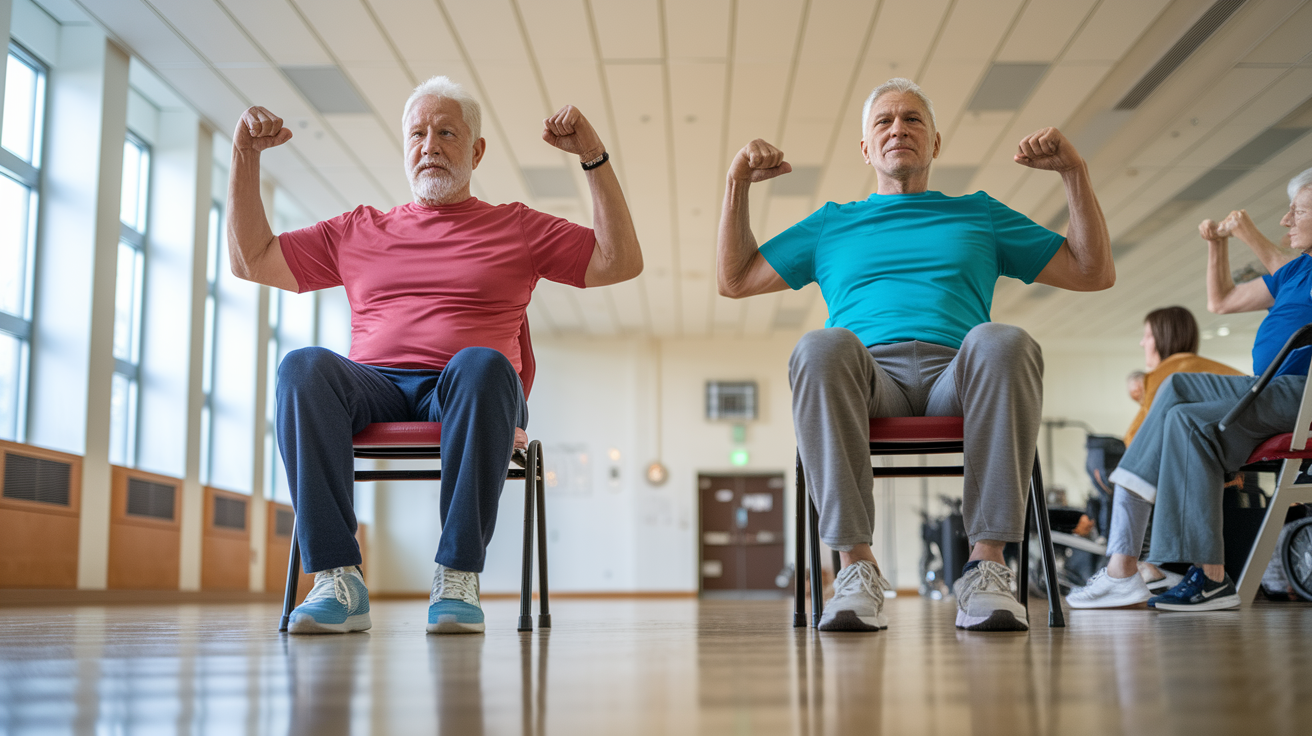

Think strength training after sixty is risky?
Think again.
Done right, it protects joints, cuts fall risk, and keeps you independent.
In this post you’ll get simple, safe ways to scale full-body moves: chair and wall support, reduced range, slower tempo, and small resistance steps.
Follow three rules: control, support, and slow progress.
Read on to learn clear modifications you can try today and a plan to add a little more next week.
Foundational Guidance for Safely Scaling Strength Exercises for Older Adults

Safe strength training for older adults comes down to three things: control, support, and taking it slow. Every movement should keep your spine neutral (think of balancing a cup of water on your lower back), knees tracking over your toes, and a controlled tempo. Two seconds to lift, two to three seconds to lower. Breathe through it: exhale when things get hard, and don’t hold your breath. These basics protect your joints, cut down injury risk, and make every rep actually work.
Before you touch any weights, spend five to ten minutes warming up. Light marching, walking, maybe some ankle pumps, hip circles, shoulder rolls. After your session, cool down the same way: slow walking and gentle stretches. Warm muscles respond better. Cool-downs help flush out metabolic junk and keep you from feeling like a wreck the next day.
When you need to make an exercise easier or harder, adjust the movement itself before messing with weight or resistance. Scaling isn’t about doing less. It’s about finding the version that keeps you safe, builds strength, and lets you add a little more next time. Here are six solid ways to scale any strength exercise:
- Chair assistance – Use a sturdy chair for balance during squats, step-ups, or single-leg work. Touch lightly or hold as needed.
- Wall support – Do push-ups, rows, or shoulder presses against a wall to reduce load and improve stability.
- Reduced range – Move through a smaller, pain-free range. Partial squats and shallow lunges still count.
- Slower tempo – Take three or four seconds on the way down to increase time under tension without adding weight.
- Lighter resistance – Start with bodyweight. Progress to resistance bands or light dumbbells (two to five pounds) only when form is solid.
- Balance aids – Keep a countertop, cane, or walker within arm’s reach during anything that challenges stability.
Warm-Up Routines That Prepare Older Adults for Full Body Strength Work

Warming up isn’t optional after sixty. Cold muscles, tendons, and joints are more likely to get hurt. Your heart needs a gradual ramp-up before moderate effort. A proper warm-up gets blood flowing to working muscles, lubricates joints, and primes your nervous system to move safely. Five to ten minutes of prep can save you weeks of recovery from something totally preventable.
The warm-up doesn’t need to be fancy. But it does need to be deliberate. Start with low-intensity cardio to raise your heart rate gently, then move into dynamic stretches that rehearse what you’ll do during the strength session. Here’s a simple four-step warm-up that works every time:
-
Light cardio (three to five minutes) – March in place, walk briskly around the room, or step side to side. Aim to feel your breathing pick up slightly but still be able to talk.
-
Ankle pumps and circles (twenty pumps, ten circles per ankle) – Sit or stand and flex your foot up and down, then rotate each ankle slowly in both directions. This wakes up the lower leg and improves balance readiness.
-
Hip circles and leg swings (ten per side) – Hold a chair for support. Circle one knee outward in a slow arc, then swing the same leg forward and back like a pendulum. Repeat on the other side.
-
Shoulder rolls and arm swings (ten rolls, ten swings) – Roll shoulders backward in big circles, then swing both arms forward and back across your body to open the chest and prepare the upper back.
Full Body Strength Movements Older Adults Can Scale Safely

The best full-body strength routines for older adults focus on functional movements. Exercises that train the patterns you use every day: standing up from a chair, reaching overhead, picking something off the floor, stabilizing on one leg. These movements engage multiple muscle groups at once, making efficient use of limited time and building strength that translates directly into daily independence.
Lower Body Scaling Options
Lower-body exercises are the foundation of fall prevention, mobility, and independent living. Sit-to-stand is the single most important movement pattern for older adults. It trains the quads, glutes, and core in the exact pattern needed to get out of a chair, off the toilet, or up from bed. Start with a standard-height chair and use your hands on the armrests for support. Progress to crossing your arms over your chest, then to a single-arm reach forward, and finally to adding a light dumbbell (five to ten pounds) held at chest height.
- Regression: Sit on a higher surface (add a cushion), use both hands on armrests or a walker, reduce depth to a quarter squat, or do seated leg presses against a wall.
- Baseline: Sit-to-stand from a standard chair with arms crossed, eight to twelve reps, controlled two-second rise and three-second lower.
- Progression: Lower chair height, hold a dumbbell at chest, add a pause at the bottom, or move to step-ups onto a four- to six-inch platform.
- Alternative for limited mobility: Seated marches (lift knees alternately for thirty to sixty seconds) or seated leg extensions (straighten one leg at a time and hold for two seconds).
Upper Body Scaling Options
Upper-body strength keeps you able to lift groceries, open jars, push yourself up from a fall, and maintain posture. Wall push-ups are the safest entry point. They train the chest, shoulders, and triceps with minimal joint stress. Stand three to four feet from a wall, place hands at shoulder height, keep your body straight, and bend your elbows to bring your chest toward the wall. Progress by moving your feet farther back to increase the angle, then to countertop push-ups, knee push-ups, and eventually full floor push-ups if cleared by a healthcare provider.
- Regression: Increase wall distance (stand closer), reduce range of motion (shallow bend), or do seated chest presses with a light resistance band.
- Baseline: Wall push-ups with feet three feet from wall, ten to fifteen reps, controlled two-second lower and one-second press.
- Progression: Move to countertop or bench incline, increase reps to fifteen, slow the eccentric to four seconds, or add knee push-ups.
- Resistance band row alternative: Step on the center of a band with both feet, cross the handles, hinge forward at the hips about forty-five degrees, and pull elbows back toward your ribs. This trains the upper back and posture muscles with adjustable resistance and zero joint impact.
Core & Posterior Chain Scaling Options
Core stability and posterior-chain strength (glutes, hamstrings, low back) protect your spine, improve posture, and reduce low-back pain. Glute bridges are the safest foundational movement. Lie on your back with knees bent and feet flat, brace your core, and lift your hips until your body forms a straight line from shoulders to knees. Squeeze your glutes at the top, pause for two seconds, then lower with control.
- Regression: Reduce range (partial bridge), do single-leg marches while lying down, or use a rolled towel under your low back for support.
- Baseline: Glute bridge with full hip extension, eight to twelve reps, two-second hold at the top.
- Progression: Add a light dumbbell on your hips (five to ten pounds), do single-leg bridges, or hold the top position for ten seconds.
- Bird-dog for balance and anti-rotation: Start on hands and knees, extend your right arm and left leg at the same time, hold for three seconds, return, and alternate. This builds core stability and coordination with minimal spinal load.
Using Progressive Overload Strategies Designed for Seniors
Progressive overload is what drives strength gains: to get stronger, you’ve got to ask your muscles to do a little more than they did last week. For older adults, progressive overload doesn’t mean piling on heavy weight. It means strategically increasing the challenge in small, sustainable steps while protecting joints and minimizing injury risk. Slow, deliberate progression builds strength that lasts.
The safest way to apply progressive overload is to change one thing at a time. Add one or two reps before increasing resistance. Slow down the lowering phase before adding a second set. Reduce support before adding external load. This keeps form clean, confidence high, and risk low.
| Method | How It Works | Senior-Friendly Example |
|---|---|---|
| Increase reps | Add one to three reps per set once current reps feel manageable with good form | Sit-to-stand: move from 8 reps to 10 reps over two weeks |
| Slow the eccentric | Extend the lowering phase to three or four seconds to increase time under tension | Wall push-up: take four seconds to lower your chest toward the wall |
| Reduce support | Gradually remove external assistance or balance aids | Single-leg balance: move from two-hand chair hold to fingertip touch to no support |
| Add resistance | Increase band tension, add light dumbbells, or use ankle weights after form is stable | Band row: move from yellow (light) to red (medium) band, or add a two-pound dumbbell to glute bridge |
Chair-Based and Low-Impact Strength Alternatives
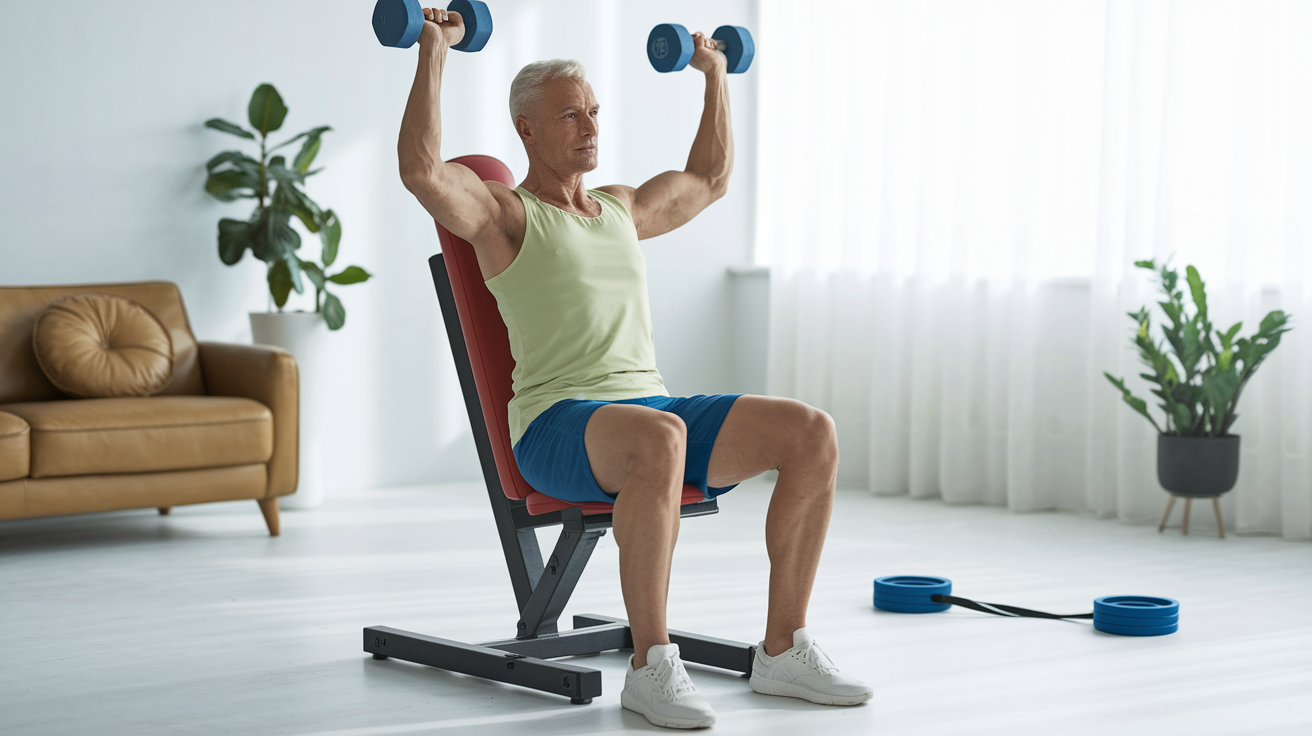
Not everyone can safely get down to the floor or stand for long periods. Chair-based strength training gives you a full-body workout while reducing fall risk, accommodating joint pain, and supporting those with limited balance or mobility. A sturdy, armless chair at standard height becomes a versatile piece of equipment that opens access to nearly every major muscle group.
Seated exercises maintain the same strength-building principles as standing work: controlled tempo, full range of motion, and progressive resistance. The chair provides stability, letting you focus entirely on muscle engagement and breathing. Seated strength routines aren’t “easier” in a way that limits results. They’re smarter adaptations that meet people where they are and build from there.
- Seated overhead press with light dumbbells or band – Sit tall, hold weights at shoulder height, press overhead until arms are nearly straight, then lower with control. Trains shoulders and triceps.
- Seated band row – Wrap a resistance band around both feet, hold handles with arms extended, pull elbows back toward ribs, and squeeze shoulder blades together. Builds upper back and posture.
- Seated marches – Sit at the front edge of the chair, lift one knee toward your chest, lower, and alternate. Strengthens hip flexors and core stability.
- Seated leg extensions – Sit upright, extend one leg straight out in front, hold for two seconds, and lower. Targets quads without putting weight on knees.
- Seated calf raises – Place feet flat on the floor, lift heels as high as comfortable, hold two seconds, and lower. Improves ankle strength and circulation.
Balance and Stability Progressions to Reduce Fall Risk
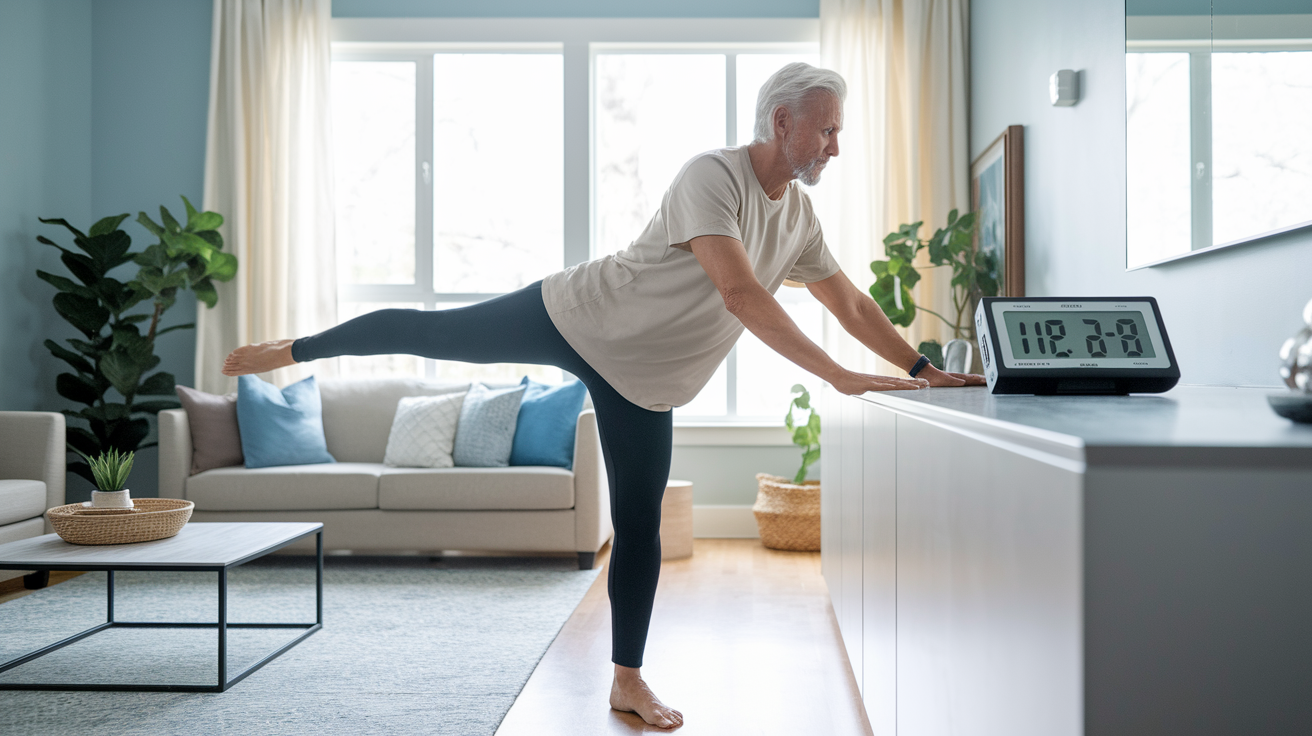
Balance training is as important as strength work for older adults. One in four adults over sixty-five falls each year, and falls are the leading cause of injury-related death in this age group. Balance declines with age due to reduced muscle mass, slower reflexes, and changes in inner-ear function. But it responds quickly to targeted practice. Three to seven short balance sessions per week, even five to ten minutes each, can produce measurable improvements in stability and confidence within four to eight weeks.
Start every balance exercise near a sturdy support: a countertop, chair back, or wall. The goal isn’t to white-knuckle through instability. The goal is to challenge your balance just enough to stimulate adaptation, then gradually reduce support as control improves. Single-leg balance is the simplest and most effective drill: stand next to a chair, place your fingertips lightly on the back for support, and lift one foot a few inches off the ground. Hold for ten to thirty seconds, rest, and repeat on the other side. Progress by lifting your fingers off the chair, closing your eyes for brief intervals, or holding the position for up to sixty seconds.
Dynamic balance drills add movement and coordination. Tandem stance (placing one foot directly in front of the other as if standing on a tightrope) challenges lateral stability and mimics the narrow base of support used during walking. Heel-to-toe walking for ten to twenty steps down a hallway trains gait control and body awareness. Single-leg reaches, where you stand on one leg and reach the opposite hand toward the floor or to the side, build strength and balance at the same time. All of these can be practiced with light fingertip support initially, then progressed to unsupported holds as confidence builds.
Sets, Reps, and Intensity Guidelines for Older Adults
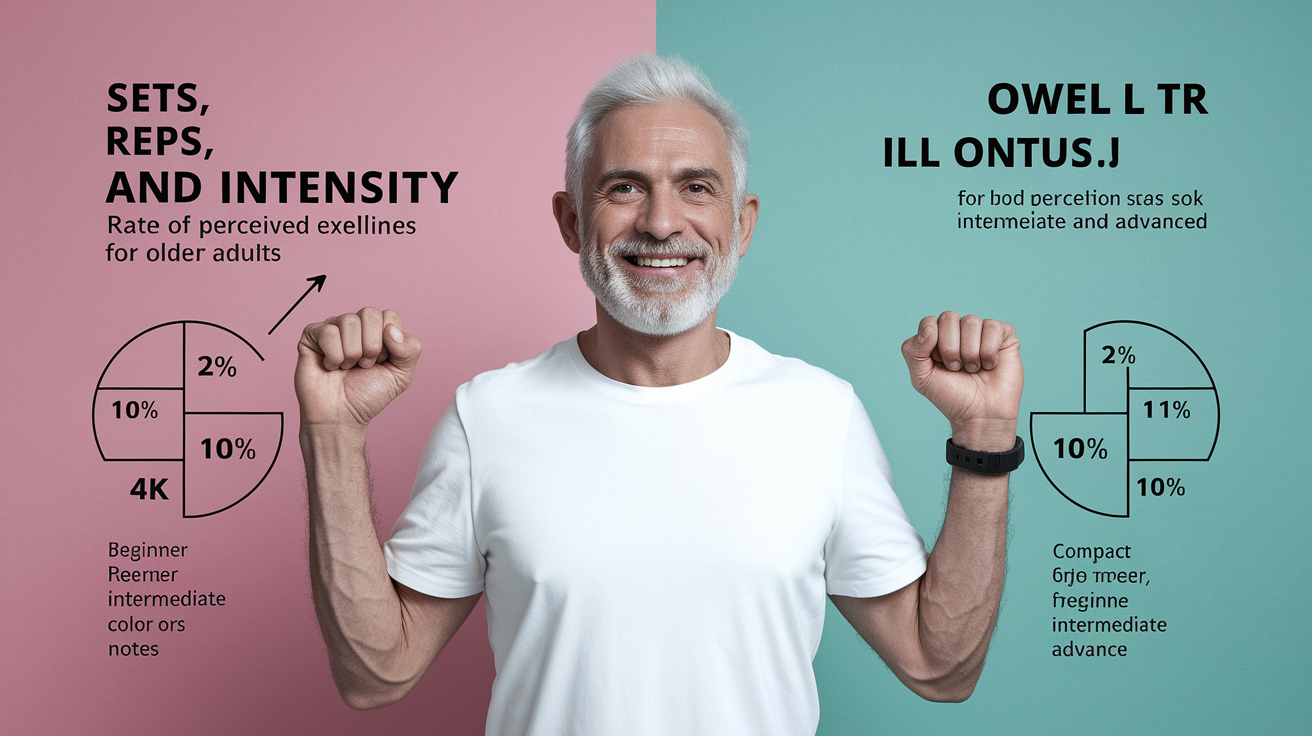
Strength training for older adults works best with moderate volume and moderate intensity spread across the week. The standard prescription is one to three sets of eight to twelve reps for most exercises, with a focus on controlled form and full range of motion. If your goal is muscular endurance (sustaining effort over time), you can increase reps to ten to fifteen per set and reduce rest periods to thirty to sixty seconds. For balance exercises, hold static positions for ten to thirty seconds per set and aim for two to three sets per leg.
Train two to three times per week on nonconsecutive days to allow for recovery. Muscles grow and strengthen during rest, not during the workout itself. Older adults typically need forty-eight to seventy-two hours between sessions targeting the same muscle groups. Rest between sets should be sixty to one hundred twenty seconds for strength exercises and thirty to sixty seconds for endurance or balance work. This recovery time lets your heart rate settle, clears metabolic byproducts, and prepares you for the next set with good form.
Intensity is best monitored using the Rate of Perceived Exertion (RPE) scale, where one is no effort and ten is maximum effort. Here’s how to apply it:
-
Aim for RPE four to seven during strength work – This feels “moderate” to “somewhat hard.” You should be able to speak in short sentences but not hold a casual conversation.
-
Stop or regress if pain exceeds four out of ten – Discomfort and muscle fatigue are normal. Sharp, localized joint pain is not.
-
Watch for signs of overtraining – If soreness lasts more than seventy-two hours, resting heart rate is elevated by twenty beats per minute above usual, or fatigue prevents you from completing planned sets with good form, reduce volume or take an extra rest day.
Sample Beginner, Intermediate, and Advanced Senior Workouts
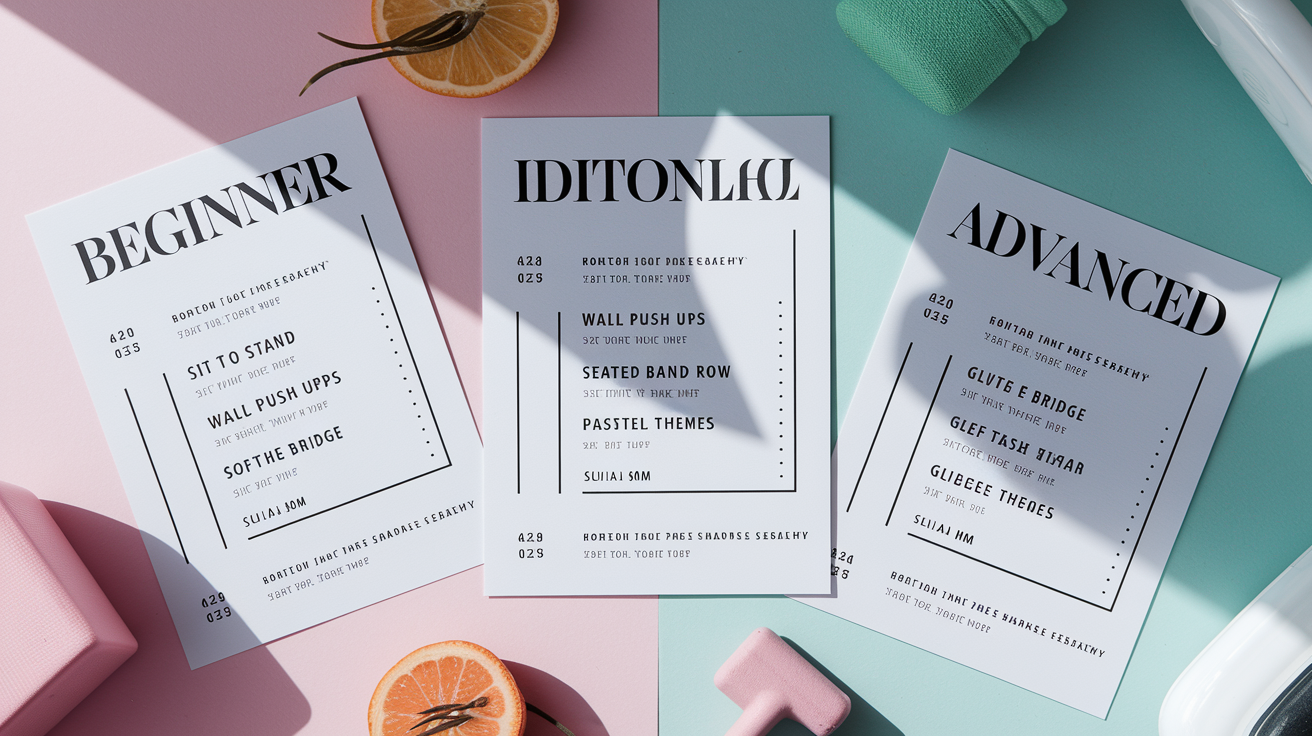
These three templates give you ready-to-use strength sessions for different experience levels. Each session takes twenty-five to forty-five minutes, including warm-up and cool-down. Follow the beginner plan for four to eight weeks before moving to intermediate. Follow intermediate for another eight to twelve weeks before considering advanced progressions. Consistency matters more than intensity. Two solid sessions per week will produce noticeable strength and balance improvements.
All three levels share the same structure: five to ten minutes of warm-up (marching and dynamic mobility), four to six strength exercises ordered from largest to smallest muscle groups, balance work, and five to ten minutes of cool-down stretching. Rest sixty to one hundred twenty seconds between sets, and two to three minutes between exercise transitions if needed.
| Level | Exercises | Sets/Reps | Progression Notes |
|---|---|---|---|
| Beginner | Sit-to-stand, Wall push-ups, Seated band row, Glute bridge, Single-leg balance (supported) | 2 sets × 8–10 reps; balance 2 × 20 sec per leg | Use chair for squat support, hands on wall; increase reps to 12 before adding resistance |
| Intermediate | Chair-assisted squats, Incline push-ups (countertop), Standing band row, Hip hinge with light dumbbells (5–10 lb), Single-leg balance (fingertip support) | 2–3 sets × 10–12 reps; balance 2 × 30 sec per leg | Reduce chair assistance, progress incline angle, add 1–2 lb to hinge; aim for 45–60 sec balance holds |
| Advanced | Weighted sit-to-stand (5–10 lb dumbbell), Knee or full push-ups, Step-ups (4–6 inch platform), Single-leg Romanian deadlift (bodyweight or light load), Unsupported single-leg balance | 3 sets × 8–12 reps; balance 2 × 45–60 sec per leg | Add load incrementally (1–2 lb every 2–4 weeks); consider split-stance or single-leg progressions |
Cool-Down and Stretching Methods That Support Recovery

Cool-down isn’t a luxury. It helps your heart rate return to baseline gradually, reduces post-exercise muscle stiffness, and signals to your nervous system that the work is done. Spend five to ten minutes after every strength session on gentle movement and static stretching. This small investment speeds up recovery, improves next-session readiness, and reduces the risk of delayed-onset muscle soreness that can mess with daily activities.
Start your cool-down with two to three minutes of slow walking, either in place or around the room. Let your breathing settle and your heart rate drop. Then move into static stretches, holding each position for twenty to thirty seconds without bouncing. Stretch the muscles you just worked, breathe deeply into each stretch, and ease into the position gradually. Never force a stretch to the point of pain.
- Hamstring stretch – Sit at the edge of a chair, extend one leg straight with heel on the floor, hinge forward at the hips until you feel a gentle pull along the back of the thigh.
- Calf stretch – Stand facing a wall, step one foot back, press the back heel into the floor, and lean gently forward to stretch the lower leg.
- Hip flexor stretch – Stand in a staggered stance with one foot forward, gently shift your hips forward until you feel a stretch at the front of the back hip.
- Chest opener – Sit tall at the edge of a chair, interlace fingers behind your back, lift your chest, and gently pull your hands down and away from your body.
Red Flags, Contraindications, and When to Seek Medical Input

Strength training is safe for the vast majority of older adults. But certain conditions require medical clearance, modification, or supervision before starting a program. If you’ve had a heart attack within the past three months, live with uncontrolled high blood pressure, experience unstable angina (chest pain that occurs unpredictably or at rest), or have been diagnosed with arrhythmias that aren’t medically managed, talk with your physician before beginning resistance training. These conditions don’t rule out exercise. They simply require tailored guidance and monitoring.
Severe osteoporosis or a history of vertebral fractures requires special attention. Avoid exercises that involve spinal flexion (rounding the back forward), such as seated toe touches or crunches, as these can increase compression forces on fragile vertebrae. Instead, prioritize extension-based movements like glute bridges, bird-dogs, and wall angels, and work with a physical therapist to design a bone-safe progression. If you’ve had recent hip or knee surgery, follow your surgeon’s and physical therapist’s timeline for returning to resistance work. Jumping back too soon can compromise healing.
Stop exercise immediately and seek medical input if you experience any of these warning signs:
-
Chest pain, pressure, or tightness during or after exercise – especially if it radiates to the arm, jaw, or back.
-
Dizziness, lightheadedness, or shortness of breath at rest – particularly if it doesn’t resolve within a few minutes of stopping.
-
Sharp, localized joint pain that worsens with movement – distinct from general muscle fatigue or delayed soreness. This may indicate ligament strain, cartilage damage, or inflammation requiring evaluation.
Final Words
in the action we walked through how to safely scale full-body strength work for older adults: core safety cues (neutral spine, controlled 2 to 3-second lowering), warm-up and cool-down needs, chair and range modifications, and gentle progression methods.
Use the movement options: wall or chair support, lighter bands, slower tempo, and added balance work. Watch for red flags and get medical input when needed.
Keep practicing the steps. When you stick with them, scaling full body strength exercises for older adults gets easier and more effective with small, steady progress. You’ve got this.
FAQ
Q: What is the best full body workout for seniors with weights?
A: The best full-body strength workout for seniors with weights is a balanced routine of sit-to-stand, hip hinges, rows, and overhead presses, plus balance work, slow controlled reps, and chair regressions as needed.
Q: What is the 3-3-3 rule at the gym?
A: The 3-3-3 rule at the gym is typically a low-rep strength template: three sets of three reps, used to focus on maximal strength with heavier loads and longer recovery between sets.
Q: What is the 5 5 5 30 rule?
A: The 5 5 5 30 rule is often a circuit guideline, commonly meaning five exercises, five rounds, five reps (or 30 seconds per station), useful for short, scalable, full-body sessions.