


Think lifting heavy all the time is the only way to get bigger?
Not true.
Muscle growth comes from the right mix of mechanical tension, weekly volume, and enough recovery, not random hard days.
This guide cuts through the noise and shows programs and exercises that actually maximize growth: core compound lifts, sensible set-and-rep targets, simple overload methods, and recovery and nutrition habits you can stick with.
Read on to build a plan that fits your schedule and delivers real muscle gains.
Core Principles of Muscle Hypertrophy

Hypertrophy just means muscle growth. It happens when your muscle fibers adapt to stress by getting bigger. Three things drive this: mechanical tension (the load you’re placing on a muscle when it contracts), metabolic stress (that burn and pump you feel from sustained effort), and muscle damage (tiny tears that repair stronger). You don’t need to max out all three every session, but good programs create enough of each to tell your body it needs bigger muscles.
Most people need 10 to 20 sets per muscle group each week for consistent growth. Beginners often do fine at the lower end. Intermediates and advanced lifters usually need more. Frequency matters too. Hitting each muscle two or three times per week spreads volume across sessions and keeps the growth signal active without wrecking your recovery. Compound lifts like squats, deadlifts, and bench presses hit multiple large muscle groups at once, so they’re efficient for piling up volume.
Five factors govern hypertrophy across every approach:
- Progressive overload – you’re gradually upping the challenge through more weight, reps, sets, or intensity over time.
- Training volume – you’re stacking enough total sets and reps each week to push muscles past their comfort zone.
- Exercise selection – you’re using movements that match your goals, recruit target muscles well, and let you progress safely.
- Intensity and effort – you’re working close enough to failure (usually 1 to 3 reps shy) to create real stimulus without burning out.
- Recovery – you’re giving yourself sleep, nutrition, and rest days so muscles can repair and grow between sessions.
Every hypertrophy program you’ll come across mixes these principles in different ratios and schedules. Once you understand what actually drives growth, you can look at any routine and know if it’s built to produce results or just waste time.
Selecting the Right Exercises for Muscle Gain

Compound exercises recruit multiple joints and large muscle groups in one movement. That lets you move heavier loads and rack up volume efficiently. Squats, deadlifts, bench presses, rows, and overhead presses anchor most solid hypertrophy programs because they create high mechanical tension across your chest, back, legs, and shoulders. When you’re tight on time or training frequency, compounds give you the most growth per set.
Isolation exercises target a specific muscle or muscle head. Biceps curls, leg extensions, lateral raises. They’re useful for adding volume to smaller muscles that don’t get enough work from compounds alone, for fixing imbalances, and for finishing a session with focused metabolic stress. Use isolation movements after your primary compounds to bring up weak spots without messing with your heaviest lifts.
Six core hypertrophy exercises that cover all major movement patterns:
- Barbell back squat or trap bar deadlift (legs and glutes)
- Bench press or dumbbell press (chest and triceps)
- Barbell row or pull-up (back and biceps)
- Overhead press (shoulders and triceps)
- Romanian deadlift or hip thrust (hamstrings and glutes)
- Lat pulldown or chin-up (lats and biceps)
Build your weekly training around these patterns, then toss in isolation work for arms, calves, rear delts, or abs as needed to hit your total volume targets for each muscle.
Structuring an Effective Beginner Strength Program

Beginners respond well to full-body routines three days per week. Monday, Wednesday, Friday works. This frequency lets you hit each major muscle group multiple times while leaving recovery days in between. Start with compound movements that teach foundational patterns and let you add weight session to session. Shoot for 8 to 12 reps per set on most exercises, staying 1 to 2 reps short of total failure, and do 3 sets of each lift.
A simple full-body template includes one squat or deadlift variation, one horizontal press, one horizontal pull, one hip hinge or posterior chain movement, and one or two accessory exercises for smaller muscles. This balances pushing, pulling, and leg work while keeping total session volume manageable. When you can complete all prescribed reps with good form across all sets, bump the load by 2.5 to 5 pounds for upper body and 5 to 10 pounds for lower body the next week.
| Day | Primary Lifts | Accessory Work |
|---|---|---|
| Monday | Squat 3×8, Bench Press 3×8, Barbell Row 3×10 | Dumbbell Curl 2×12, Triceps Pushdown 2×12 |
| Wednesday | Trap Bar Deadlift 3×6, Overhead Press 3×8, Lat Pulldown 3×10 | Leg Curl 2×12, Lateral Raise 2×15 |
| Friday | Front Squat or Leg Press 3×10, Incline Dumbbell Press 3×10, Pull-Up 3×6–8 | Face Pull 2×15, Plank 2×30–60 sec |
Track every set, rep, and load in a notebook or app so you can see when you’re ready to progress. Expect to add weight almost every session for the first four to eight weeks. Then progress slows and you’ll add load every two to three sessions instead.
Understanding Training Volume and Intensity
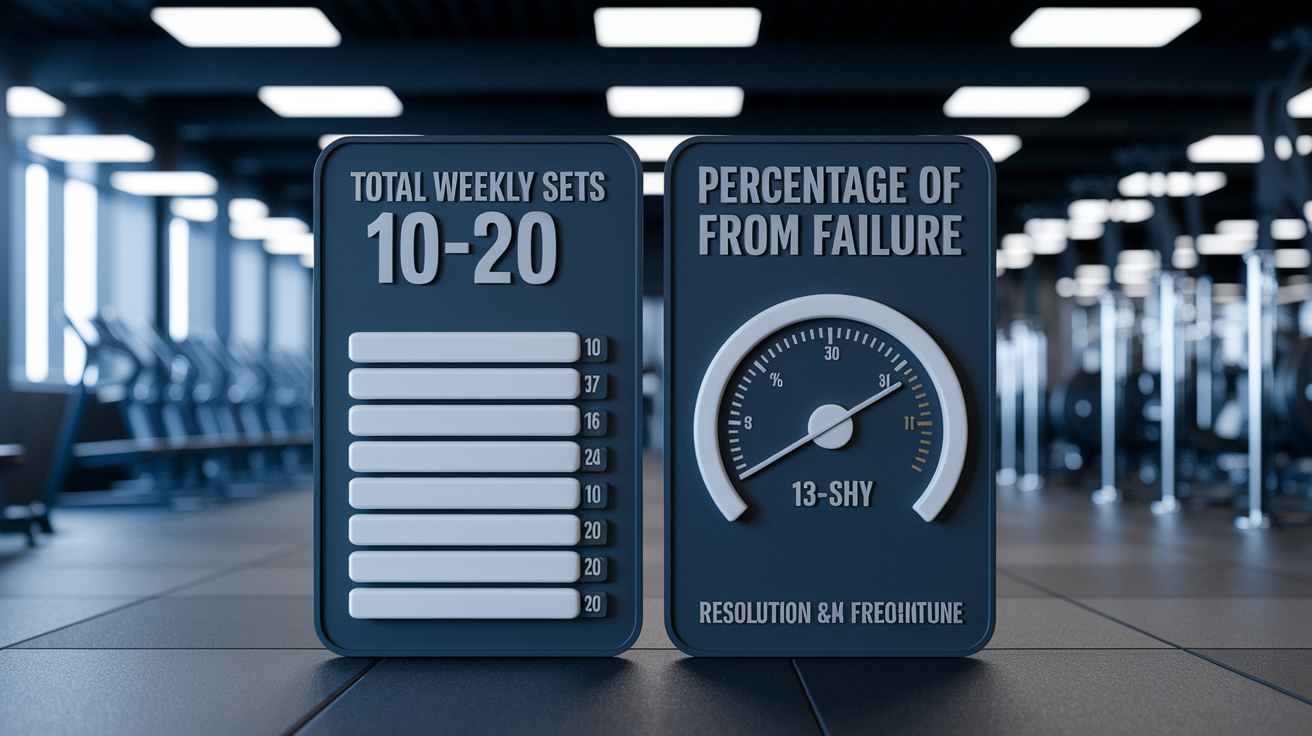
Weekly volume is the total number of sets you do for a muscle group across all workouts. Research and real-world experience show that 10 to 20 sets per muscle per week drives hypertrophy for most people. Beginners thrive at the lower end. Intermediates often need 12 to 18 sets. Advanced lifters sometimes push beyond 20 sets for priority muscles, but more volume only helps if recovery keeps up. Split that total across two or three sessions so each workout stays manageable and you don’t kill your form with local fatigue.
Intensity refers to how close you take each set to muscular failure. For hypertrophy, working 1 to 3 reps short of failure on most sets produces strong growth stimulus without excessive fatigue or injury risk. Save true failure or beyond-failure techniques like drop sets and forced reps for occasional finishing sets, not every working set. Monitor your performance week to week. If you’re hitting rep targets and adding load every few sessions, your volume and intensity are dialed in. If performance stalls or drops for two weeks straight, you’re probably doing too much or recovering too little.
Progressive Overload Methods

Progressive overload is the practice of gradually increasing the demand on your muscles so they’re forced to adapt by growing stronger and larger. Without systematic overload, your body has no reason to change. The simplest and most common method is adding weight to the bar once you can complete your target reps for all sets. But that’s not the only way to progress.
Five proven overload methods you can rotate or combine:
- Increase load – add 2.5 to 5 percent more weight when you hit the top of your rep range across all sets. Example: bench press 3×12 at 100 lb becomes 3×8 at 105 lb, then work back up to 3×12 before adding weight again.
- Add reps – keep the same weight and push from 8 reps per set to 10, then 12, before increasing load and resetting reps to the bottom of the range.
- Add sets – increase weekly volume by adding one set to a movement every two to three weeks, raising total stimulus without changing weight or reps.
- Reduce rest – shorten rest intervals from 90 seconds to 75 or 60 seconds while keeping reps and load constant, increasing training density and metabolic stress.
- Improve tempo or range of motion – slow down the eccentric (lowering) phase from 2 seconds to 3 or 4 seconds, or reach deeper into a squat or row to increase time under tension and mechanical work per rep.
Pick one or two methods per training block and track them session to session. When progress stalls on one variable, shift to another to keep adaptation rolling.
Recovery and Rest for Muscle Growth

Muscle growth doesn’t happen in the gym. When you lift, you create the stimulus. Microtears, metabolic byproducts, nervous system fatigue. The actual repair and rebuilding occur during rest, especially sleep. Without enough recovery, you’re stacking stress on top of stress, and performance drops instead of climbing.
Shoot for 7 to 9 hours of sleep per night. Studies consistently show that sleep deprivation reduces protein synthesis, lowers testosterone, raises cortisol, and tanks strength recovery. If you’re training hard but sleeping five or six hours, you’re leaving gains on the table. Beyond sleep, manage life stress where you can. Chronic high stress uses recovery resources that could otherwise go toward muscle repair.
Schedule at least one full rest day per week. Don’t train the same muscle group on consecutive days if you did high volume or high intensity. For example, if you hit legs hard on Monday with 12 to 15 total sets, wait until Wednesday or Thursday before training legs again. Active recovery like walking, light cycling, or yoga on rest days can improve blood flow and reduce soreness without messing with adaptation.
Nutrition and Supplementation for Muscle Gain

Building muscle requires a calorie surplus. You need to eat slightly more than you burn so your body has the energy to build new tissue. Aim for a surplus of 250 to 500 calories per day above your maintenance intake. Larger surpluses speed up weight gain but also pile on fat, so a moderate approach keeps most of the gain lean. Protein intake should sit between 1.6 and 2.2 grams per kilogram of bodyweight per day. For an 80 kg person, that’s roughly 128 to 176 grams daily. Spread protein across three to five meals, shooting for 20 to 40 grams per meal to keep muscle protein synthesis humming throughout the day.
Carbohydrates fuel training performance and refill glycogen stores, so target 3 to 6 grams per kilogram depending on your activity level and body composition goals. Fats should make up about 20 to 30 percent of total calories to support hormone production and overall health. Pre-workout, a meal with 30 to 60 grams of carbs one to two hours before training can improve performance. Post-workout, a meal with protein and carbs within two hours supports recovery.
Four evidence-backed supplements that can support muscle growth:
- Creatine monohydrate – 3 to 5 grams per day improves strength, power output, and muscle volume by increasing phosphocreatine stores. Optional loading phase: 20 grams per day split into four doses for five to seven days.
- Whey protein – 20 to 40 grams per serving helps you hit daily protein targets conveniently, especially post-workout or between meals.
- Caffeine – 3 to 6 milligrams per kilogram of bodyweight 30 to 60 minutes before training boosts focus, strength, and work capacity.
- Beta-alanine – 3.2 to 6.4 grams per day buffers muscle acidity during high-rep sets, improving endurance in the 8 to 15 rep range. Takes two to four weeks to saturate muscle stores.
Expected Timelines and Realistic Results

Beginners can expect to gain roughly 0.5 to 2 pounds of muscle per month during the first six to twelve months of consistent training and nutrition. This “newbie gain” phase happens because untrained muscles respond fast to any structured stimulus. You’ll also see strength increases within two to six weeks as your nervous system learns to recruit muscle fibers more efficiently, even before visible size changes show up.
Intermediate lifters (those with one to three years of solid training) typically gain 0.25 to 0.5 pounds of muscle per month. Progress slows even more for advanced lifters. Genetics, age, training history, sleep quality, stress levels, and nutrition consistency all influence how fast you build muscle. Visible hypertrophy usually becomes noticeable around the six to twelve week mark for beginners, and twelve to sixteen weeks or longer for intermediates making smaller gains. Track body weight, measurements, photos, and training performance every two to four weeks to measure progress objectively instead of relying on the mirror alone.
Common Mistakes That Limit Muscle Growth

Most training plateaus come down to a handful of recurring errors that interrupt the growth process. Fixing even one or two of these can restart progress without overhauling your entire program.
Six common mistakes and how to avoid them:
- Skipping progressive overload – training with the same weights, reps, and sets week after week gives your body no new stimulus. Track your lifts and aim to increase load, reps, or sets every one to three weeks.
- Insufficient weekly volume – doing only one or two sets per muscle group per week rarely drives growth. Aim for at least 10 sets per muscle weekly, split across two or three sessions.
- Eating in a calorie deficit or at maintenance – you can’t build significant muscle without a surplus. If the scale isn’t moving up slowly over weeks, bump daily calories by 200 to 300.
- Low protein intake – falling below 1.6 grams per kilogram leaves your muscles without enough raw material to repair and grow. Get protein at every meal.
- Too much cardio – excessive cardio burns calories you need for growth and messes with recovery from strength sessions. Limit cardio to one or two short sessions per week during a hypertrophy phase.
- No deload or recovery weeks – training hard for months without a planned deload (cutting volume or intensity by 30 to 50 percent for one week) leads to piled-up fatigue, performance drops, and higher injury risk. Schedule a deload every four to eight weeks.
Final Words
Start today: set weekly volume, choose compound lifts, and apply progressive overload.
We covered how hypertrophy works (mechanical tension, metabolic stress, muscle damage), why compound and isolation moves both matter, a beginner full-body routine, volume and intensity targets, overload methods, recovery, nutrition, timelines, and common mistakes to avoid.
Use this as a simple blueprint: train consistently, eat enough protein, sleep well, and track progress. strength training for muscle gain is a skill. Get a little better each week, and it adds up. You’ve got this.
FAQ
Q: What is the 3-3-3 rule for lifting?
A: The 3-3-3 rule for lifting is performing three sets of three reps per working exercise, using heavy loads with full rest between sets and focusing on tight technique to build maximal strength.
Q: Can I build muscle with strength training?
A: You can build muscle with strength training by using progressive overload, training consistently, eating enough protein and calories, and prioritizing recovery; simple compound lifts speed early gains.
Q: Can I build muscle while on zepbound?
A: You can build muscle while on ZepBound, but expect appetite shifts: eat enough protein and calories, follow resistance training, track progress, and consult your clinician for personalized guidance.
Q: Can you gain muscle with Marfan syndrome?
A: You can gain muscle with Marfan syndrome, but get medical clearance first; use controlled, low-to-moderate loads, prioritize technique, avoid maximal strain, and work with a knowledgeable clinician or coach.